
The Serbia election 2026 has produced one of the most dramatic political turnarounds in modern European history. Long-serving leader Aleksandar Vucic conceded defeat on Sunday after a student-led opposition movement won a parliamentary election that many observers had expected his party to control. Trending per news coverage, the result ended 14 years of Vucic's dominance and set off celebrations across Belgrade, where tens of thousands of people poured into the streets within hours of the concession.
Vucic told supporters at his party's election-night event that the youth-backed Students' List had won. On his party's own projections, the Students' List will take between 135 and 140 seats in Serbia's 250-member parliament, while his Serbian Progressive Party (SNS) will hold around 105 seats. "The Students' List has won," Vucic said, adding that no other party had entered parliament. The concession came before final results were published, but it was unambiguous: the leader who had ruled Serbia as prime minister or president since 2014 accepted that his party had lost.
This article explains what happened in the Serbia election 2026, why the student movement won, what Vucic said in conceding, and what happens next as a largely unknown group of candidates tries to turn a protest movement into a government.
Serbia election 2026 results: what Vucic conceded
Serbia's 6.4 million voters were electing lawmakers to the 250-member parliament in a snap election that Vucic himself had called in September. The vote was a direct showdown between Vucic and his right-wing SNS and a diverse student-led opposition that had spent almost two years protesting his government. Turnout was reported at around 70 percent, the highest since the break-up of Yugoslavia in 1992, with long lines outside polling stations in cities across the country.
According to projections cited in Vucic's concession, the Students' List won about 2.2 million votes against about 1.7 million for the SNS. A projection from the Centre for Free Elections and Democracy and Ipsos Serbia put the Students' List at about 52 percent of the vote, against 39.3 percent for Vucic's party. Those figures, if confirmed in the final count, give the student-backed list a clear parliamentary majority and the right to form the next government.
Vucic did not congratulate his opponents in conventional terms. He blamed Serbia's independent media and alleged interference by unnamed European countries and what he called an "American deep state" for the loss. He also said he would not appeal against the result in the courts, saying he wanted to avoid "unrest and clashes in the streets". In a later message to supporters, he urged them to avoid violence, saying: "I do not want unrest, I do not want killings, I do not want anything like that on the streets." He added: "No one is going to run away. We will protect everyone from their harassment."
How students toppled Vucic after two years of protests
The roots of the Serbia election 2026 result go back to November 2024, when a railway station canopy collapsed in the city of Novi Sad, killing 16 people. Students blamed corruption and shoddy public works, and the tragedy ignited a protest movement that grew far beyond university campuses. For almost two years, students organised marches, blockades and silent vigils, accusing the government of corruption and of dismantling democratic checks.
What began as a demand for accountability became a broader challenge to Vucic's rule. The students built a popular following across the country, drawing support from lawyers, professors, actors, farmers and workers who shared their frustration. Vucic, who had been endorsed by Russian President Vladimir Putin, denounced the movement as a foreign-led attempt to unseat him. That argument, which had worked in earlier political fights, did not stop the movement from turning protest energy into votes.
The Students' List that contested the election was deliberately different from a traditional party. Its 250 candidates were largely unknown to the public, drawn from the protest movement itself rather than from Serbia's established political class. That novelty was both its appeal and its risk: voters were choosing people they barely knew, but they were also choosing a clean break from a political system many felt had stopped listening to them.
Belgrade celebrations: "The people have won"
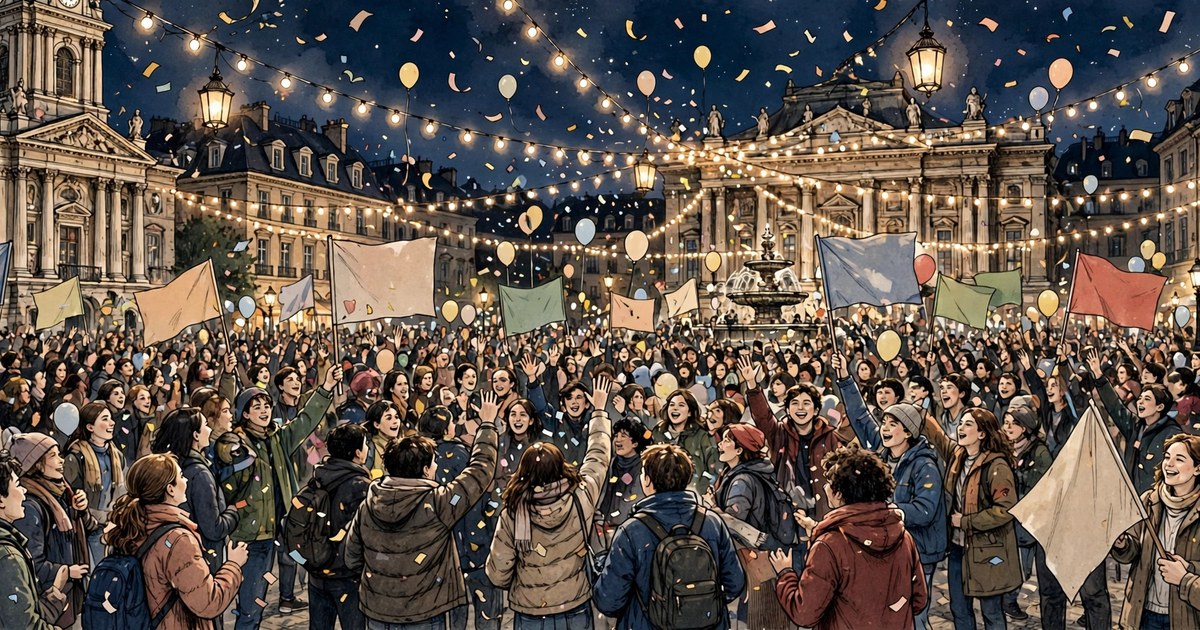
Almost immediately after Vucic's concession, crowds flooded the streets of Belgrade and other Serbian cities in what reporters described as euphoric celebration. Tens of thousands of people packed the capital's main boulevards, halting trams and traffic. The air was thick with smoke from flares, car horns blared, and a man on a car waved a flare above the crowd as supporters chanted "victory" and "he's done".
At the Students' List headquarters, candidates hugged and cheered in near disbelief. Radomir Saicic, a chemistry professor at the University of Belgrade who stood as a candidate and has been touted as a possible future president, said: "Tonight is a victory of courage over fear, and of faith that Serbia can and must be different." On the streets, one supporter, Nebojsa Cosic, waved a flag and shouted: "The people have won! The people defeated a dictator! The people will lead Serbia!" A law student named Milica told reporters: "That is the best thing that happened in my life. We will now breathe freely."
Belgrade resident Dragana Kovacevic said she was thrilled that "everyone greets with smiles", adding: "We are all too happy, finally we are becoming one normal and free country." Another supporter, Maja Stetic, said the result "means liberation for me, means a new future for us and our children". For many in the crowd, the night was less about party politics than about a feeling that two years of protest had finally changed something real.
Serbia election 2026: what happens next
The celebrations will quickly give way to the hard work of governing. The disparate group of 250 student-backed candidates must now agree on a prime minister, a cabinet and a legislative programme, and then negotiate the day-to-day business of running a country of about six million people. They will face immediate questions on the economy, on Serbia's relationship with the European Union and Russia, on corruption investigations, and on the public-works failures that started the movement.
Serbia's path matters beyond its borders. The country sits at a crossroads between the EU and Russia, and Vucic had maintained a close relationship with Putin while also negotiating with Brussels. A student-led government will be watched closely in European capitals, in Moscow and in Washington for signs of which direction it takes. Its leaders have so far defined themselves mainly by what they oppose — corruption and creeping authoritarianism — and the world will now watch what they propose instead.
There are also risks. A movement built on protest must learn to compromise, to manage ministries and to survive its first unpopular decision. Its opponents, including a still-powerful SNS with around 105 seats, will scrutinise every step. And Vucic himself, even in defeat, remains a formidable political figure who has promised to stay in Serbia and to protect his supporters. The next weeks, as a government is formed and final results are confirmed, will show whether Sunday's celebration becomes a lasting political change.
For now, though, the Serbia election 2026 stands as a rare example of a protest movement winning power at the ballot box. Students who began by demanding answers over 16 deaths in Novi Sad ended by defeating a leader who had dominated Serbian politics for 14 years. As one Belgrade crowd put it on Sunday night, the people had spoken — and this time, the leader listened. For background on the vote itself, see our earlier guide to the Serbia snap election and the student movement. The result also comes in a year of major political upheavals elsewhere, from Maria Corina Machado's return to Venezuela to mass protests in France and Brazil's presidential runoff.
Sources: Reuters, CNN and The Times reporting on the Serbia parliamentary election, Vucic's concession speech and Belgrade celebrations on 25 October 2026.