
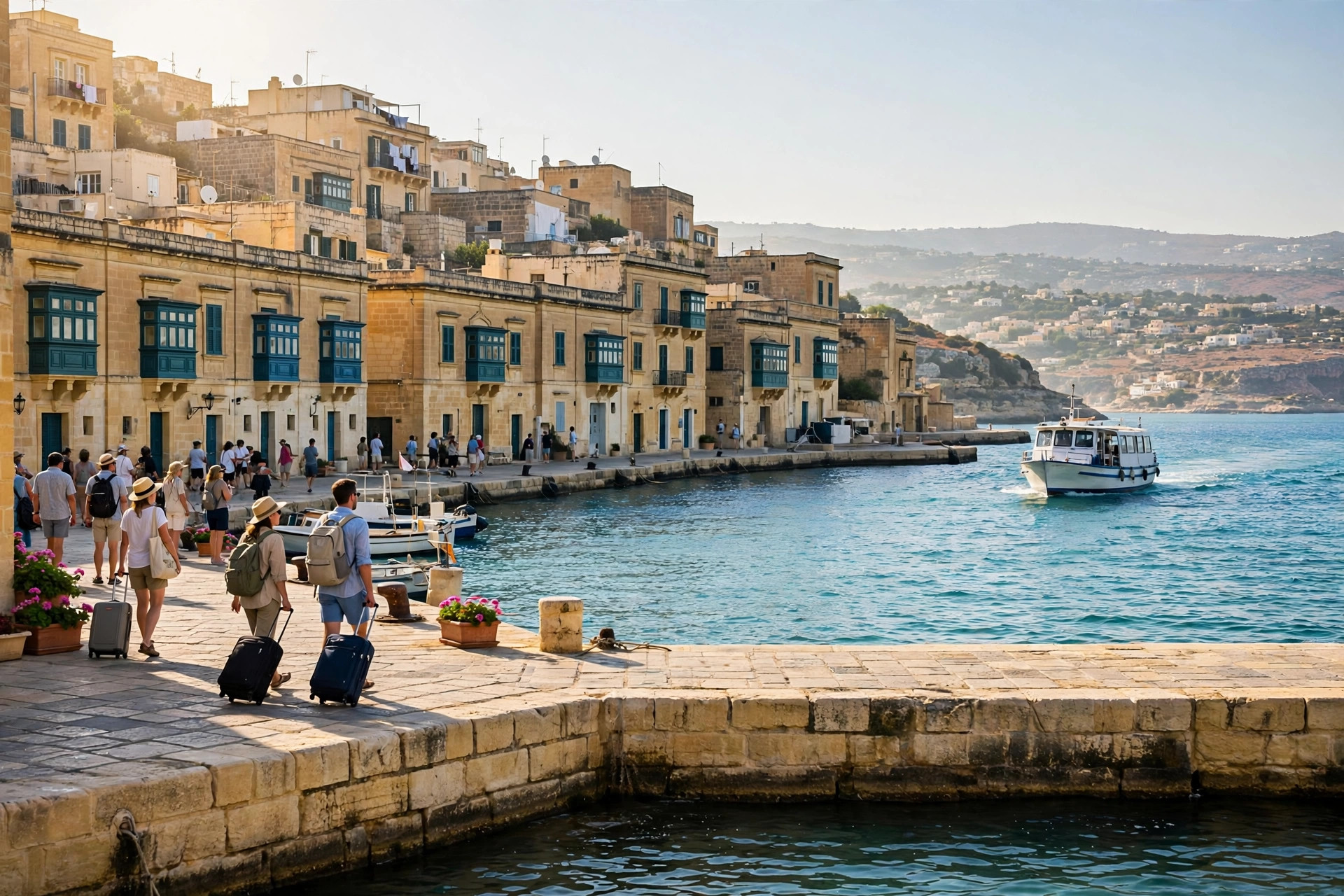
The Malta tourist tax 2027 will make a holiday on the islands noticeably more expensive. Under Budget 2027, presented to parliament on 26 October 2026 by Finance Minister Clyde Caruana, the nightly eco-contribution rises from €1.50 per person to €8 in hotels and €10 in short-let apartments, starting on 1 January 2027. The same budget adds new charges for cruise passengers and visitors to Comino, raises Gozo ferry fares for non-residents, and limits free public transport to Maltese nationals, European Union citizens and people with long-term resident status. For anyone planning a Malta or Gozo holiday in 2027, the new rates are worth working into the budget now, even though one important detail is still open: the measures were announced in the budget speech, but the legal notice that would put them into law had not yet been published when the budget was presented.
Malta Tourist Tax 2027: The New Nightly Rates
The headline change is the accommodation eco-contribution, the small tax added to a guest's bill. In 2026 it stood at €1.50 per person per night. From 1 January 2027, the Malta tourist tax 2027 sets it at €8 per person per night in hotels and other collective accommodation, capped at €64 per person per stay, which is the charge for eight nights. Guests in short-let apartments, including Airbnb-style lets, will pay €10 per person per night, capped at €80 per person per stay. The charge applies to guests aged 18 and over. Accommodation provided to students attending English-language schools will be exempt from 2027. The government expects the higher accommodation charge to generate about €182 million a year, with the money earmarked for improvements to Malta's tourism infrastructure and services. That figure covers the accommodation eco-contribution alone, not the ferry and cruise charges described below, which are separate measures with their own revenue estimates.
To see what the change means in practice, take a couple spending seven nights in a hotel. At €8 a night each, the eco-contribution comes to €112 for the stay, against €21 at the old €1.50 rate. A family of four, with two adults and two children over 18, staying ten nights in a short-let apartment would hit the cap: €10 a night for ten nights is €100 per person, capped at €80, so €320 for the four of them. Shorter stays escape the cap but still cost far more than before. A single traveller on a three-night hotel break pays €24 instead of €4.50. None of this is a charge on Maltese residents staying in their own country for leisure; it is a visitor charge, and it lands on the accommodation bill rather than at the airport.
How the Malta Tourist Tax 2027 Changes a Gozo Day Trip
The Malta tourist tax 2027 is not only about beds. The Gozo Channel ferry, which carries visitors between Ċirkewwa on Malta and Mġarr on Gozo, will charge non-residents much more from 1 January 2027. An adult foot passenger will pay €11 instead of €4.65, a child €7 instead of €1.15, and a vehicle including its driver €22 instead of €15.70. A car carrying a driver, one adult passenger and one child will cost €40 for the crossing, up from €21.50. The fast ferry between Valletta and Gozo will cost tourists an extra €3 per trip. The government expects the revised Gozo ferry tariffs to generate around €13 million in additional revenue, which it says will help support infrastructure operations and reduce the burden of subsidies. The fare changes are aimed at non-residents; the subsidised fares available to eligible residents are not affected.
Two more visitor charges arrive with the same budget. Cruise passengers who disembark in Malta and then reboard the same ship will pay a €10 eco-contribution, while passengers whose cruise begins in Malta are exempt. Visitors to Comino, the small island between Malta and Gozo that is home to the Blue Lagoon, will pay a €5 contribution collected through the existing visitor booking system, with Malta residents exempt. Taken together, the package means a typical Malta holiday in 2027 carries several small new charges that add up: the nightly contribution, the ferry, and, for some travellers, the cruise or Comino fee.
What Else Costs More for Visitors in 2027
Free public transport, which Malta has offered broadly, will be limited from 1 January 2027 to Maltese nationals, EU citizens and people with long-term resident status. Visitors from outside the EU will need to pay for buses, which matters for travellers who planned to explore the islands without a hire car. The budget also raises annual registration fees for pleasure boats, with increases ranging from €300 for yachts of 10 to 12 metres to €2,600 for vessels between 21 and 24 metres, expected to generate an estimated €3 million. For context on the islands themselves, our Malta island travel guide covers the places most visitors combine with a Gozo day trip, and travellers weighing other Mediterranean options can compare with our Cyprus beach holidays guide.
The budget's wider picture is a government that says it is investing in tourism while asking visitors to pay more of the cost. The Gozo allocation in the budget rose by 15.7 percent to €122.08 million, with recurrent spending up 13.4 percent and capital spending up 23.8 percent. The finance minister described Budget 2027 as the most important of his six years in office, combining tax cuts for residents with higher charges on tourism and transport. There are no expected increases in income tax rates, VAT or social security contributions, and a three-year income tax cut for parents is set to continue. The deficit is targeted at 2.6 percent of GDP in 2027.
What Is Still Unconfirmed
The most important caveat is that the announced rates are not yet law. The budget speech set out the measures, but the legal notice fixing them had not been published, and the measures remain subject to implementing legislation. That means the rates could still change before 1 January 2027, and travellers should check with their accommodation before paying. The exact start date for some charges has also not been confirmed in every case, so the 1 January date should be treated as the announced date rather than a settled one. Anyone who has already booked a 2027 stay should ask the hotel or host whether the new contribution is included in the price quoted or will be added on arrival, because the answer will differ from property to property until the rules are final.
Even with that uncertainty, the direction is clear: Malta is moving from one of Europe's lowest tourist taxes to one of its highest nightly charges. At €8 a night, the Malta rate sits well above the few euros charged in many European cities, and the €10 short-let rate is higher still. For a week's holiday the difference runs into tens of euros per person, and for a longer stay the per-person caps of €64 and €80 set a ceiling that longer-stay visitors will welcome. The Gozo ferry rise is proportionally even sharper for a family with a car, nearly doubling the return cost of a day trip. Visitors who travel light, stay fewer nights, or cross to Gozo as foot passengers will feel the changes least; families and longer-stay guests will feel them most.
What to Do Before You Book
First, work the new charges into the trip budget rather than discovering them at check-in: €8 a night per adult in a hotel, €10 in a short-let, plus €11 per adult for the Gozo ferry and €3 extra on the fast ferry. Second, check whether children in the party are under 18, since the accommodation charge applies only to guests aged 18 and over. Third, if a cruise is part of the plan, confirm whether it starts in Malta, because that decides whether the €10 cruise charge applies. Fourth, look at the booking terms: some properties may already include the new contribution in the price, while others will add it separately. And fifth, keep an eye out for the legal notice. Once it is published, the rates will be fixed, and any later change would need a new announcement. Until then, the figures in this guide are the announced rates from Budget 2027, presented on 26 October 2026, and they are the best basis for planning a Malta holiday in 2027. For the wider policy picture, see our report on Malta's rule-of-law ranking.