
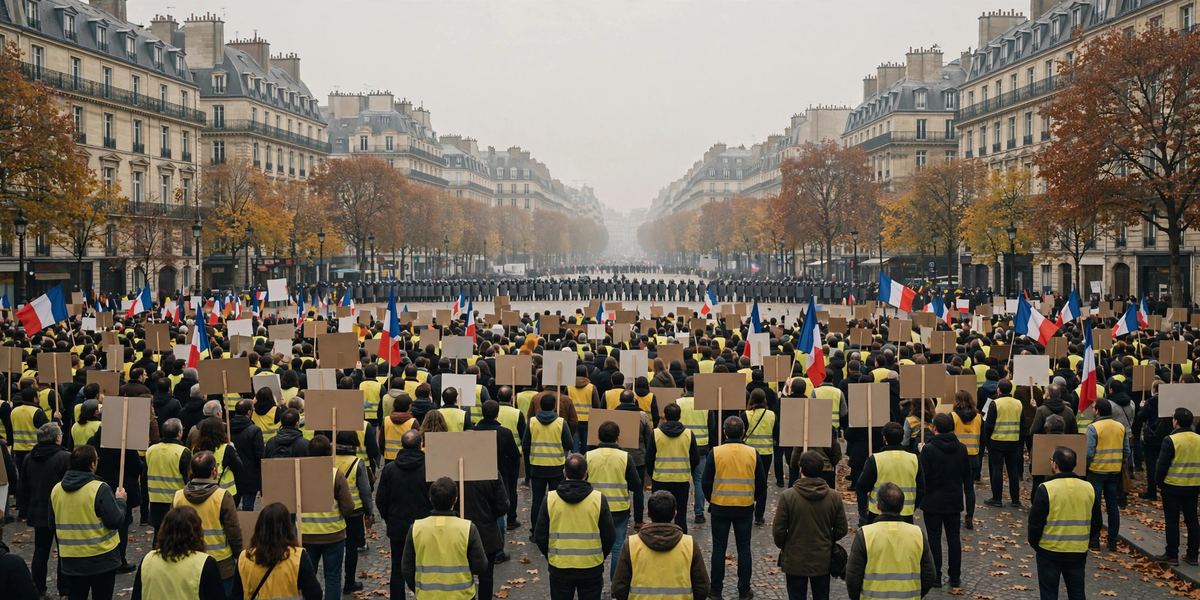
France saw one of its biggest days of protest in years on Saturday 17 October 2026, as tens of thousands of people took to the streets in a nationwide day of action that fused three movements into one: high-school and university students, trade unions, and the returning Yellow Vest movement. Police fired tear gas in Paris and Strasbourg, dozens of people were arrested in the capital, and hundreds of demonstrations, blockades and marches were staged from Rennes to Marseille. The story is trending per news coverage.
The day had been building for weeks. What began in mid-September as a student revolt over teacher shortages and crumbling schools in the Paris suburbs has grown into a far broader challenge to the government of President Emmanuel Macron and Prime Minister Sebastien Lecornu — over the cost of living, public spending, and what protesters describe as a fraying French social model. Saturday was the moment those separate grievances converged on the streets at the same time.
What happened on 17 October
The main Paris demonstration was due to set off at 2pm from Place de la Republique, heading toward the north of the capital. But the day began much earlier, with actions at dawn across the country. In Rennes, protesters built barricades from rubbish bins and large pallets on the outskirts of a shopping mall and on the ring road, briefly blocking traffic before police moved in. In Lyon, police dispersed groups of demonstrators on the Guillotiere bridge, at the Feyssine roundabout, near the Feyzin refinery, and along the banks of the Rhone, where around 100 people had gathered. Blockades were also reported in Nancy and Lille, and in Marseille protesters attacked a police building, clashed with officers who responded with tear gas, and briefly blocked a main road with bins and scooters before being cleared.
In Paris, riot police fired tear gas and made arrests as clashes broke out ahead of the main march, and in Strasbourg tear gas was used to disperse student demonstrators. The number of people arrested in the Paris metropolitan area rose through the morning, reaching 61 according to a police tally reported by CNews; earlier reports had put the figure at around 40. Paris police chief Patrice Faure had banned demonstrations around the Elysee presidential palace, the prime minister's office at Matignon, and the Champs-Elysees, and a planned march through the heart of the capital was banned after negotiations with organisers over an alternative route failed to reach agreement.
Update — turnout: the Interior Ministry put the number of people who marched nationwide on 17 October at 550,000, including about 110,000 in Paris, while organisers put the figure at 800,000. The two counts differ, as they routinely do for French protests. Both figures were reported by Le Monde on 18 October 2026.
The scale of the mobilisation was striking. Sources close to Interior Minister Laurent Nunez put the number of planned actions at around 500, with more than 90 formal demonstrations organised, while Yellow Vest networks announced as many as a thousand actions. Organisers set up a website listing more than 600 demonstrations across France. In Toulouse, a joint union demonstration by the CGT, FSU and Solidaires unions was due to depart at 2pm. High-school students from Seine-Saint-Denis, the department north of Paris where the student movement began, planned a mass march into the capital.
How a school protest became a national movement
The roots of the day lie in France's schools. The student uprising began in mid-September 2026 at lycees in the Paris suburbs, over unreplaced absent teachers, overcrowded classes and dilapidated buildings, and spread quickly into a nationwide wave of school blockades. Earlier marches over school funding drew hundreds of thousands of people, and the movement has kept growing despite government concessions.
Those concessions have been real but, for the protesters, insufficient. Education Minister Edouard Geffray said 3,000 substitute teachers would be deployed to about 100 high schools with the worst teacher shortages, and that he would authorise the recruitment of several hundred new teachers. Prime Minister Lecornu said the government would propose amendments to the 2027 budget to translate some of the students' demands into concrete measures, particularly on teacher replacements. But student leaders said there had been no concrete measures at all. One student association said the rallies would continue for as long as 10 billion euros had not been put on the table for schools.
As the weeks passed, the movement's demands widened. What started as a complaint about schools became a protest about inequality, weak public spending, falling standards in public services and the rising cost of living. The unions joined over wages, pensions and public services; the Yellow Vests — the movement that shook France in 2018 over fuel tax rises — returned with their call for a "yellow and youth" day, appealing to teachers, students, workers, pensioners and farmers to take part on the first day of the half-term holidays.
"It's not just a Yellow Vest movement, it's not just a student movement, it's all the people who are rising up," said Benjamin Ball, an activist working on a website for Saturday's demonstrations. In Rennes, Christophe, a 47-year-old carpenter and former Yellow Vest protester, told AFP he was protesting after seeing what he viewed as police brutality against teenagers: "We've reached the point where the repression is targeting our own children."
A government under pressure
The protests arrive at a difficult moment for France. President Macron is in the final stretch of his presidency, leaving behind a polarised electorate and a fragmented parliament. Prime Minister Lecornu is trying to push a cost-cutting budget through a hung parliament while protesters demand greater protection from inflation and more spending on public services, particularly education. Investors have been selling French government debt, driving borrowing costs to their highest levels in more than two decades — a sign of the country's long struggle to get its public finances in order.
On Friday, Macron appealed for calm from Brussels. "There is a constitutional right to protest and to express oneself, and I have always been vigilant and attentive that that right is fully respected," he said. "But this right comes with the need to respect. Respect for people, respect for property, and therefore a commitment not to insult or destroy." He denounced the potential presence of people "solely to cause damage and create unrest" as "unacceptable."
Lecornu convened an interministerial crisis cell to monitor the demonstrations and said on Thursday that he feared clashes after what he called "urban violence" during the student protests. "This is a moment of fatigue in the country," he said. "We are in an atmosphere of perma-crisis: wars, inflation, and issues surrounding purchasing power." The government has blamed the hard-left France Unbowed party for inflaming the protests, an accusation the party denies. Opposition chief Jordan Bardella, whose far-right National Rally leads in the polls ahead of next year's presidential election, said he expected violence: "I'm extremely concerned. It will be a day of chaos for France."
Violence, injuries and policing
Both sides of the confrontation point to injuries. Lecornu has said the protests have been among the most violent in decades, with more than 900 police officers and gendarmes injured since the protests began — 937 by one of his counts — alongside 248 students and 149 teaching staff. Police unions have complained that officers are being left exposed; the Alliance Police Nationale union announced plans to file a complaint against the state for endangering lives.
Protesters and rights groups, meanwhile, have denounced what they describe as disproportionate police force. More than 6,800 people have been taken into custody since the student movement began, 86% of them minors. The most shocking cases involve stun grenades: a 15-year-old student had his hand blown off in Lens after picking up a stun grenade, and another teenager reportedly lost an eye to a rubber bullet. The government suspended the use of certain stun grenades after the injuries, but Interior Minister Nunez said on Friday that they would remain an option on 17 October if "extremely serious urban violence" occurred. He told the Senate that 36 investigations into alleged police misconduct have been launched, including four involving mutilating injuries.
The justice minister has asked prosecutors for a firm legal response to violence during the demonstrations, and the ministry authorised police and gendarmes to use all intermediate weapons at their disposal for the day.
What happens next
Saturday's test was never only about one day. For the government, the question is whether the convergence of students, unions and Yellow Vests becomes a sustained movement — or a peak that fades as the half-term holidays begin. For the protesters, the question is whether the scale of the day forces new concessions on school funding and the budget, or whether the government waits them out.
Three things will decide that. The first is turnout: the official counts of how many people marched, and whether the movement holds its numbers in the days ahead. The second is the politics of the budget, as Lecornu tries to pass spending cuts through a parliament where he has no majority, while the street demands the opposite. The third is the presidential race: with an election due next year, every party — from the far right to the hard left — is watching Saturday's crowds as a measure of the country's mood.
France has seen protest movements force governments to retreat before, and it has seen them burn out. What made 17 October different was the breadth of the coalition on the streets: teenagers who started by blockading their schools, marching alongside trade unionists and Yellow Vests who have been fighting over living standards for years. That convergence is why Saturday mattered — and why the coming week, in parliament and on the streets, will matter more. Sources: Reuters (17 October 2026), via WNCY; BBC News (17 October 2026); LaPresse, citing CNews police tally (17 October 2026); Bangkok Post, via AFP (17 October 2026); BritBrief (17 October 2026); Policy-Wire (17 October 2026); Voice of Emirates (12 October 2026); PressTV (9 October 2026).
The unrest has also drawn in Washington, where Trump has threatened that the US could 'leave' Europe, citing France's riots in a fresh NATO ultimatum.