
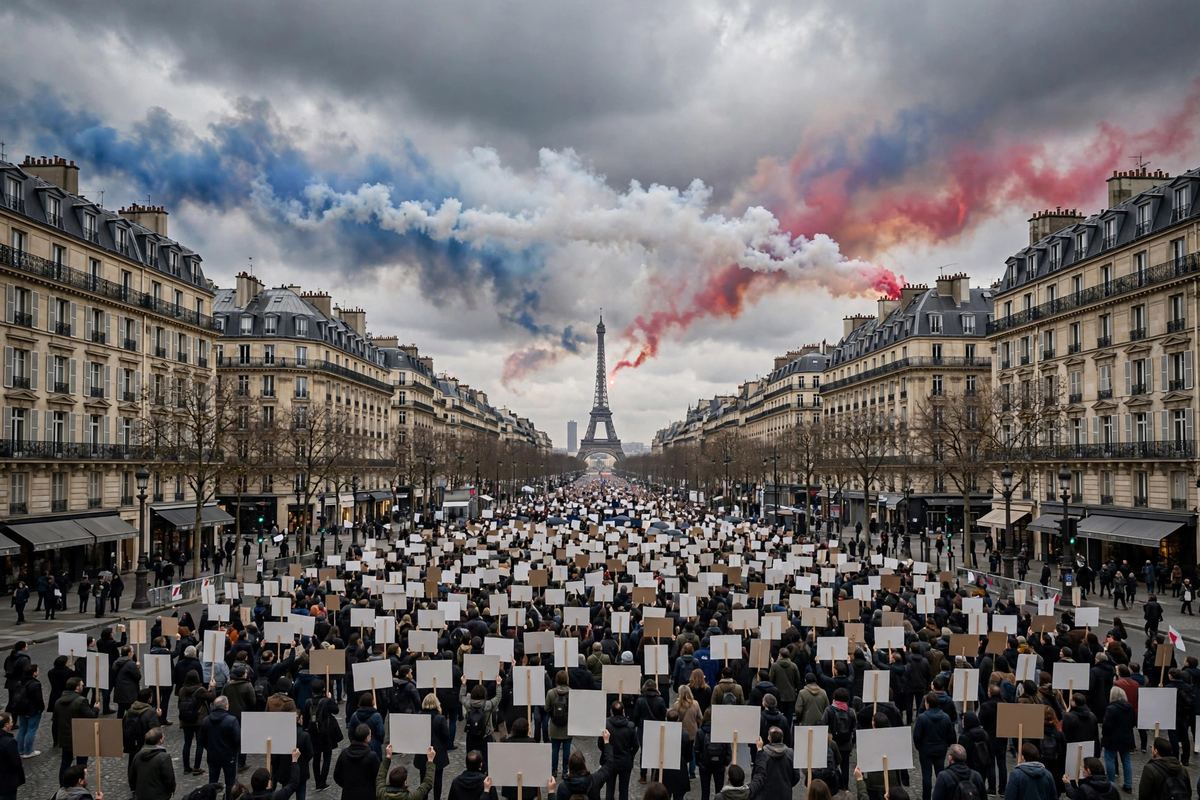
In October 2026, more than 250,000 people — over 2.5 lakh — took to the streets across France in protests over school funding. Demonstrations that began as gatherings of teachers, parents and students escalated in some cities, with riot police firing tear gas. The unrest unfolded against a difficult economic backdrop: France is grappling with serious fiscal concerns, and the euro had slipped to a 17-month low. Why did school funding bring a quarter of a million people onto the streets, and what does it tell us about the state of France?
What Happened?
According to reports from Reuters, the BBC and Hindustan Times, the protests mobilised more than 250,000 people across the country. Marches were reported in major cities, with teachers' unions, parent associations and student groups among the organisers. In some locations, confrontations developed between demonstrators and riot police, who used tear gas to disperse crowds.
The central grievance was school funding — the money that pays for teachers' salaries, classroom resources, building maintenance and support staff. Protesters argued that years of tight budgets had left schools struggling with overcrowded classrooms, deteriorating buildings and staff shortages. For a country that has historically taken enormous pride in its public education system, the sense that schools are being starved of resources struck a powerful chord.
France's Protest Culture: Why Schools, Why the Streets?
To outsiders, the scale of the mobilisation can be puzzling. To the French, it is a familiar grammar of politics. France has one of the most deeply rooted protest cultures in the democratic world — a tradition in which citizens express political demands directly in the street rather than waiting for elections. Mass demonstrations have been part of French political life for centuries, and unions and associations maintain sophisticated networks capable of bringing hundreds of thousands of people out at short notice.
Education holds a special place in this culture. The French public school system — the école publique — is seen not just as a service but as a pillar of the Republic itself. Since the late 19th century, free, secular public schooling has been understood as the institution that makes citizens equal. Threats to school funding are therefore felt as threats to a national ideal, not merely a budget line. When teachers say the system is underfunded, parents listen — and march.
This also explains why school funding can succeed as a mobilising cause where other issues fail. Almost every family in France has a direct stake in the public school system. A protest about classroom conditions is, in effect, a protest about every child's future — a message that cuts across class and region in a way that few other causes can.
The Fiscal Backdrop: France's Economic Strain
The protests did not happen in an economic vacuum. France has been facing mounting fiscal concerns — the gap between what the state spends and what it collects in taxes has become a source of political tension. When governments run persistent deficits, every budget becomes a battleground: money for schools competes with money for healthcare, pensions, defence and debt servicing.
Against this backdrop, the euro fell to a 17-month low, a sign that currency markets were nervous about the economic outlook of the eurozone's second-largest economy. A weaker euro reflects investor unease — about growth, about government finances, or about political stability. For ordinary citizens, currency movements are abstract; but the fiscal squeeze that underlies them is very concrete. It is the reason school budgets are tight, and it is why the government says it cannot simply spend its way out of the crisis.
This is the classic dilemma of public finance in a democracy. Citizens demand better-funded services while resisting the tax rises or spending cuts elsewhere that would pay for them. Understanding how prices, wages and government budgets interact helps make sense of why these fights are so hard to resolve — see our explainer on what inflation is for the basics of how rising costs squeeze everyone, including governments.
Tear Gas and Tensions: When Protests Turn Confrontational
The reported use of tear gas by riot police is a reminder that even broadly peaceful mobilisations can turn confrontational at the edges. French authorities maintain specialised riot-control units, and clashes between a radical fringe of demonstrators and police have become a recurring feature of large French protests. Each side tends to blame the other for the escalation, and images of tear gas in the streets quickly become political symbols in their own right.
It is worth keeping perspective: the vast majority of the 250,000-plus demonstrators marched peacefully. The confrontations, while newsworthy, involved a small fraction of those present. But the symbolism matters — footage of tear gas outside schools hardens positions on both sides and makes compromise harder, a dynamic familiar from protest movements elsewhere in the world, including recent demonstrations in India covered in our explainer on the Delhi Jantar Mantar protest of October 2026.
Why It Matters
The protests matter for three reasons. First, they signal the depth of public anxiety about education — a quarter of a million people marching for school funding is a vote of no confidence in how the issue has been handled. Second, they constrain the government's room for manoeuvre on the budget: any fiscal consolidation plan that touches education will now face organised, visible opposition. Third, they are a reminder that in democracies, legitimacy is earned continuously, not just on election day — the street is where many French citizens feel their voice is truly heard.
What Happens Next?
The trajectory of the protests will depend on how the government responds. Possible paths include:
- Negotiation: The government could open talks with teachers' unions and announce new funding commitments for schools — the classic French resolution to education disputes.
- Escalation: If unions judge the response inadequate, they may call for further days of action, potentially including strikes that close schools.
- Budget politics: School funding will become a flashpoint in the broader fight over the national budget, with opposition parties using the protests to attack the government's fiscal management.
- Long-term reform: Beyond immediate funding, the protests may force a deeper conversation about how France pays for its cherished public services in an era of slower growth and tighter budgets.
Whatever happens, the October 2026 school funding protests have already demonstrated something enduring about France: when citizens feel a core public institution is under threat, they do not just write letters or wait for the next election — they march. And 250,000 pairs of feet in the street are very hard for any government to ignore.