
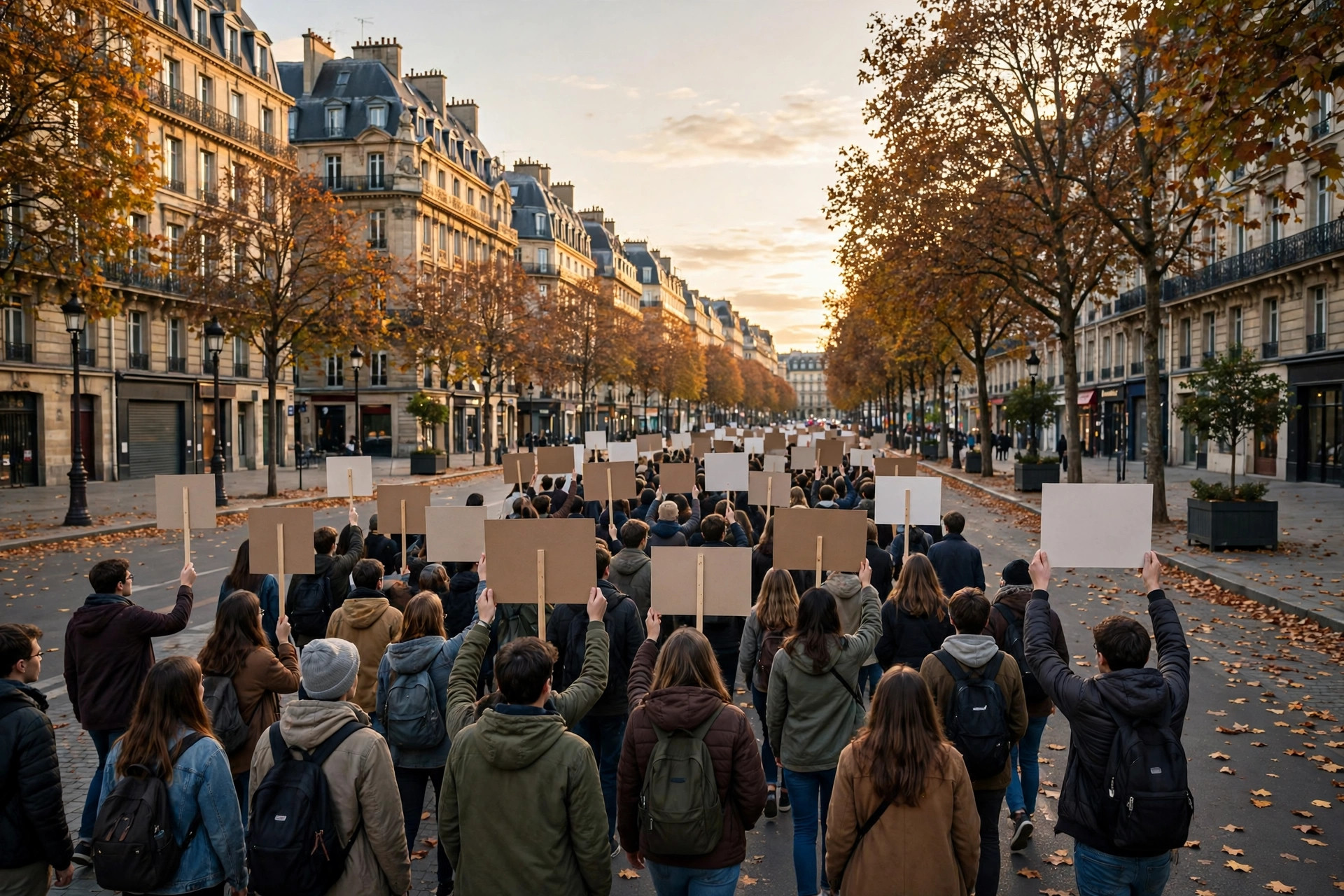
The Europe youth protests November 2026 reached a new scale on Saturday 31 October, when a third consecutive weekend of youth-led demonstrations in France over living costs and education was joined by rallies across Germany, Italy, Spain, Portugal and the Netherlands. What began in France as a student-led movement about neglected schools and rising prices has become a pan-European wave, with young people in different countries raising strikingly similar demands: affordable housing, properly funded schools and universities, decent public services, action on the climate, and a life they can afford. The French government estimated that 320,000 people protested nationwide on Saturday, including 70,000 at the main Paris march, while organisers put the turnout far higher. In Germany, a youth initiative called "Gen Z regelt" — roughly "Gen Z's got this" — rallied in more than 30 cities. This article explains what happened on 31 October, why the protests are spreading, what the demonstrators want, how the disputed numbers should be read, and what comes next.
Europe Youth Protests November 2026: The Third Weekend in France
Hundreds of thousands of mostly young protesters took to the streets across France on Saturday 31 October, in a third consecutive weekend of demonstrations over living costs and education. The French government estimated nationwide participation at 320,000, including approximately 70,000 at the main Paris demonstration, according to the Interior Ministry. That is fewer than the previous weekends: government estimates put turnout at 410,000 on 24 October and 550,000 on 17 October, when mass protests deteriorated into some of France's worst rioting in years. About 70,000 police and gendarmes were deployed across the country, and Paris marches were rerouted to the capital's edge, from Porte de Bagnolet to Porte de Charenton, after a last-minute court battle, in an attempt to reduce the risk of unrest around government buildings and tourist sites. Interior Minister Laurent Nuñez warned of a "very high risk" of disorder, especially after dark on Halloween, and the authorities were braced for a repeat of the violence of 17 October. By Saturday night, the Interior Ministry said 296 people had been detained countrywide as of 6 p.m. local time, and the Associated Press reported more than 560 arrests nationwide by Saturday night. Police fired tear gas in Lyon and Toulouse, and tension broke out at the end of the Marseille march. The ministry said that as of 29 October, at least 1,193 police officers had been injured since the start of the protests. Students cited neglected schools, teacher shortages, housing conditions and rising living costs as their reasons for marching, and the movement has been sustained for three weekends in a row, a sign that the grievances behind it have not been answered.
Europe Youth Protests November 2026: Germany's Gen Z Regelt Movement
The most important development on 31 October was that the protests were no longer a French story. In Germany, a youth initiative called "Gen Z regelt" — roughly "Gen Z's got this" — rallied in more than 30 cities "for education, health, climate protection and an affordable life", and against any return of military conscription. Organisers said more than 180,000 people had registered online for the day of action, and that around 120,000 people attended the protests across Germany on Saturday, although official figures were not immediately available. Tens of thousands marched in Berlin, Frankfurt, Munich, Cologne and Hamburg, and young demonstrators gathered at Berlin's Brandenburg Gate to call for increased spending on schools and housing. The day was not peaceful everywhere in Germany: in Cologne, water cannons were used after fireworks were thrown at police, and in Hamburg barricades were set on fire. The German movement is distinct from the French one in its organisation — it is a self-consciously youth-led campaign built largely online, with its Halloween timing chosen to maximise turnout and visibility — but its demands overlap almost exactly with the French protesters': underfunded schools and universities, cuts to education, social services, culture and healthcare, rising living costs, and opposition to the return of mandatory military service. The fact that tens of thousands of young Germans turned out on the same day as the third French weekend is what makes 31 October a genuinely European moment rather than a French one with foreign echoes.
Italy, Spain, Portugal and the Netherlands Join In
Beyond France and Germany, the wave reached across southern and western Europe. In Italy, protests took place in Rome and more than 50 cities over rising costs and public services, and Italian police were on alert following earlier clashes in Milan, Turin and Bologna. In Spain, regional police in Barcelona planned to activate their highest alert level after an anonymous TikTok network called Blocus urged further gatherings, following rioting there on 24 October that resulted in approximately 130 arrests, mostly involving minors. In Portugal, thousands of people joined demonstrations in Lisbon over the country's housing crisis and the increasing difficulty of finding affordable accommodation. In the Netherlands, authorities increased security preparations in The Hague following online calls for demonstrations, although no major disturbances had been reported by mid-afternoon. Calls for protests also circulated on TikTok in Belgium, Austria and Switzerland. The pattern is consistent: in each country the trigger is local — housing in Lisbon, the Blocus network in Barcelona, school funding in Germany — but the underlying complaints are the same, and social media is carrying the tactics and the slogans from one country to the next within days. That is why police forces across Europe were preparing for the same Saturday, and why the French government's figures are only part of the story.
What the Protesters Want
Strip away the national differences and the demands of the Europe youth protests are remarkably consistent. The first is the cost of living: young people say that food, transport, rent and everyday essentials have become unaffordable, and that wages and student support have not kept up. The second is education: in France, students cite neglected schools and teacher shortages; in Germany, the Gen Z regelt movement demands investment in schools and universities and an end to cuts in education, culture and healthcare. The third is housing, which was the central issue in Lisbon, where thousands marched over the housing crisis, and a major theme in Paris and Berlin as well. The fourth is public services more broadly — health, transport and social support — which protesters say have been hollowed out. The fifth is climate protection, which the German movement lists alongside education and health as a core demand. And in Germany there is a sixth, distinctive demand: opposition to any return of military conscription, which has become a live political debate as European governments reconsider defence. None of these demands is new on its own. What is new is that they are being raised at the same time, by the same generation, in many countries at once, and that the protests have now sustained themselves for three consecutive weekends in France while spreading to Germany and beyond.
How the Numbers Are Counted — and Disputed
Readers should treat protest turnout figures with care, because they are always disputed, and this weekend is no exception. The French government's estimate for Saturday was 320,000 nationwide, including 70,000 in Paris. Youth unions, cited by the newspaper Libération, put the turnout far higher, at around 500,000 nationwide, including 200,000 in Paris. Neither figure can be independently verified, and the gap between them is normal for large protests: governments count using police estimates, while organisers count using their own methods, and the two rarely agree. What can be said with confidence is the trend: on the government's own figures, turnout fell from 550,000 on 17 October to 410,000 on 24 October and 320,000 on 31 October, which suggests the movement is smaller than at its peak but still very large. The same caution applies in Germany, where organisers said more than 180,000 people registered online and around 120,000 attended, but official figures were not immediately available, and where other reports put the online registration figure lower, at more than 140,000. One figure that should not be used is a claim circulating online of only around 15,000 protesters in France, which conflicts with every other source and appears to be an error. The honest way to report this weekend is to give both the official and the organisers' figures, attribute each one, and note the direction of travel — and that is what this article has done.
What Happens Next: 5 November and Beyond
The movement is not stopping. French student unions have called for blockades of schools and universities on Tuesday and Thursday, and the next big mobilisation is planned for Thursday 5 November, when an inter-union strike and day of action is scheduled. The question now is whether the third weekend's smaller turnout in France marks the beginning of a decline, or whether the spread to Germany and other countries gives the movement a second wind. Two things will matter. The first is whether governments respond to the substance of the demands — on school funding, housing and living costs — rather than only to the policing of the marches. The second is whether the pan-European character of 31 October holds: if young people in Germany, Italy, Spain and Portugal keep turning out on the same days as the French protests, the movement becomes much harder for any single government to dismiss as a national problem. For now, the Europe youth protests of November 2026 have done something unusual: they have made the same generation's complaints visible in many countries at once, on the same day, over the same issues. That is the story of 31 October, and it is why this weekend matters beyond France.
Related reading: France protests: 1,000 arrested in October, Italy protests: 371 detained in October, and France student protests over Parcoursup replacement.