
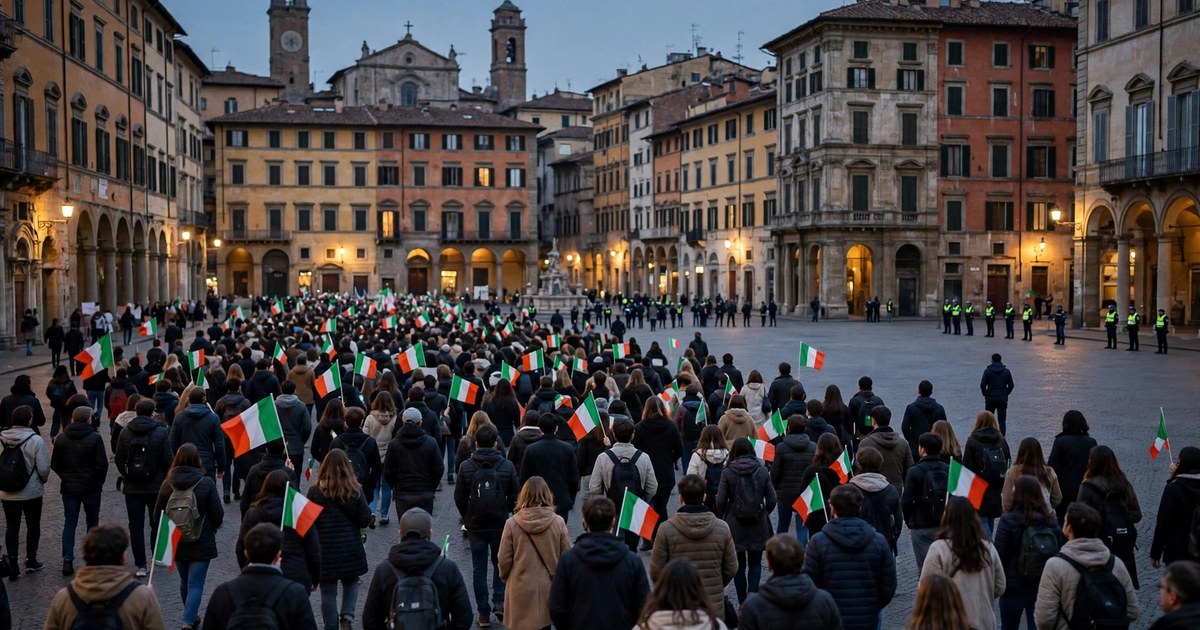
Italy protests 2026 reached a new flashpoint on Saturday 24 October, as demonstrations against the cost of living, rearmament and the government of Prime Minister Giorgia Meloni swept major Italian cities for a second consecutive weekend. Clashes between protesters and police were reported in Rome, Turin and Bologna, while Milan — the scene of looting a week earlier — saw a largely peaceful march of more than 10,000 people under the watch of around 500 soldiers. The story is trending per news coverage across Europe, where it forms part of a wider wave of street protests over household finances and public spending.
According to state broadcaster RAI News, police identified almost 5,000 people across Italy on Saturday, detained 371 — including 110 minors — and made nine arrests. Among those detained was the suspected organiser of the "Movimento 17 Ottobre" (October 17 Movement), the student-linked network behind last weekend's demonstrations, who was taken to police headquarters in Milan for questioning. Reuters witnesses reported no repeat of the shop looting seen in Milan the previous weekend, a key concern for authorities who had flooded city centres with officers.
Italy protests 2026: what happened in Rome, Turin and Bologna
In Rome, demonstrators set off from Piazza della Repubblica on Saturday afternoon for an anti-war march, according to the ANSA news agency. Clashes erupted in the city centre later in the evening, prompting police to use water cannons and tear gas to disperse crowds. A group of demonstrators entered the Colosseum area, and dozens of young people were taken to the central police headquarters. Armoured police vehicles near the Quirinale, the president's official residence, were pelted with bottles before officers intervened. More than 1,500 police officers were deployed in the capital, and many shops in the centre closed or boarded up their windows as a precaution.
In Turin, in Italy's north, the Italy protests 2026 turned violent when demonstrators threw bottles and firecrackers at officers. Police responded with baton charges and tear gas, and there were injuries on both sides. Police in Turin identified 421 people — 313 Italians and 108 foreign nationals — during the day's operations. Protesters there were demonstrating mainly against increased military spending and rising fuel prices, two of the grievances driving the wider movement.
In Bologna, protesters threw stones, set bins alight and built makeshift barricades in the historic centre. Officers used batons, tear gas and a water cannon, and at least one young man was treated by ambulance crews. Emergency medical services received 17 calls for assistance in the city, and six people were taken to hospital by ambulance, according to the Corriere della Sera newspaper. Bologna's railway station was closed for a time as a precaution.
Milan presented a calmer picture for the Italy protests 2026. More than 10,000 people marched around Piazza del Duomo, according to RAI News, with around 500 soldiers supporting police and armoured vehicles stationed around the square. Prime Minister Meloni had announced the deployment of the additional troops alongside around 5,000 security personnel for the city. The Milan march remained largely peaceful, though brief clashes were reported at its edges.
Why are Italy protests 2026 happening?
The Italy protests 2026 are driven by a cluster of grievances that have built up through the autumn: the rising cost of living, higher fuel prices, underfunded education, and opposition to military spending and rearmament. The movement is led largely by students and young workers, and it began in earnest on 16 October with student demonstrations under the slogan "No Meloni Day". A week later, on 17 October, protests in several cities escalated into riots and looting, most seriously in Milan, where shops in the Galleria Vittorio Emanuele II were looted and around 50 people, including minors, were detained, according to the Associated Press.
Last weekend's violence set the tone for this Saturday's heavy security. Interior Minister Matteo Piantedosi ordered additional police forces deployed across the country, with reinforcements concentrated in the major cities where the largest rallies were expected. Authorities also acted on calls for further demonstrations that had circulated on social media during the week, hoping to prevent a repeat of the looting and vandalism.
The generational character of the Italy protests 2026 has become a political issue in itself. Police in Milan said last weekend's violence and looting involved about 2,000 very young protesters, many of them second-generation Italians, and 45 people were arrested over two days including 34 minors. The government has since pushed tougher penalties for minors involved in violent protest, a proposal that has itself drawn criticism from youth groups and the opposition.
Italy protests 2026: Meloni's response and the security crackdown
Prime Minister Giorgia Meloni condemned the violence in a social media post on Saturday evening, stressing the need to protect both peaceful demonstrators and the wider public. "Everyone's safety must be guaranteed: those who wish to demonstrate peacefully, those who work, and those who want to live in their cities without fear," she wrote. "We must leave no room for those who seek nothing but confrontation and violence." In a later statement she thanked law enforcement personnel, saying they had protected public safety and the right to peaceful protest despite attempts by "violent individuals" to provoke clashes.
Meloni also turned her attention to the opposition, asking it to avoid ambiguity and unequivocally condemn the violence. Defence Minister Guido Crosetto clarified the limits of the soldiers' role in Milan: the troops were only recently authorised to use plastic restraint ties, and only in areas around train stations, not throughout the city, and they are not authorised to carry pepper spray or tasers.
Milan's centre-left mayor, Giuseppe Sala, also condemned the violence, saying the reasons behind the protests were understandable but the attacks on police and the damage to the city could not be justified. He added that police numbers around Piazza del Duomo had appeared too low for the size of the crowd the previous weekend and said the situation seemed to have been underestimated — a rare point of agreement between the city and the government on the need for a heavier presence this time.
Italy protests 2026 in a European context
The Italian unrest is part of a wider European protest wave that has been building through October. In France, around 410,000 people marched on the same Saturday, with nearly 1,000 detained, as documented in our coverage of the France protests. Students in Albania rallied outside the Ministry of Education in Tirana demanding lower tuition fees and the resignation of Prime Minister Edi Rama, while police used water cannons and tear gas on barricades in Brussels. The continent-wide picture is covered in our Europe protests explainer, which tracks how a French movement over living costs spread across borders.
What links the Italy protests 2026 to the wider European wave is a shared squeeze: household budgets under pressure from prices and fuel costs, young workers and students frustrated by education funding and job prospects, and governments facing competing demands to spend more on defence. In Italy, that mix has produced a movement that is at once anti-austerity, anti-war and generational — and that shows no sign of stopping with one weekend of marches.
What happens next for the Italy protests?
Attention now turns to whether the Italy protests 2026 can sustain their momentum without the violence that has dominated headlines. The October 17 Movement's organisers face questioning in Milan, and the government says measures approved by the Council of Ministers are intended to strengthen the authorities' ability to prevent violence at future demonstrations. Further protests are expected in the coming weeks, and organisers have shown they can mobilise quickly through social media.
For Meloni's government, the test is twofold: keeping the streets calm without being seen to crush peaceful dissent, and answering the underlying grievances — prices, fuel, education funding — that brought thousands of young Italians out in the first place. For the protesters, the test is whether a movement born in student anger can turn street numbers into political pressure. Saturday's marches, peaceful in Milan and confrontational in Rome, Turin and Bologna, suggest both sides are still finding out.
Sources: Reuters via TBS News; ANSA via Business Today; Corriere della Sera; RAI News; Associated Press; Euronews.