
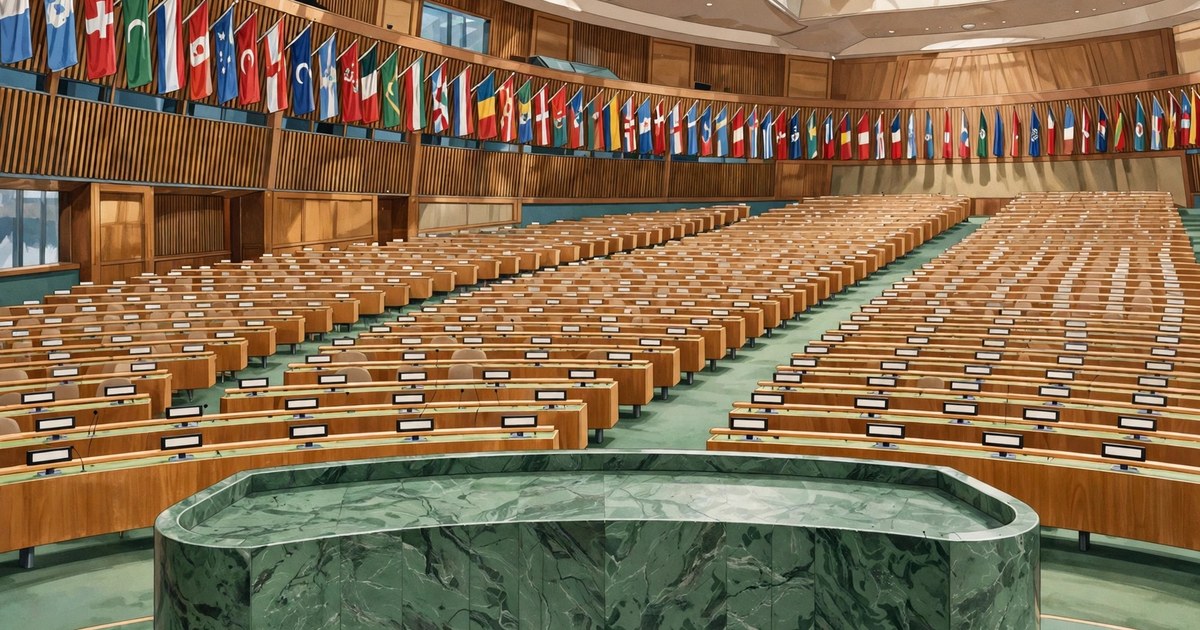
The UN Cuba embargo vote takes place on Wednesday, 28 October 2026, when the United Nations General Assembly votes for the 34th time on a resolution calling for an end to the United States economic embargo against Cuba. The vote, trending per news coverage, follows a debate that turned into a shouting match on Tuesday, when United States Ambassador Mike Waltz and Cuban Foreign Minister Bruno Rodriguez Parrilla confronted each other at the rostrum in New York. Rodriguez is due to deliver Cuba's statement on Wednesday, before member states cast their votes. This article was written before the result was known, so it explains what the vote is, what happened in the chamber, what each side argues, and what the result will — and will not — change.
At its simplest, the vote is a test of world opinion. All 193 member states of the United Nations have one vote each in the General Assembly. The resolution is not legally binding, which means that even an overwhelming vote in favour does not lift the embargo by itself. What it does is record, year after year, how isolated the United States position is in the chamber — and, this year, whether Washington's unusually public campaign against the resolution has moved any votes at all.
What the UN Cuba embargo vote is — and why it happens every year
The resolution before the Assembly is titled “Necessity of ending the economic, commercial and financial embargo imposed by the United States of America against Cuba.” As in previous years, the Cuban-drafted text reaffirms the sovereign equality of states and the principles of non-intervention and non-interference in internal affairs, as well as freedom of international trade and navigation. It voices concern over laws such as the Helms-Burton Act, enacted by the United States on 12 March 1996, whose extraterritorial effects, it says, undermine the sovereignty of other states and freedom of trade and navigation. It calls on all states to refrain from adopting such measures and urges those that still apply them to repeal them.
The Assembly has called for an end to the embargo, first imposed in 1960 according to UN News, on 33 previous occasions. Support has grown markedly since the first vote in 1992, when 59 countries backed the resolution, three opposed it, 71 abstained and 46 did not vote. It peaked at 191 votes in favour in 2015, 2016 and 2017, during the thaw in relations under US President Barack Obama. The United States and Israel voted against in 2015 and 2017; in 2016, both abstained. Canada, China and Russia have long voted in favour, while the United States, backed by Israel, has voted against every year bar one, according to UN News. That long record is why the size of this year's majority, rather than the outcome itself, is the number diplomats will be watching.
What happened in the UN shouting match between Waltz and Rodriguez
The confrontation took place on Tuesday, 27 October, during the first day of the two-day debate. Waltz was midway through the United States statement, urging member states to oppose the resolution and criticising Cuba's government over alleged corruption and repression, when members of the Cuban delegation began banging on their desks and calling for a point of order. Rodriguez then left his seat, walked towards the rostrum and accused Waltz of lying, shouting “liar” — “mentiroso” in Spanish — according to reports of the exchange. Waltz shouted back, telling him to “Back up!” and saying: “This is America. This isn't Havana.” The President of the General Assembly briefly suspended the session. The debate later resumed without further incident, UN News reported.
Waltz continued his statement after order was restored. He rejected the premise of the debate, arguing that Cuba's crisis was the fault of its own government, not the embargo. “There is no blockade,” he said. If there were, he argued, there would be no explaining United States exports to Cuba — which he put at more than $876 million in the first eight months of 2026 — or shipments from Canada, Spain, Mexico, China, Russia, the European Union and UN agencies. The country's wealth had not vanished, he said, but had “simply” passed from ordinary Cubans into the hands of the ruling elite. He also displayed a photograph of former Cuban leader Fidel Castro wearing a Rolex watch and pointed to GAESA, the Cuban military's business group, which he said held billions of dollars in hard currency while ordinary Cubans lived with blackouts and empty shelves, according to reports of his speech.
Waltz also said of Rodriguez: “He's not going to intimidate me in the United States of America, like he tries to intimidate political prisoners,” and added: “I know that you don't like to hear these hard truths, but I am speaking for the Cuban people.” The White House later backed Waltz publicly, sharing his account of the exchange on social media. Tuesday's clash was the second confrontation in a week between Waltz and Cuban officials, after a similar exchange the previous week with Cuba's deputy foreign minister, Ernesto Soberon Guzman, outside a United States-hosted panel with Cuban dissidents and former prisoners.
The UN Cuba embargo vote in numbers: 34 votes, 165 to 7 last year
Last year's vote stood at 165 in favour, seven against and 12 abstentions — a weaker result for Cuba than the near-unanimous tallies of the mid-2010s, and one that followed active United States lobbying. This year, the Trump administration has campaigned still more openly against the resolution, pressing member states to oppose it or abstain, while Cuba has accused Washington of using threats and pressure to change voting intentions. The question on Wednesday is therefore not only whether the resolution passes, which is widely expected, but whether the number in favour falls further, holds steady, or recovers — and which countries, if any, change sides.
The vote is also taking place against a deepening crisis on the island. Cuba's fuel crisis, blackouts and airline suspensions have already shown how the energy squeeze reaches everyday life, from power cuts to stranded travellers. The wider United States-Cuba confrontation has also included a Florida arrest warrant for former Cuban leader Raul Castro over a 1996 plane shootdown, a case Havana rejects. Those tensions form the backdrop to the debate, but the vote itself is about one document: the annual resolution on the embargo.
Why Cuba says the embargo cost more than $8 billion in a year
Cuba's case rests on figures presented by its own government, and they should be read as Havana's account of the damage. Foreign Minister Rodriguez said in September that the embargo caused losses of $8.083 billion between March 2025 and February 2026, seven per cent more than the previous year, with cumulative damage over more than six decades exceeding $178.7 billion at current prices. “The embargo does not punish a government; it punishes the daily lives of a people in every aspect,” Rodriguez said, calling it an act of collective punishment that had left Cubans living for long months with only two or three hours of electricity a day, or less.
The sharpest part of Cuba's argument concerns fuel. In January, the Trump administration threatened tariffs on any country that sells or provides oil to Cuba, a move Havana and UN officials describe as an energy blockade. Fuel imports were effectively cut off, and Cuba's oil-fired power system — which generates most of the island's electricity — could not keep up. The result, according to Cuban officials and UN reporting, has been prolonged blackouts, interruptions to water supplies, difficulties obtaining food and medicines, and strain on hospitals. In May, senior UN officials reported that more than 100,000 surgical procedures had been postponed. The World Health Organization has warned that energy shortages are taking a toll on health, and the UN Resident Coordinator in Cuba, Francisco Pichon, has warned of an energy crisis and possible humanitarian collapse.
Rodriguez has also put the fuel shortage in practical terms: a single shipment of 100,000 metric tons of crude oil could drastically reduce power outages for about two weeks, he said, while sanctions also blocked parts for thermoelectric power plants and the solar panels and batteries needed for photovoltaic parks. For Cuba, the embargo is therefore not an abstract diplomatic dispute. It is the reason, in Havana's telling, that lights, water, transport and medical care fail — and the reason the annual UN vote matters even though the resolution cannot compel Washington to act.
What the US says: “There is no blockade”
The United States position, as set out by Waltz, is that Cuba's hardship is caused by its own government and that the embargo is a legitimate tool of pressure for political change. On that view, the ruling elite has enriched itself from confiscated businesses, farms, factories, homes and savings, and from the forced labour of its own citizens, while blaming Washington for the consequences. Waltz urged other countries to reject what he called a one-sided resolution and to hold Havana to account for human rights abuses and corruption, rather than endorsing Cuba's account of the embargo.
Washington also disputes the word “blockade” itself. The United States points to its own commercial shipments to Cuba, valued by Waltz at more than $876 million in the first eight months of 2026, and to trade between Cuba and other countries, as evidence that the island is not sealed off. From the United States perspective, the embargo restricts American trade and investment with Cuba and penalises third parties that deal with Havana, but it does not prevent Cuba from buying food, medicine and other goods elsewhere. Cuba replies that banking restrictions, shipping penalties and secondary sanctions make those purchases far harder and more expensive than the headline trade figures suggest — and that the January oil measures, which threaten tariffs on any country supplying oil, amount to a blockade in practice, whatever it is called.
What happens next after the UN Cuba embargo vote
The sequence on Wednesday is straightforward. Rodriguez is due to deliver Cuba's statement, member states will explain their positions, and the Assembly will then vote on the resolution. The result is expected the same day. If the pattern of 33 previous votes holds, the resolution will pass by a large margin. The detail that matters will be the breakdown: how many voted in favour, how many against, and how many abstained — measured against last year's 165 to seven, with 12 abstentions.
Whatever the tally, the vote alone will not end the embargo. The embargo is written into United States law, notably through the Helms-Burton Act, so ending it would require action in Congress as well as a change of policy in the White House. What the vote can do is signal the direction of world opinion, test the effect of Washington's lobbying, and keep the humanitarian argument in public view at a moment when Cuba faces acute shortages. It also comes as President Donald Trump has raised the possibility of military intervention in Cuba, saying United States warships could stop over in Cuba on their way back from the Iran war, according to the Associated Press. Havana treats that language as a threat; Washington presents its campaign as maximum pressure for change. The vote will not settle that dispute, but it will show, in counted votes, where the rest of the world stands on it.
For readers following the story, the most useful next steps are concrete: the final vote count, any change in the positions of United States allies, Cuba's response to the result, and any further United States measures on oil or sanctions in the days that follow. The shouting match in the chamber made headlines because it broke the usual diplomatic decorum. The vote matters for a different reason: it is the one moment each year when every country in the world is asked, on the record, whether the embargo against Cuba should end.
Sources: UN News reporting on the General Assembly debate on the United States embargo against Cuba, the 33-vote record, the Waltz-Rodriguez exchange, the $876 million in United States exports and the health warnings, 27 October 2026; Associated Press reporting, via The Sen Times, on the 28 October vote, the shouting match, the 165-7 vote last year and the military intervention remarks, 28 October 2026; Particle News summary of the clash, Cuba's $8.056 billion cost figure and the non-binding nature of the resolution, 27 October 2026; Xinhua reporting, via New Kerala, on Cuba's $8.083 billion loss figure for March 2025 to February 2026, the cumulative $178.7 billion figure and the two-to-three-hours-a-day electricity account, 8 September 2026; Pollar News reporting on the chamber exchange, the January oil measures and the earlier Waltz-Soberon Guzman clash, 28 October 2026; New York Post reporting on the shouting match and Waltz's remarks, 27 October 2026; and Worldlession's earlier reporting on Cuba's fuel crisis and the Florida arrest warrant for Raul Castro.