
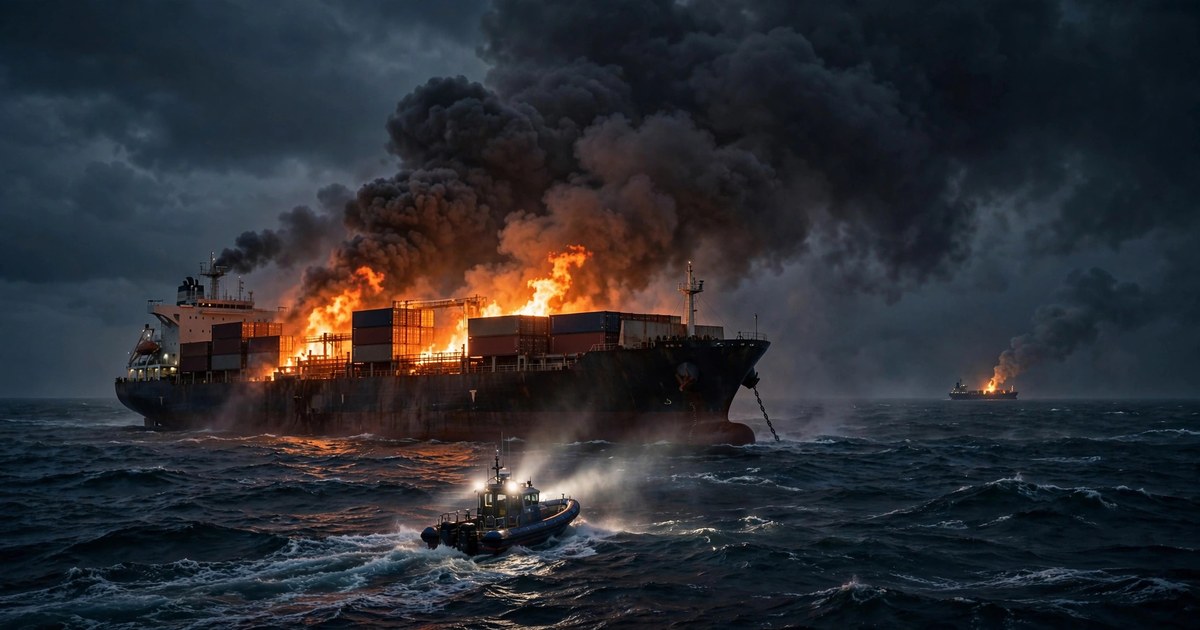
Two chemical tankers caught fire overnight inside Romanian territorial waters in the Black Sea, and rescuers were searching on Thursday morning, October 15, 2026, for sailors missing from one of them. The incident, trending per news coverage across Reuters and maritime trade outlets, is the latest and most politically sensitive in a wave of attacks on merchant shipping that has turned the Black Sea into one of the most dangerous stretches of water in the world.
Romanian officials stopped short of explicitly linking the fires to the Russian drones that had strayed into Romanian airspace around the same time. But the context is impossible to ignore: at least five other cargo ships have been hit near the coasts of Romania and Bulgaria over the past ten days, at least 23 sailors have been lost in those strikes, and three vessels have sunk. What makes this latest incident different is where it happened. The earlier attacks took place in exclusive economic zones, just outside any country's sovereign waters. This time, the burning ships were anchored inside Romania's territorial waters, inside the maritime boundary of a NATO member state.
What happened overnight
According to Romania's naval authority, it received an emergency alert from the San Marino-flagged chemical tanker Wine Trader. Eight of the tanker's 12 crew members were reported missing, with four confirmed safe. One maritime outlet later reported seven missing and five rescued, a reminder that casualty figures in fast-moving maritime incidents are often revised as rescue operations continue. Either way, the search was under way at first light, and the human cost was already severe.
Earlier the same night, a second vessel, the Comoros-flagged chemical and oil tanker Yara J, also caught fire. Its crew reported an explosion and fire on board while the ship was anchored about 10 nautical miles southeast of Sulina, at the mouth of the Danube River's Sulina Canal. The Yara J was in ballast, meaning it was sailing empty, and was reportedly preparing to enter the Danube. Its crew managed to extinguish the fire without outside assistance, and all of its crew members were reported safe. Romania's defence minister, Radu Miruta, said an investigation was under way, adding that military radar had not detected a drone approaching the ship. The tanker was expected to undergo an inspection at the port of Constanta.
Both vessels caught fire near the mouth of the Sulina Canal, the shipping channel that connects the Danube River to the Black Sea. Ships routinely anchor in that area waiting to pass through the canal, held up by weather and congestion. That anchorage, normally one of the quieter corners of European shipping, has become a front line.
A pattern, not an isolated incident
The overnight fires did not come out of nowhere. They are the latest entries in a grim sequence that began in early October. On October 5, the Turkish-owned cargo ship Royad Mammadov, carrying corn, was struck in Romania's exclusive economic zone. The vessel caught fire and later sank. Two crew members were killed, eleven were rescued by Romanian vessels and helicopters, and one remained missing.
The following day, two more merchant ships were hit off Bulgaria. The Togo-flagged Alfa Watan sank after the attack, leaving all twelve of its crew members missing. Bulgarian authorities later halted the search after finding no survivors. The Palau-flagged Able was also struck and caught fire; a Bulgarian ferry rescued all eighteen of its crew, while two severely injured sailors were taken to a hospital in Varna. Days later, two more merchant ships were attacked roughly twenty miles off the Bulgarian coast, with eleven crew members missing from one vessel and fifteen rescued from the other.
Maritime security analysts tracking the campaign count at least five drone attacks on merchant shipping off Romania and Bulgaria since October 5, with three vessels sunk. At least 23 sailors have been lost across those strikes. The overnight fires off Romania, if they prove to be part of the same campaign, would extend a toll that has already made Black Sea shipping one of the deadliest trades in commercial seafaring.
It is worth noting that the Black Sea is not the only place where merchant shipping is under attack. In the Gulf, the United States has been striking Iranian-linked vessels, and two cargo ships recently sank near the Strait of Hormuz as attacks on shipping escalated there. The world's two great energy and grain chokepoints are under pressure at the same time, and insurers, shipowners and crews are all recalculating risk.
Why "territorial waters" changes everything
The distinction between where the earlier attacks happened and where the overnight fires happened is the heart of this story. A country's territorial waters extend 12 nautical miles from its coastline, and within them the coastal state exercises full sovereignty, much as it does on land. An exclusive economic zone stretches much further out, up to 200 nautical miles, but it grants the coastal state rights over resources, not full sovereignty.
All of the previous attacks in this wave took place in exclusive economic zones, in international waters where jurisdiction is murkier and where a government can plausibly argue that an attack on a foreign-flagged merchant ship is a matter for flag states and insurers. An attack inside territorial waters is different in kind. It is an attack inside the sovereign territory of a NATO member state, against civilian ships at anchor in waters that Romania governs outright.
That is why the overnight incident is being watched so closely in Brussels and in NATO capitals. Bulgaria's prime minister, Rumen Radev, has suggested that Russia was behind the earlier attacks, while acknowledging that definitive evidence was lacking. Moscow's ambassador in Sofia has suggested the incidents could have involved a third party. European Commission President Ursula von der Leyen has called the attacks on Black Sea vessels "increasingly concerning" and described the Black Sea as "another front of escalation" in Russia's war in Ukraine. Bulgaria's president, Iliana Yotova, said Russia's war in Ukraine had contributed to a significant deterioration of the security environment in the Black Sea region, pointing to a growing trend of attacks by maritime and aerial drones against commercial vessels.
NATO has strengthened its posture along its eastern flank and is monitoring the security situation. The growing number of Russian hybrid activities was also due to be discussed at a European Council meeting in Brussels scheduled for Thursday and Friday. For now, no NATO member has publicly invoked the alliance's formal consultation mechanisms, and attribution for the overnight fires remains unconfirmed. But the move from international waters into a NATO member's territorial sea is precisely the kind of escalation that alliance planners have warned about for months.
The Danube corridor and the food-security stakes
There is a second reason the location matters. The Sulina Canal is not just any anchorage. It is the gateway to the Danube, and the Danube has become a lifeline for Ukrainian exports since Russia began attacking Ukraine's own Black Sea ports. Grain, vegetable oil and other cargoes that once moved through Odesa and other deep-water terminals now move up the Danube to Romanian ports, then out through Sulina into the Black Sea.
Attacking ships waiting to enter that corridor strikes at Ukraine's wartime export economy without touching Ukrainian territory at all. It also threatens the wider world. Both Russia and Ukraine are major exporters of grain, and increasing attacks on Black Sea shipping have raised warnings of a global food crisis. When ships carrying corn and wheat are set on fire and sunk, the consequences reach far beyond the crews and the owners: they reach bread prices in North Africa, animal-feed supplies in Europe and food aid budgets in the Middle East.
Russia's defence ministry claimed on Wednesday that its forces had struck a dry cargo ship heading towards Odesa, and followed up on Thursday with claims of attacks on two more dry cargo vessels bound for the Ukrainian port, alongside strikes against infrastructure at the Danube port of Izmail. Those claims have not been independently verified, and the ships have not been identified. If they are accurate, they would confirm that the campaign is aimed squarely at the Danube-Odesa export corridor.
The pattern fits a broader escalation in the war's economic dimension. Russia has been pounding Ukrainian energy infrastructure, in strikes that recently left 600,000 Ukrainians without power, as covered in our report on Russia's overnight energy attacks. Ukraine, for its part, has been striking Russian oil refineries, and Kyiv has signalled it is restarting that campaign. The Black Sea shipping attacks extend that economic war onto the water, where civilian crews, not soldiers, bear the risk.
What officials are, and are not, saying
The careful language coming out of Bucharest is itself part of the story. Romanian officials said Russian drones had strayed into Romanian airspace around the time of the fires, but stopped short of explicitly linking the fires to those drones. Defence minister Miruta noted that military radar had not detected a drone approaching the Yara J, a detail that either points to a different cause for that fire or exposes a gap in detection.
That caution is understandable. Attribution in drone warfare is hard. Small uncrewed aircraft can be launched from ships, from shore, or from across a border; they can be flown by state forces, proxies or deniable third parties; and the debris they leave behind often sinks with the ship. Bulgaria's prime minister said the evidence for Russian responsibility in the earlier attacks was not yet definitive. Russia's ambassador to Sofia floated the possibility of a third party. Both statements may be genuine caution, or they may be political positioning by governments that do not want to be forced into a confrontation they have not chosen.
Romania is no stranger to this problem. The country shares a 614-kilometre border with Ukraine, much of it running along the Danube, and has reported repeated breaches of its airspace by Russian drones over the past four years. Each incident has forced Bucharest to balance the same calculation: respond firmly enough to deter, without escalating a war it is not fighting.
The stakes of that calculation keep rising. Ukraine's leadership has been pressing Western partners for more support, including in high-level meetings in London, as described in our coverage of Zelenskyy's London visit, where Starlink disruptions and UK missile supplies were on the agenda. The Black Sea campaign, whether directed from Moscow or not, tests the willingness of NATO states to defend civilian shipping in their own waters.
What happens next
Three things will determine what this incident becomes. The first is the investigation. Romanian authorities will inspect the Yara J at Constanta, and the Wine Trader's wreckage, if it can be examined, may yield debris, burn patterns and sensor data that point to a cause. If investigators find drone fragments or explosive residue consistent with the earlier attacks, the attribution debate will shift decisively.
The second is the rescue. With up to eight sailors missing from the Wine Trader, the search operation in the coming hours will decide whether this incident adds to the death toll that has already reached at least 23. Families in the crews' home countries are waiting for news that, in the Black Sea's autumn conditions, may take time.
The third is the political response. NATO and the European Union will have to decide whether fires inside a member state's territorial waters demand a different answer than attacks in international waters received. Options range from stepped-up naval patrols and air surveillance over the western Black Sea, to new sanctions, to a formal alliance consultation. None of them is cost-free, and none of them has been publicly chosen yet.
Meanwhile, the wider regional picture keeps darkening. The Gulf has seen its own escalation, including a missile strike on Saudi Aramco's headquarters in Dhahran, and the Strait of Hormuz has seen ships sink under attack. The world is watching two maritime chokepoints burn at the same time, and the civilian sailors caught between them have become the war's most exposed victims.
For the crews anchored off Sulina, the lesson of this week is brutal: the Black Sea's most dangerous waters are no longer confined to the war zone. They now include the anchorage outside a NATO country's busiest river port, in waters that were supposed to be safe. Until someone can explain how two tankers caught fire there in a single night, and stop it from happening again, no ship in the western Black Sea can be called safe.
Sources: Reuters; Splash 247; Baird Maritime; Atlantic Council; Associated Press via syndication. Casualty figures were still evolving at the time of publication; where outlets differed, this article reports the range.
Frequently Asked Questions
How many sailors are missing after the Black Sea tanker fires?
Reuters reported that eight of the Wine Trader's 12 crew members were missing, with four confirmed safe. One maritime outlet later reported seven missing and five rescued. Figures in fast-moving maritime incidents are often revised as rescue operations continue, so the exact number may change.
Where exactly did the two tankers catch fire?
Both vessels caught fire inside Romanian territorial waters in the Black Sea, near the mouth of the Danube River's Sulina Canal. The Yara J was anchored about 10 nautical miles southeast of Sulina when its crew reported an explosion and fire. Territorial waters extend 12 nautical miles from a country's coast, and the coastal state exercises full sovereignty within them.
Was Russia behind the tanker fires?
That has not been confirmed. Romanian officials said Russian drones had strayed into Romanian airspace around the time of the fires, but stopped short of explicitly linking the fires to those drones. Bulgaria's prime minister has suggested Russia was behind the earlier attacks on merchant shipping in the region, while acknowledging that definitive evidence was lacking. Russia's ambassador to Sofia suggested a third party could have been involved. An investigation is under way.
Why do attacks on Black Sea shipping matter for food prices?
Russia and Ukraine are both major exporters of grain, and the Danube-Sulina corridor has become a vital export route for Ukrainian cargo since Russia began attacking Ukraine's own Black Sea ports. When ships carrying grain and other cargoes are attacked, insurance costs rise, shipowners avoid the route, and export volumes fall, all of which can push global food prices higher.
What is the difference between territorial waters and an exclusive economic zone?
Territorial waters extend 12 nautical miles from a country's coastline, and the coastal state exercises full sovereignty there, much as on land. An exclusive economic zone extends up to 200 nautical miles and gives the coastal state rights over resources such as fish and oil, but not full sovereignty. That is why fires inside Romania's territorial waters are a more serious escalation than the earlier attacks, which took place in exclusive economic zones.
In response to the attacks on shipping, NATO is sending additional patrol aircraft, radar systems and drones to the Black Sea.