
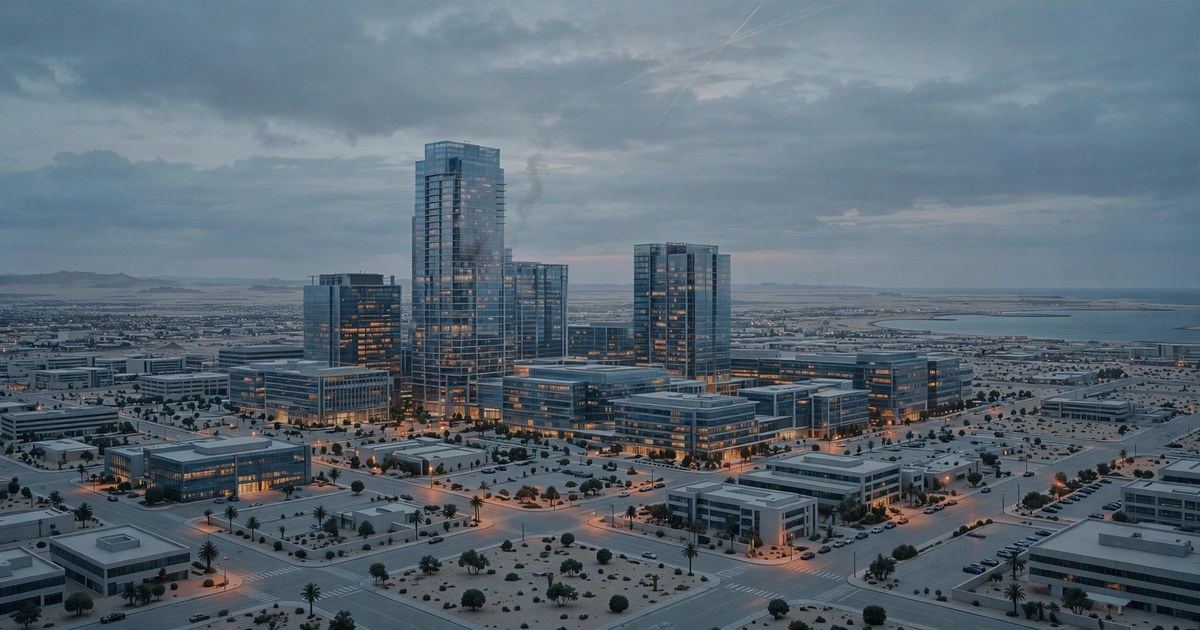
A missile strike hit the headquarters complex of Saudi Aramco, the world's largest oil company, in the eastern Saudi city of Dhahran on Tuesday night, 13 October 2026 — the most symbolically and economically significant target yet in the renewed war between Yemen's Houthi movement and a Saudi-led coalition. The strike, which is trending per news coverage across CNN, Reuters, Bloomberg and other outlets, set part of an office building alight and brought a conflict that had already shut Riyadh's main airport and killed 13 people days earlier to the doorstep of the company at the heart of the Saudi economy.
The basic facts are not in serious dispute: something struck the Aramco complex in Dhahran on Tuesday night, a fire followed, and the incident came at the end of a day of strikes traded in both directions across the Saudi-Yemeni border. But the precise details — whether the building took a direct hit or was struck by falling debris, and how serious the damage was — differ between accounts, and honest reporting has to carry all of them. This article lays out what each side and each source has said, the context that made the strike possible, and what to watch next.
What happened on Tuesday night
According to Saudi Arabia's Energy Ministry, an administrative building belonging to Aramco in Dhahran was targeted on Tuesday night, causing a limited fire. The ministry said no injuries were reported at the complex, and that authorities responded and took the necessary measures. The Saudi-led coalition said it had intercepted and destroyed a missile over Dhahran, and that fragments fell on a residential area.
A different, more serious picture came from a company source who spoke to Reuters. That source said a ballistic missile hit the headquarters complex, striking an office tower and damaging its top three floors, and that the building caught fire. The source and two other people familiar with the matter said the building was on fire, and six sources told Reuters they had heard loud booms near the complex. Aramco itself had given no immediate public comment at the time of reporting.
These accounts are not necessarily contradictory — a missile can be intercepted and still rain damaging debris, and a "limited fire" in an official statement can sit alongside serious damage to upper floors in a source account — but they do show why early casualty and damage figures in a fast-moving conflict should be treated as provisional. What is clear is that the headquarters of the company that pumps the oil underwriting the Saudi state was hit, or at minimum struck by debris from a strike aimed at it, on a night of heavy missile and drone activity.
The Dhahran strike was not the only attack that night. The Saudi-led coalition said it intercepted and destroyed three cruise missiles and two drones targeting the Riyadh region and southern Saudi Arabia. In Riyadh, four people were injured by falling debris, according to Saudi civil defence, which said the debris also caused limited damage to 15 homes. The coalition had earlier said it intercepted a ballistic missile aimed at the eastern province and another aimed at Haradh near the Yemeni border, and reported intercepting three Houthi drones north of Riyadh.
Why Dhahran matters
Dhahran is not just another Saudi city. It is the home of Aramco's headquarters and of a major operations centre that oversees the state-owned giant's vast network of onshore and offshore oil rigs, pipelines, refineries and export terminals. Aramco is the backbone of the Saudi economy: the world's largest oil company by production, the source of the overwhelming share of state revenue, and the operator of the infrastructure that moves Saudi crude to world markets. A strike on its headquarters is therefore different in kind from a strike on a border town or a remote facility — it is a blow aimed at the command centre of the kingdom's energy machine.
That is precisely why the Houthis had named it. Houthi spokesperson Yahya Saree had warned of a "harsh and painful" response to Saudi-led strikes on the Yemeni capital, Sanaa, and said targets could include the Aramco headquarters in Dhahran and an oil refinery in Riyadh. The group also warned oil workers in Saudi Arabia to stay away from sites that could be targeted. When the Dhahran strike came hours later, it looked like the carrying-out of a threat made in public, in advance.
It is also worth being precise about what the strike did not do, as far as is known. Saudi authorities reported no disruption to oil production or export operations from the Dhahran incident, and the market reaction — described below — was consistent with a strike that rattled confidence without stopping barrels. The significance of the attack lies less in the physical damage reported so far than in the demonstration that the headquarters itself is now within reach.
A day of strikes in both directions
The Dhahran strike came hours after Saudi Arabia attacked a key fuel depot in Sanaa on Tuesday, which it said was being used by the Houthis to support strikes on the kingdom's airports and energy facilities, as well as attacks on shipping in the Red Sea. The coalition said it had warned civilians to leave the area beforehand. The Houthi-controlled Yemen Oil Company said the facility held no stocks of petroleum products and that an attack would not affect fuel reserves or supplies. The Houthis said the Saudi strikes killed two civilians and injured two.
Coalition spokesperson Major General Turki al-Maliki said the operation was focused on "neutralizing the capabilities the Houthi militia uses to threaten the kingdom, Yemen, the southern Red Sea and maritime corridors." Houthi-run Al Masirah TV reported Saudi-led artillery fire in Saada province wounding several people, and strikes in Sanaa and other provinces. CNN noted it could not independently verify those reports — a reminder that casualty claims from either side in this war should be treated with caution until independently confirmed.
The exchange sits inside a week of intensifying attacks. Houthi missiles and drones have struck Saudi targets repeatedly, including four strikes on Riyadh's King Khalid International Airport. A missile strike on the airport on Saturday killed 13 people and wounded more than 300, according to reporting by CNN and Reuters — the deadliest attack on Saudi soil in more than a decade. The airport has been shut, and several countries have warned their citizens against travel to Saudi Arabia. The US State Department on Tuesday expanded travel restrictions for US government personnel in the kingdom, requiring special authorisation to use any airport in Saudi Arabia.
Saudi Arabia has been hitting back. As covered in Worldlession's earlier report on the Saudi retaliation, the kingdom has carried out counter-strikes in Yemen and stepped up its air campaign in support of Yemen's internationally recognised government, which is fighting the Houthis on the ground. Tuesday's fuel-depot strike in Sanaa was part of that campaign — and the Dhahran strike was the Houthi answer.
Why the war reignited
To understand why missiles are falling on Dhahran now, you have to go back to the summer. The Saudi-Houthi conflict had been largely quiet for roughly four years under a UN-brokered truce that followed the 2022 ceasefire. That calm broke in July 2026, when Saudi Arabia bombed the runway at Sanaa airport to stop an Iranian aircraft carrying Yemenis who had attended the funeral of Iran's supreme leader. Riyadh said a charter flight could land but not an Iranian-owned plane; the aircraft diverted. The Houthis called the bombing part of a siege and promised "a siege for a siege," announcing a naval blockade of Saudi Arabia and firing missiles at oil facilities.
In mid-September, the Houthis pushed south down the Red Sea coast toward the Bab el-Mandeb Strait, the narrow chokepoint between the Red Sea and the Gulf of Aden through which a large share of the world's traded oil and container traffic passes. They took the port town of Mocha, small islands in the strait and an airport, and the fighting moved into the mountain chains overlooking the strait and toward Taiz, Yemen's third-largest city. The stakes of that advance go well beyond Yemen: because Iran's closure of the Strait of Hormuz during the 2026 Iran war forced Saudi Arabia to rely far more heavily on its Red Sea export route, the Bab el-Mandeb has become the jugular of Saudi oil exports. A Houthi force astride it, firing missiles at the headquarters of the company that runs the trade, is a threat to the kingdom's economic lifeline.
The deeper roots run further back. The Houthis, an armed movement also known as Ansar Allah from northern Yemen, seized the capital Sanaa in September 2014. In March 2015, Saudi Arabia led a coalition in support of the internationally recognised government of then-President Abdrabbuh Mansur Hadi, with the stated aims of restoring that government and containing Iranian influence. The war that followed became one of the world's worst humanitarian crises, with nearly half of Yemen's population — roughly 22 million people — in need of assistance. The 2022 ceasefire froze the fighting without resolving it. The summer of 2026 unfroze it.
How oil markets reacted
The market reaction to the Dhahran strike was swift but measured. Brent crude futures rose 89 cents, or 0.8 per cent, to $106.58 a barrel by 0030 GMT on Wednesday, while US West Texas Intermediate gained 80 cents, or 0.9 per cent, to $94.94, according to Reuters. The move followed a mixed prior session in which Brent had fallen 0.9 per cent.
"Supply concern stemming from conflict between the Houthis and Saudi Arabia is driving prices higher," Hiroyuki Kikukawa, chief strategist at Nissan Securities Investment, told Reuters. He added that expectations of increased Russian diesel exports were likely to limit sharp price movements in either direction, and projected WTI trading between $90 and $100 a barrel. In other words: traders are pricing in risk, not yet disruption. Brent at around $106 is already far above the levels of a year ago, reflecting months of Middle East supply anxiety — and the Dhahran strike adds a fresh premium for the possibility, rather than the fact, of interrupted Saudi supply.
There is important context on the supply side. Saudi Arabia actually raised oil production last month despite disruption to shipments caused by the US-Iran war, leading to a sharp production increase from OPEC+, according to OPEC. A refinery in Jazan had been shut after an earlier attack, a key oil export port on the Red Sea coast had been targeted, and a cross-country pipeline used by Aramco was temporarily shut after an attack launched from Iraq, Bloomberg reported. Each of those incidents, on its own, was absorbable. Together, they describe a pattern of sustained pressure on Saudi energy infrastructure — and Dhahran is the most alarming entry on that list because of what the building is, not just what it does.
What this means for civilians and travellers
For people living in Saudi Arabia, the escalation is already a daily reality: air-raid warnings, falling debris from interceptions, a shuttered main airport, and now a strike on the headquarters of the country's most important company. For travellers, the practical advice is unchanged but more urgent: check with airlines before travelling, expect cancellations and airspace closures, and heed the travel advisories issued by your own government. The US embassy in Riyadh has renewed warnings about flight cancellations and airspace closures, and the US, UK, Spain and Canada are among the countries warning citizens against using King Khalid International Airport.
For Yemenis, the other side of the exchange is measured in airstrikes on Sanaa and Saada, a fuel depot hit in the capital, and a humanitarian situation that was already catastrophic before this summer's escalation. The Houthis' claim of civilian casualties in Tuesday's Saudi strikes could not be independently verified, but the pattern of the war — strikes on infrastructure that civilians depend on, on both sides — is well documented.
What happens next
Three things will decide what comes next. First, whether the Houthis follow through on the rest of their threat list — the Riyadh refinery was named alongside Aramco's headquarters, and the group has shown it can reach deep inside Saudi Arabia. Second, how Saudi Arabia responds — whether the kingdom escalates its air campaign, seeks a new round of air-defence support from partners, or pursues a diplomatic track alongside the military one. Third, whether Washington gets drawn in directly: the conflict is already an overspill of the wider US-Iran war, and the Houthis have warned the United States as well as Saudi Arabia. Watch for the reopening of Riyadh's airport, the next OPEC+ signals, and any sign of mediation — the absence of all three would mean the escalation is still running. As with the earlier phases of this conflict, covered in Worldlession's report on the Riyadh airport strike, the next development may come within hours. Sources: CNN, Reuters, Bloomberg (via LiveMint), and background reporting on the Yemen conflict (per news coverage, 13-14 October 2026).
The violence soon reached civilian infrastructure, with a deadly strike on Dammam airport that killed one person and injured eight.