
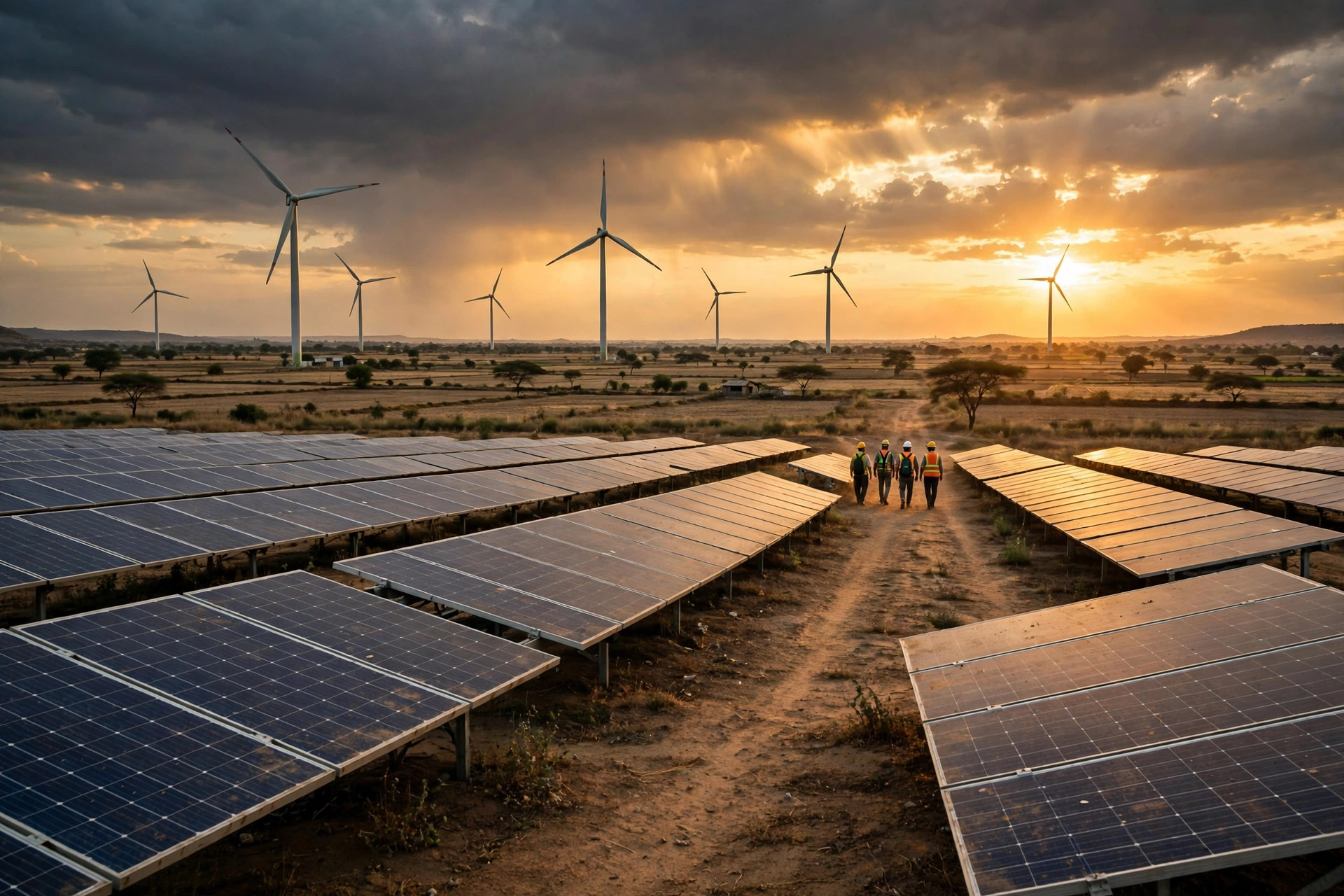
Amazon $7 billion renewable energy India investment is the company's biggest clean-energy commitment in the country so far. Amazon announced on 17 November that it will invest $7 billion in renewable energy in India by 2030, on top of $4 billion it has already contracted for clean power there. The money will fund four new utility-scale wind and solar projects with a combined capacity of 934 megawatts, and it will take Amazon's total renewable portfolio in India past 2 gigawatts — enough electricity, the company says, to power more than 3.5 million homes. For a country adding power demand faster than almost any other large economy, and for a company whose data centres and delivery network keep growing, the announcement is both a climate statement and a practical piece of infrastructure planning.
Amazon $7 Billion Renewable Energy India: The Four New Projects
The Amazon $7 billion renewable energy India plan centres on four projects that Amazon has now contracted, spread across three states. The largest single piece is a 234 MW wind farm in Karnataka, which Amazon describes as the largest wind project it has contracted anywhere in Asia. A second Karnataka project combines solar and wind capacity at 200 MW. The other two are solar farms: a 300 MW project in Madhya Pradesh and a 200 MW project in Rajasthan. Together they add up to 934 MW of new capacity, all of it utility-scale, which means the power is generated at large plants and fed into the grid rather than produced on rooftops. Each project was secured through a power purchase agreement, the long-term contract under which Amazon agrees to buy the electricity a plant produces. That structure matters because it gives developers the revenue certainty they need to build, and it gives Amazon a direct claim on new clean power rather than simply buying credits. Union Minister Pralhad Joshi welcomed the investment, a sign that the government sees corporate clean-energy spending as part of its own renewables push. The four projects are the headline, but the mechanism behind them — long-term contracts for new plants — is what turns an announcement into actual steel in the ground.
How the Projects Fit Amazon's Existing Portfolio in India
Amazon already has 57 renewable energy projects in India, according to the company, and the four new ones build on that base. Of the existing 57, fourteen are utility-scale projects and forty-three are on-site solar installations, the panels on rooftops at Amazon's own buildings. Once the new projects are running, the portfolio will exceed 2 GW of capacity. To put that in context, 2 GW is roughly the output of two large coal-fired power stations, except that it produces no smoke and its fuel — wind and sun — costs nothing once the plant is built. Amazon says the portfolio will generate enough electricity for more than 3.5 million homes, a figure that helps readers picture the scale but is worth reading carefully: it describes the portfolio's output in household terms, not a promise that 3.5 million specific homes will be connected to Amazon's plants. The electricity feeds the grid, and Amazon's operations draw from the grid, so the company's claim is about matching its consumption with new clean generation. Solar panels convert sunlight into electricity with no moving parts, which is one reason solar has become the cheapest new source of power in much of India, while wind farms in Karnataka's breezy interior add generation at times of day when the sun is not shining. The mix of wind and solar across three states is deliberate: different places, different weather, steadier combined output.
Why Amazon's Renewable Energy India Push Matters
The announcement also came with a new global goal. Amazon says it now aims to cut the carbon intensity of the electricity it uses by 65 percent by 2030 compared with 2019. Carbon intensity is a ratio — emissions per unit of electricity — and that distinction deserves attention. An intensity target can be met even while a company's total electricity use keeps rising, as long as each unit gets cleaner faster than consumption grows. Amazon's data-centre and logistics operations are expanding, so the 65 percent goal is ambitious, but it is not the same as a promise to cut total emissions by 65 percent. Readers should hold both ideas at once: the four new projects are real, additional clean capacity, and the intensity framing leaves room for total energy use to keep climbing. There is also a commercial logic that has nothing to do with climate messaging. Electricity is one of the largest running costs for cloud computing, and locking in power prices through long-term agreements protects Amazon against volatile energy markets. In India, where the government has set large national renewable targets, a company that contracts gigawatts of clean power also builds goodwill with policymakers — a practical consideration for a business that keeps expanding its Indian operations. Solar technology supply chains and costs are changing fast, and India's domestic manufacturing push means more of the panels in projects like these may be made locally in the coming years.
The Bigger Number: Amazon's $55 Billion India Commitment
The $7 billion figure sits inside a much larger total. According to PTI, the $7 billion is worth about 65,393 crore rupees, and it takes Amazon's total commitment to India through 2030 to $55 billion. That total includes a $13 billion artificial-intelligence and cloud announcement Amazon made in June, covering data-centre and cloud infrastructure. The distinction matters: the $7 billion is for renewable energy, while the $55 billion covers the company's whole Indian investment programme across e-commerce, cloud, AI and energy. Put together, the numbers describe a company deepening its bet on India on several fronts at once — selling to Indian consumers, renting computing power to Indian businesses, and now buying large volumes of Indian clean electricity to run it all. India's economy is growing fast, and its power demand is growing with it, so the commercial case for building generation close to that demand is straightforward. The announcement also fits a pattern of large technology companies signing some of the biggest clean-power deals in the world, because their data centres are among the largest single consumers of electricity anywhere.
What Happens Next for Amazon $7 Billion Renewable Energy India
The four projects now move from contract to construction, and the test of the announcement will be visible in the ground: turbines rising in Karnataka, panels laid out in Madhya Pradesh and Rajasthan, and the projects connecting to the grid over the coming years. Amazon has not given a project-by-project completion schedule in the announcement, so the 2030 date is the frame to watch — the $7 billion is a commitment to be invested by then, not money already spent. The company's 65 percent intensity goal will be measured against its 2019 baseline, and future sustainability reports will show whether the new capacity is bending that ratio fast enough. For India, the practical effect is four more large clean-energy plants in states that are already among the country's renewable leaders, and more evidence that corporate buyers are becoming a major force in financing new generation. For Amazon, the deal secures power for a growing Indian business at prices fixed years in advance. And for anyone tracking the energy transition, the announcement is a reminder of its scale: a single company's Indian clean-energy portfolio is now measured in gigawatts, and its investment is measured in billions.