
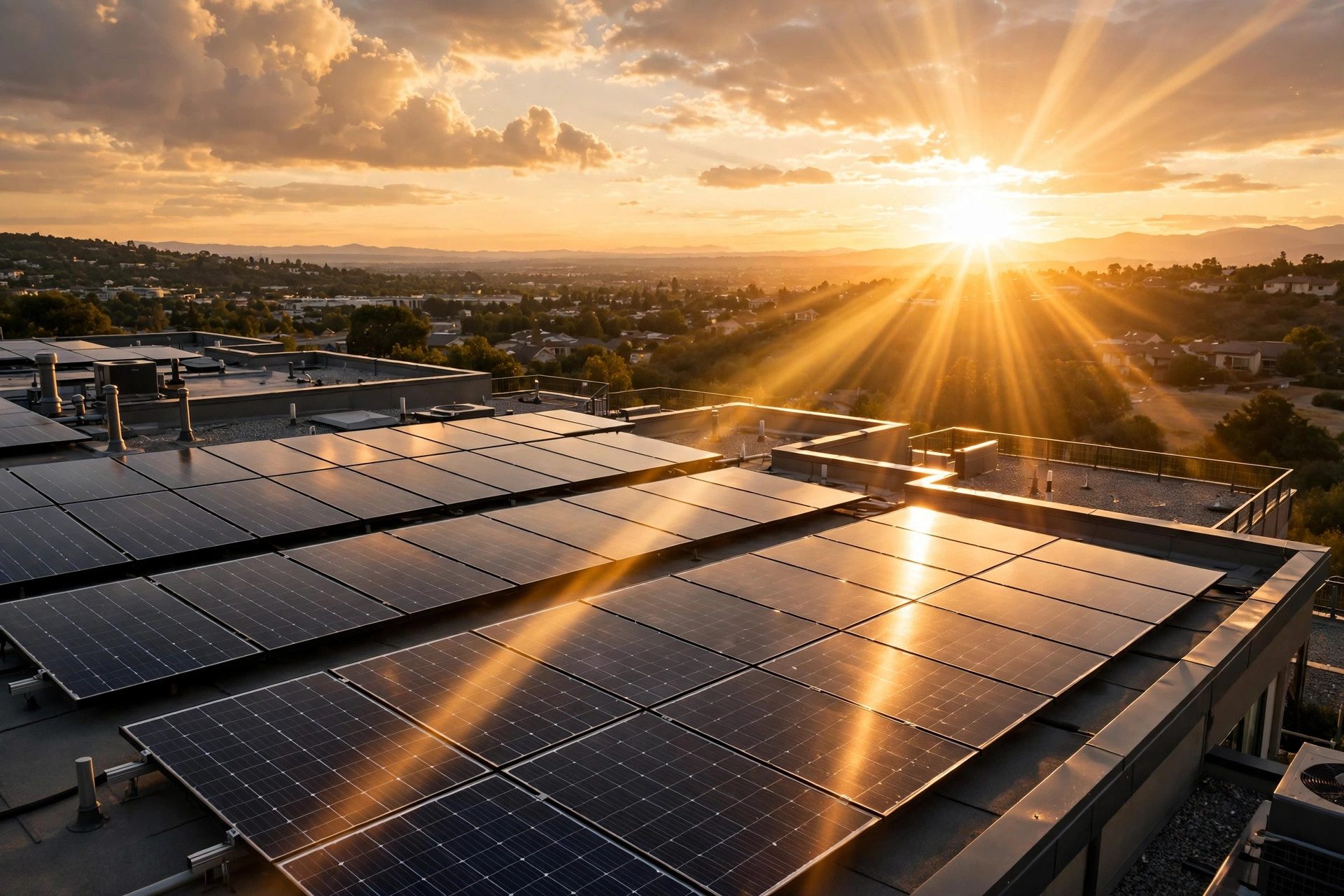
Solar panels generate electricity directly from sunlight with no moving parts and no emissions during operation. The core principle — the photovoltaic effect — was first observed in the 19th century, but practical solar cells only became widespread in recent decades as manufacturing costs fell dramatically.
This guide explains the photovoltaic effect in plain language, what's inside a solar cell, the different panel types, how inverters and batteries fit into a complete system, what affects output, and what installing solar actually involves. If you're interested in shrinking your environmental footprint, see our guide to reducing your carbon footprint.
The photovoltaic effect, explained simply
Most solar cells are made from silicon, a semiconductor — a material that conducts electricity better than an insulator but worse than a metal, which makes its behaviour precisely controllable. When particles of light (photons) strike the cell, they knock electrons loose from silicon atoms. An internal electric field, created by layering two specially treated types of silicon, sweeps these freed electrons in one direction — and a flow of electrons is an electric current.
Think of it like rain falling on a sloped roof: the photons are the rain, the electric field is the slope, and the electrons flow downhill into gutters (the cell's metal contacts) that carry them away as usable current. No fuel is burned, nothing moves, and nothing wears out in the process — which is why panels last so long.
Inside a solar cell
A standard cell is a thin silicon wafer, typically around 15–20 cm square, treated in two layers. The top layer is doped with phosphorus to create an excess of electrons (n-type silicon); the bottom layer is doped with boron to create electron "holes" (p-type silicon). Where the layers meet, the imbalance creates a permanent electric field — the p-n junction. Metal gridlines on the surface collect the flowing electrons, and an anti-reflective coating plus a glass cover maximize the light reaching the silicon while protecting it from weather.
Types of solar panels
Not all panels are built the same. The three main technologies differ in efficiency, appearance and cost:
| Type | How it's made | Typical efficiency | Best for |
|---|---|---|---|
| Monocrystalline | Cut from a single silicon crystal; distinctive dark colour with rounded cell corners | Highest (roughly 20–23%) | Rooftops where space is limited |
| Polycrystalline | Cast from multiple silicon fragments; blue, speckled appearance | Moderate (roughly 15–18%) | Budget installations with ample space |
| Thin-film | Photovoltaic material deposited in thin layers on glass or flexible backing | Lower (roughly 10–13%) | Large commercial roofs, portable or flexible uses |
Higher efficiency means more power from the same roof area — important when space is limited, less important on a large empty field.
From cells to complete systems
A single cell produces only a small voltage, so cells are wired together into modules (panels), and panels into arrays. Panels produce direct current (DC), but homes and grids use alternating current (AC), so an inverter converts the electricity. Mounting hardware, wiring, monitoring equipment and safety disconnects complete the system.
Inverters: the unsung heroes
The inverter is the system's brain as well as its translator. String inverters handle a whole row of panels together — simple and affordable, but one shaded or dirty panel can drag down the entire string. Microinverters attach to individual panels, so each panel operates independently; they cost more but perform better with partial shading and make it easy to monitor each panel. Power optimizers are a hybrid: small devices on each panel paired with a central inverter. Inverter warranties are typically shorter than panel warranties, so expect at least one inverter replacement over a system's life.
Batteries and energy storage
Panels only generate power when the sun shines, so storage determines how independent a system can be. Most grid-connected homes skip batteries: excess daytime power flows into the grid (often earning credits through net metering), and the grid supplies power at night. Batteries make sense where outages are common, where utilities charge much more for evening electricity, or for off-grid living. Modern lithium-based home batteries typically store enough for an evening's essential use, and their costs have fallen sharply — though they remain the priciest part of a system after the panels themselves.
What affects solar output
Output depends on sunlight intensity (stronger sun, more power), orientation and tilt (in the northern hemisphere, south-facing roofs tilted near the local latitude perform best), temperature (cells actually lose a little efficiency when very hot — solar loves light, not heat), shading (even partial shade from a chimney or tree disproportionately reduces output), and dirt or snow cover. Well-sited systems in sunny regions produce far more over a year than identical systems in cloudy northern locations — though panels still generate useful power on overcast days, typically 10–25% of their sunny-day output.
Installing solar: the basic process
A typical residential installation follows these steps: a site assessment (roof condition, orientation, shading analysis, electrical panel capacity); system design (sizing the array to the household's usage and goals); permits and approvals from local authorities and the utility; installation itself, usually one to three days for a home; inspection; and finally grid connection and activation. The paperwork phase often takes longer than the physical installation. Always get multiple quotes from certified installers and check references — quality of installation matters as much as quality of equipment.
Costs, savings and payback
Solar economics vary enormously by country, sunlight, electricity prices and available incentives — there is no single global payback figure worth quoting. The right way to evaluate it is: total installed cost after incentives, divided by expected annual electricity savings, adjusted for rising energy prices. Key variables include your current electricity rate (higher rates mean faster payback), how much of your usage falls in sunny hours, net metering rules, and whether you add a battery. Be sceptical of salespeople promising exact savings without studying your bills and your roof.
Maintenance and lifespan
Solar systems are famously low-maintenance: no moving parts means little to wear out. Panels typically carry 25-year performance warranties and often keep producing well beyond that, degrading very slowly (roughly half a percent of output per year for quality panels). Maintenance is mostly keeping panels reasonably clean — rain does most of the work in many climates — and occasionally checking that monitoring shows expected output. Inverters are the component most likely to need replacement, typically after 10–15 years.
Solar in the clean energy transition
Solar is now one of the fastest-growing energy sources worldwide, deployed both as rooftop systems and as utility-scale solar farms — and it's increasingly paired with electric vehicles, which can charge from daytime solar. Because sunlight is intermittent, grids combine solar with other sources, storage such as batteries, and demand management to keep supply reliable around the clock. Understanding climate change and its causes and solutions puts solar's role in perspective: it's one essential piece of a much larger transition, not a silver bullet on its own.