
Background
Solar energy has become the cheapest source of new electricity in much of the world, and the machines and recipes used to make solar panels are at the heart of that story. For more than a decade, China has dominated nearly every link in the solar manufacturing chain, from refining raw polysilicon to assembling finished modules. That dominance did not happen by accident. It was built through sustained industrial policy, enormous production scale, and, crucially, mastery of the manufacturing technologies that turn silicon and chemicals into high-efficiency solar panels. If you are new to how these devices work, our explainer on how solar panels work breaks down the basic science before you dive into the business of making them.
The technology at the centre of this story is the perovskite-silicon tandem cell. A conventional solar cell uses crystalline silicon, which has a physical limit to how much sunlight it can convert into electricity. A perovskite is a crystal structure made from relatively cheap materials that can be deposited as a thin film. Layer the perovskite on top of a silicon cell, and the combination — the "tandem" — captures a broader range of sunlight than either material could alone. In laboratories, these tandems have already pushed efficiencies toward and beyond 30 percent, a level traditional silicon panels cannot reach. Because higher efficiency means more power from the same rooftop or field, tandem technology is widely seen as the most important next step for the solar industry.
That is why the process of making these cells is so valuable. Knowing how to coat a perovskite film uniformly across a wafer that is at least 182 millimetres wide — the standard size for modern large-format panels — or how to apply that coating at industrial widths of 1.1 metres or more using a technique called slot-die coating, is a kind of industrial know-how that few companies outside China currently possess. Export controls do not target the panels themselves. They target the knowledge and the equipment: the production processes, the coating machines, and the engineering designs for large-scale polysilicon plants.
Export controls on technology are not a new tool in China's policy toolkit. In recent years, Beijing has steadily tightened oversight of outbound transfers of sensitive technologies, and it has been consulting more broadly on a catalogue of 40 technologies spanning solar energy, artificial intelligence and biotechnology. The solar proposals sit inside that larger consultation, which reflects a view in Beijing that high-technology leadership is a matter of national security. For readers interested in how governments manage technology competition, our explainer on US-China AI cooperation and rivalry offers useful context on how the same logic plays out in another strategic sector.
What Happened
On October 16, 2026, China's Ministry of Commerce and Ministry of Science and Technology jointly published a proposal known as Joint Announcement No. 48. The announcement proposes adding 12 photovoltaic manufacturing technologies to China's official catalogue of export-controlled technologies, citing national security concerns. As reported by Reuters, pv magazine and The Hindu BusinessLine, the proposal is open for public consultation until November 15, after which the catalogue could be formally updated.
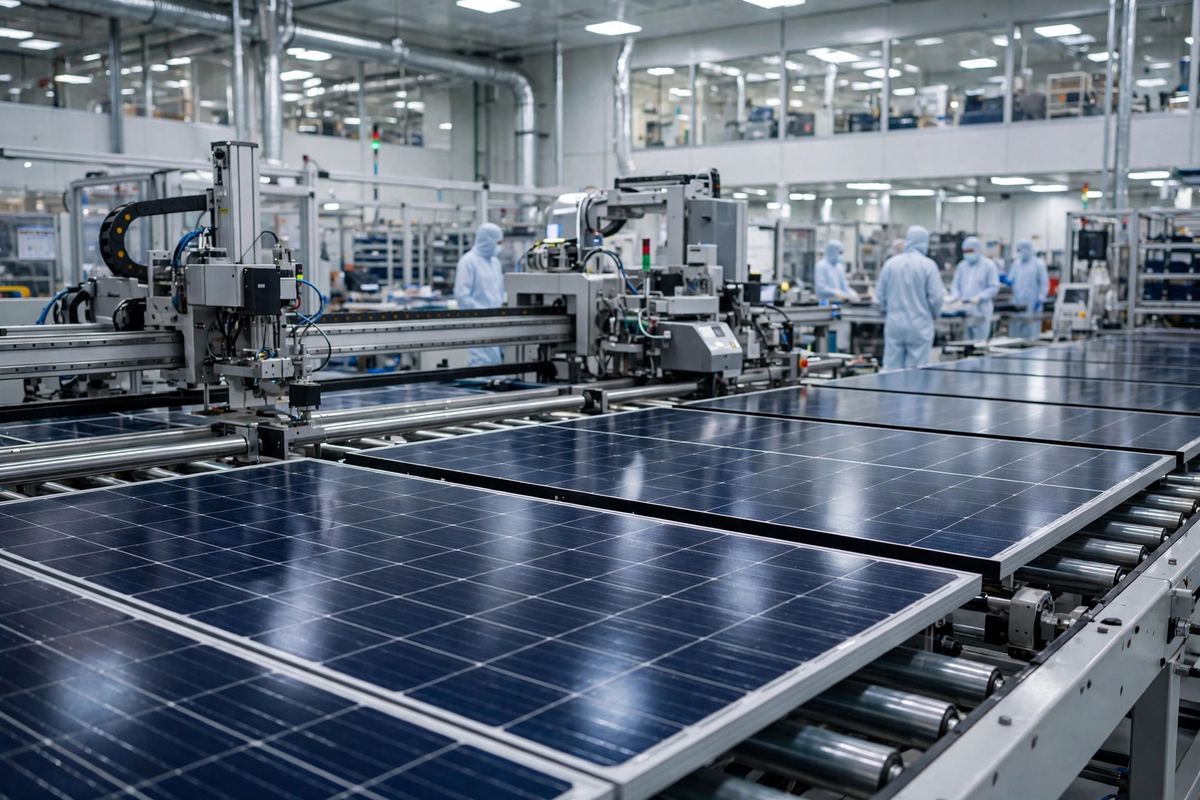
The proposed bans cover the most advanced parts of next-generation solar manufacturing. Production processes and equipment for perovskite-silicon tandem solar cells would be prohibited from export when they involve wafers at least 182 millimetres wide and efficiencies of 30 percent or more. Slot-die coating processes at widths of at least 1.1 metres — the industrial-scale technique used to deposit uniform perovskite films — would also be banned. These are not materials or finished products. They are the factory-floor capabilities that let a company build a modern high-efficiency solar line.
A second tier of the proposal covers established but critical upstream technology. Large-scale fluidized-bed polysilicon production technology and polysilicon engineering technology for production lines with annual capacity of 30,000 tonnes or more would become "restricted" rather than banned. Restricted status means exports would require government approval on a case-by-case basis, rather than being forbidden outright. Polysilicon is the ultra-pure raw material at the base of the entire solar supply chain, so control over the engineering know-how for giant refining plants gives Beijing leverage over the industry's foundation, not just its cutting edge.
Importantly, the controls are not yet law. During the consultation window, the announcement requires exporters to register certain overseas technology transfers, creating a record of deals that could later fall under the rules. Companies and foreign buyers are now watching whether the final catalogue, expected after the November 15 consultation closes, keeps the proposal intact or softens some of its provisions. Consultations of this kind sometimes narrow the scope in response to industry feedback, though they can also be finalised exactly as proposed.
Why It Matters
The proposal matters first because of what it signals about Beijing's intentions. China's stated rationale is that solar technology is increasingly used in aerospace and national defence applications, which brings it within the scope of national security. But the practical effect described in news coverage is the preservation of China's dominance in solar manufacturing. By restricting the export of the processes and equipment needed to make the most advanced panels, Beijing can slow the ability of other countries to catch up — even as demand for high-efficiency panels keeps growing worldwide.
India is one of the countries most directly affected. New Delhi has been pushing hard to localise solar manufacturing, aiming to reduce its dependence on imported Chinese cells and modules and to build an export-capable domestic industry of its own. India is also one of the fastest-growing major economies — see our report on the IMF's 7 percent growth forecast for India — and its energy ambitions are large. If Chinese authorities can now delay or complicate the licensing of key manufacturing technologies, Indian manufacturers trying to set up perovskite tandem lines or expand polysilicon capacity could face longer timelines, higher costs, or forced detours toward alternative suppliers and homegrown research.
The United States faces a different but related exposure. American firms have announced plans to expand solar manufacturing at home, part of a broader effort to rebuild domestic supply chains for clean-energy hardware. One widely noted example in news coverage is Tesla's planned US production expansion. If US companies need Chinese equipment or process licences to build advanced tandem-cell lines, export controls could force them to redesign plans, seek non-Chinese technology partners, or wait out licensing decisions. Either way, the cost and complexity of building domestic capacity rises.
The effects will not stop at factory gates. Solar panels have become cheap largely because of relentless manufacturing scale and incremental technology improvement, much of it in China. Any measure that slows the global spread of next-generation manufacturing know-how risks slowing the pace at which high-efficiency panels reach the market, which could in turn affect how quickly solar costs fall in the years ahead. For developing economies that depend on affordable imported equipment to expand electricity access, even modest frictions in technology transfer can have outsized consequences.
Key Facts
Here are the essential facts, drawn from news coverage of the proposal:
The proposing authorities are China's Ministry of Commerce and Ministry of Science and Technology. The instrument is Joint Announcement No. 48, published October 16, 2026. The number of photovoltaic technologies proposed for the export-control list is 12, and the broader consultation covers 40 technologies across solar, artificial intelligence and biotechnology. The stated justification is national security, with solar technology described as increasingly used in aerospace and national defence.
The proposed bans apply to production processes and equipment for perovskite-silicon tandem solar cells using wafers at least 182 millimetres wide with efficiencies of 30 percent or more, and to slot-die coating processes at widths of at least 1.1 metres. The restricted category covers large-scale fluidized-bed polysilicon production technology and polysilicon engineering technology for lines with annual capacity of 30,000 tonnes or more.
Until the catalogue is formally updated, exporters must register certain overseas technology transfers. The public consultation closes on November 15, 2026. Coverage of the proposal has appeared in Reuters, pv magazine and The Hindu BusinessLine.
What Happens Next
The immediate timeline is set by the consultation deadline of November 15. Between now and then, industry groups, foreign governments and affected companies can submit comments, and Chinese authorities will decide whether to adjust the proposal. Observers will be watching for any narrowing of the thresholds — for example, a higher efficiency cutoff or exemptions for certain partner countries — as well as for how the registration requirement is enforced in the interim.
Countries hoping to localise advanced solar manufacturing have three broad options. They can negotiate for licences where the restricted category allows them, which trades time and uncertainty for access to proven technology. They can invest in independent research and equipment development, which is slower but builds genuine self-reliance — a path India has already been signalling interest in. Or they can partner with equipment makers outside China, accelerating a trend toward diversified supply chains that predates this announcement. The automotive world's own supply-chain stories, such as Tesla's ambitious production plans, show how high-technology companies continually weigh dependence against independence when policy shifts.
For the solar industry as a whole, the proposal adds a geopolitical layer to what was already a competitive technology race. Perovskite tandems were supposed to be the next shared leap forward in panel efficiency. If the know-how to manufacture them at scale becomes a controlled strategic asset, the race splits: those with access move fast, and those without must find another route. That is precisely the kind of fragmentation that trade and energy analysts warn can raise costs and slow the global energy transition.
There is also a diplomatic dimension. Export controls of this kind typically invite responses, whether through trade negotiations, countervailing industrial policies, or coordination among importing countries. How Washington, New Delhi and Brussels react — and whether the issue becomes part of broader technology-trade bargaining — will shape whether Joint Announcement No. 48 becomes a footnote in a consultation or a lasting feature of the global solar market. What is already clear is that solar manufacturing, once treated mainly as a climate and business story, is now firmly part of the strategic-technology landscape, alongside semiconductors and artificial intelligence.
Sources: Reuters, pv magazine, The Hindu BusinessLine — October 2026