
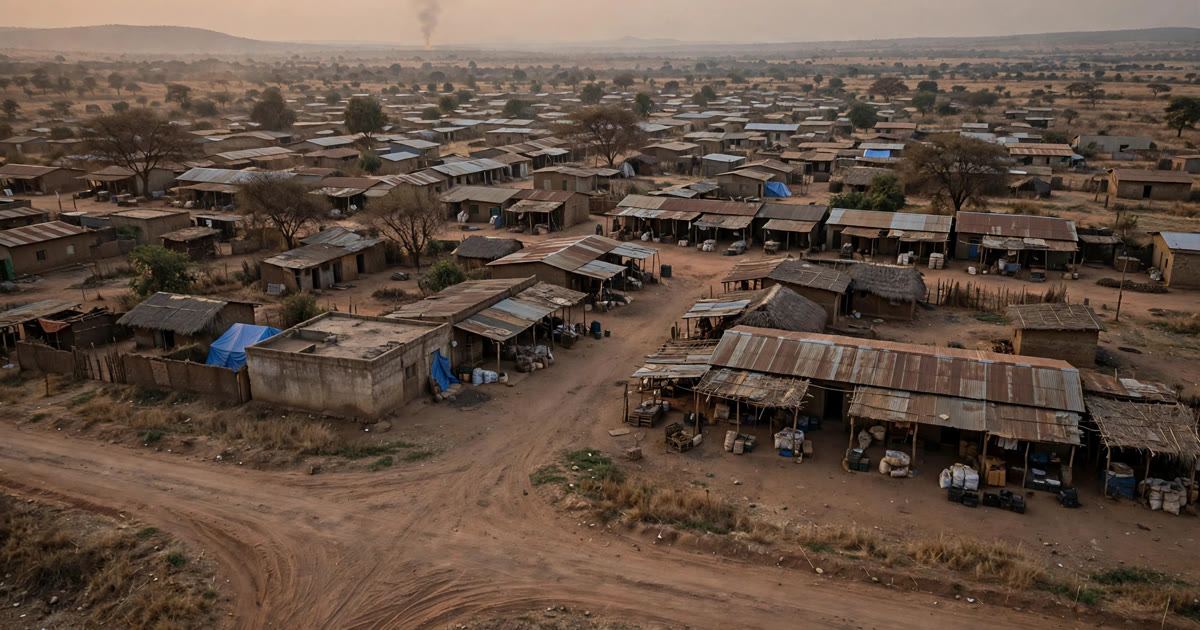
A drone strike on a crowded market and nearby fuel depot in the disputed Abyei region has become one of the deadliest incidents of Sudan's civil war — with at least 153 people reported killed and a rising international backlash. The story is trending per news coverage after the United Nations secretary-general strongly condemned the attack and warned that Sudan's war risks spreading into a wider regional crisis.
The strike hit Amiet Market, also known as Al-Naam, north of the town of Abyei, on the morning of Monday, October 19. According to Abyei's caretaker information minister, Yohanna Akol Ngor, the attack ignited a massive fire at the market and an adjacent fuel depot that was still burning days later, complicating rescue and recovery efforts. Ngor told The Associated Press that some bodies had been burned beyond recognition and warned the death toll could climb further because many people remain missing.
Independent verification of the exact casualty figure has been difficult. Local officials put the death toll at 153. A later account from the same local official, reported by Eye Radio, cited two mass graves and a toll of 226; that higher figure has not been independently verified. The United Nations has been more cautious. In a briefing on October 21, UN spokesperson Stephane Dujarric said the UN Interim Security Force for Abyei (UNISFA) had confirmed at least 80 people killed, with 27 injured people treated by UN personnel — and stressed the figures were still being verified as many victims remained unaccounted for. Doctors Without Borders (MSF) said its teams received more than 20 wounded people, several with severe burns, at Ameth Bek hospital, working alongside South Sudan's health ministry. Local officials also reported that around 8,000 people fled the area toward the town of Abyei and its surroundings in search of protection, appealing to humanitarian agencies for urgent assistance.
Who carried out the strike remains disputed — and the competing claims are a study in the fog of Sudan's drone war. Abyei and South Sudanese officials blamed the Sudanese Armed Forces (SAF). A senior Sudanese military officer, speaking anonymously to the AP because he was not authorized to talk to the press, said the army had carried out the strike on fuel tankers arriving from South Sudan that he said were bound for the Rapid Support Forces (RSF), characterizing those killed as RSF members and people involved in fuel smuggling. The AP said it could not independently verify his account. The United Nations, in its condemnation, pointedly did not identify who carried out the attack. Sudan's government subsequently denied involvement.
The UN's response has been the sharpest international reaction to the strike. Secretary-General António Guterres said in a written statement on October 20: "I strongly condemn the drone attacks in the Abyei area on 19 October that killed dozens of civilians, including women and children, near Amiet Market and Todach, and injured many others." He added that the toll was expected to rise as UNISFA continued verifying casualties, and reminded all parties that attacks targeting civilians and civilian infrastructure are prohibited under international law and that accountability would be needed. He also called on the governments of Sudan and South Sudan to take all steps possible to prevent further attacks and uphold Abyei's demilitarized status.
On the ground, UNISFA deployed medical personnel, firefighting capabilities and quick reaction forces to treat the wounded, evacuate casualties and stop the fire from spreading. Dujarric said the mission's peacekeepers extinguished the major fires at Amiet Market and Todach, doubled its patrols in the affected areas to deter further violence, and began engaging community leaders to encourage restraint and prevent retaliation. UN Mine Action personnel are assessing the area for unexploded ordnance, and the mission is engaging both governments on de-escalation, including through an upcoming Joint Political and Security Mechanism meeting scheduled in Khartoum.
The attack has also strained relations between the two Sudans. South Sudan summoned Sudan's ambassador to Juba, Essam Mohamed Karrar, on October 19 to deliver a formal protest. Its Foreign Ministry said it conveyed "strong protest and deep concern" over the attack, warning that the strike severely threatens civilian security and the fragile stability of the Abyei region. Meanwhile, the UN's envoy for Sudan was speaking to international broadcasters after an emergency international meeting on the escalating crisis, as the UN warned of the war's wider regional toll.
Abyei is one of the most contested places in Sudan — and understanding that is key to understanding why this strike matters so much. The oil-rich territory, a flashpoint of grazing land and deposits, is claimed by both Sudan and South Sudan, and its political status was never resolved after the 2005 peace agreement that led to South Sudan's independence. UN peacekeepers have been stationed there since 2011 under the UNISFA mission. When Sudan's civil war erupted in April 2023 between the SAF and the RSF, Abyei's disputed status turned it into a strategic corridor — a market and fuel hub connecting communities across the border, including fuel flows that both armies consider militarily significant.
The Abyei strike fits a grim pattern: the drone war has become the engine of Sudan's violence. An Al Jazeera investigation drawing on ACLED data counted at least 1,003 drone strikes between April 2023 and January 2026, and the UN human rights office documented more than 1,000 civilians killed by drone strikes between January and May 2026 alone — about 80 percent of all conflict-related civilian deaths it recorded in that period, including strikes on health facilities and markets. This month's wave has been particularly lethal: recent drone attacks killed 23 people at a market in Nyala on October 16 and more than 80 in RSF-controlled West Kordofan on October 18, while drones also targeted army-held Khartoum International Airport. The Abyei attack, on a market deep in disputed territory, marks a dangerous escalation of that pattern across borders — echoing the wider drone warfare that has defined recent months, from Sudan's widening drone attacks to the Houthi missile strike on Riyadh airport and the Strait of Hormuz tanker crisis.
That is why the UN's framing matters. The secretary-general's condemnation, the peacekeeping mission's heightened posture, the summoning of an ambassador and the envoy's emergency meeting all point in the same direction: the Abyei strike is being treated not as an isolated incident but as a sign that Sudan's war is becoming a regional one. With the US ordering embassy departures from the Gulf and a shadow-tanker blockade choking Iranian oil, the region is already on edge. Whether Abyei's missing are ever found, and whether the accountability Guterres demanded ever arrives, the market fire has done what little else could — forced the world to look at Sudan again.
For now, the casualty count is still moving, the fire is out, and the questions are multiplying: who ordered the drones, why a market, and what stops the next one. The answers, as the UN's own investigators acknowledge, may take weeks to verify. What is not in doubt is the scale — and the fact that it is trending per news coverage as one of the gravest moments yet in a war the world has largely watched from a distance.
Sources: Reuters, Associated Press, UN press release SGSM23339, UN media briefing October 21, France 24, The Eastleigh Voice, Doctors Without Borders, Al Jazeera, BBC.
Elsewhere in Sudan's war, a BBC investigation concluded that RSF forces deliberately targeted hospitals in El-Fasher, drawing UN warnings of possible war crimes.