
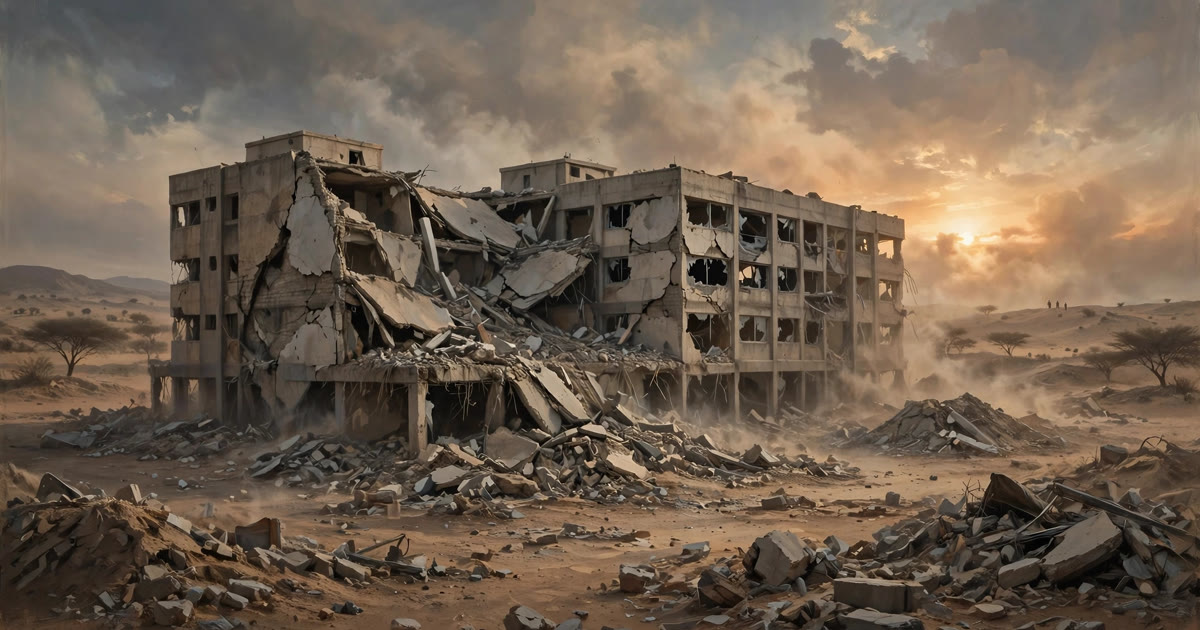
A landmark BBC investigation published on October 22, 2026 has found evidence that Sudan's paramilitary Rapid Support Forces (RSF) deliberately and systematically destroyed the healthcare system of el-Fasher, the Darfur city the group besieged and captured a year ago. Drawing on accounts from people who were inside the city during the siege, the BBC documented at least 43 separate attacks on hospitals and health sites between May 2024 and October 2025, recording that 55 medical workers were killed, 120 injured and 10 abducted or forcibly disappeared.
The findings have drawn a stark response from the United Nations. UN human rights chief Volker Türk described the investigation's conclusions as "deeply disturbing," saying the repeated RSF attacks on civilian infrastructure — including health facilities — were serious violations of international humanitarian law and may amount to war crimes. The World Health Organization said el-Fasher represents "one of the clearest and most severe examples" of the conflict's wider impact on healthcare in Sudan.
How the attacks unfolded
Doctors who worked through the siege described a pattern that appeared to follow the care itself. After shelling forced services out of the Teaching Hospital, medical teams relocated to the South Hospital — which was shelled in late May and early June 2024 and then raided on June 8, forcing its closure. The teams moved again, this time to the Saudi Maternity Hospital, which was struck repeatedly, at times multiple times in a single day. A children's hospital was shelled at two successive relocation sites, and a dialysis centre was hit again after it moved.
Medical staff tried to keep operating despite the onslaught: sandbagging buildings, constructing underground treatment spaces out of steel containers, and setting up alternative wards in any structure still standing. But by the time the RSF seized el-Fasher in October 2025, the BBC reported, only one hospital — the Saudi Hospital — was still functioning in the entire city.
The investigation's bleakest account concerns October 25, 2025, when RSF fighters stormed the Saudi Hospital amid reports that more than 460 patients and companions were killed inside. The RSF denied that account, and the WHO publicly condemned the reported killings.
"Deliberate, intense and planned"
Dr. Muhamed Suliman, a surgeon who remained in el-Fasher during the siege, told the BBC that the RSF aimed to evacuate hospitals and render them non-functional — describing their actions as intense, deliberate, and planned. The investigation found that some facilities were struck over and over, even after medical teams had evacuated patients to new locations.
International law prohibits attacks on medical facilities and healthcare workers during armed conflict. Under the rules of war, hospitals enjoy special protection — protection that is only lost if a facility is used to commit an "act harmful to the enemy," such as serving as a military base.
The RSF's rejection
The RSF has firmly rejected the BBC's findings. The group's health minister, Dr. Alaa Eldin Nugud, described the investigation as propaganda and a deliberate attempt by Sudan's national army and its allies to smear the RSF's reputation. He insisted the South Hospital had been used as a military base, telling the BBC that missile launchers had been set up on its grounds, and shared video of weapons remains filmed more than a year after the hospital closed.
Doctors who worked in el-Fasher during the war denied that the hospital had been incorporated into a military base, saying they had visited the site during the conflict to collect medical equipment. The BBC said it found no independent evidence supporting Dr. Nugud's claim, and the Darfur regional government categorically rejected the allegations.
The siege of el-Fasher: how a city was cut off
El-Fasher, the historic capital of North Darfur, was one of the last major cities in the region not under RSF control when the siege tightened in mid-2024. The city had become a refuge for hundreds of thousands of displaced people fleeing fighting elsewhere in Darfur. With supply routes cut, food prices soared, aid convoys were blocked or attacked, and humanitarian agencies warned of famine conditions in the city's displacement camps.
The deliberate destruction of the healthcare system documented by the BBC amplified every other dimension of the crisis. In a city facing shelling, hunger and disease, the closure of hospital after hospital meant that treatable injuries and illnesses became death sentences. The investigation notes that staff moved patients from facility to facility as each was hit — a macabre circuit that ended when the Saudi Hospital, the last one standing, was stormed on October 25, 2025.
The fall of el-Fasher in October 2025, a year before this investigation's publication, completed the RSF's control of Darfur's five states. The city had held out longer than any other Darfur capital, and its capture was seen as a turning point in the war. The BBC's reconstruction of the hospital campaign adds a grim new dimension to that history — suggesting the dismantling of civilian infrastructure was not collateral damage but strategy.
The wider war in Sudan
El-Fasher's destruction is one chapter in Sudan's civil war, which erupted between the RSF and the Sudanese Armed Forces in April 2023. The conflict has produced one of the world's worst humanitarian crises, with millions displaced and famine conditions reported in parts of Darfur. Earlier this month, a wave of drone attacks killed more than 160 people as strikes hit markets, dams and displacement camps — underscoring how civilians remain the primary victims of the war.
Both sides in the conflict have faced accusations of attacking health facilities. In March 2026, the WHO condemned the bombing of al-Daein hospital in eastern Darfur, an attack that killed dozens and forced the facility to close. The Sudanese military is believed responsible for drone strikes in that area, though it denied involvement.
The BBC's investigation matters because deliberate attacks on hospitals are among the most serious allegations in international humanitarian law. Türk emphasized that his assessment is not a court judgment — but his warning that the strikes may amount to war crimes raises the possibility of future accountability proceedings, whether through international tribunals or national courts. For now, calls are growing for an independent international investigation into the RSF's actions, with the UN and human rights organizations expected to take up the crisis in the coming weeks.
Sources: BBC News investigation (October 22, 2026); United Nations Office of the High Commissioner for Human Rights; World Health Organization.