
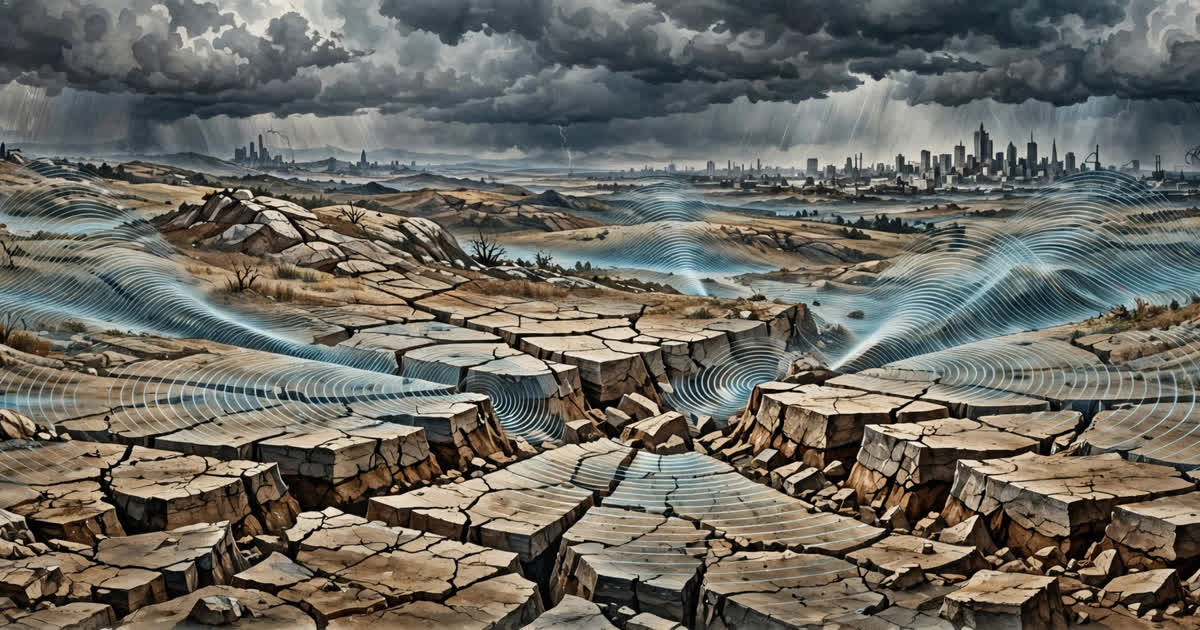
What would a 9.9 earthquake look like? Nobody has ever seen one, and according to the United States Geological Survey (USGS), no fault known to exist on Earth is long enough to produce one. But the question keeps trending, because the largest earthquake ever recorded — the magnitude 9.5 Valdivia earthquake that struck Chile on 22 May 1960 — came close enough to make people wonder what one more step up the scale would do. This article answers that question with science, not science fiction: what a hypothetical 9.9 earthquake would look like, why it almost certainly cannot happen, and what the biggest real earthquakes teach us about it.
First, a warning about the numbers. Magnitude is not like a ruler. The moment magnitude scale is logarithmic, which means each whole-number step represents roughly 32 times more energy released. A magnitude 9.9 earthquake would therefore release about four times the energy of the 9.5 Chile earthquake — an event that already reshaped coastlines and sent a tsunami racing across the entire Pacific Ocean. The scale itself has no mathematical ceiling, but planet Earth does: faults only grow so long, and that length sets the limit.
What would a 9.9 earthquake look like in the first minutes?
If a 9.9 earthquake ever began, the first thing people near the epicentre would notice is that the shaking does not stop. The 1960 Chile earthquake shook for around ten minutes. A 9.9 rupture, unzipping a fault far longer than Chile's, would shake for much longer — some estimates for a magnitude 10 event run to around 30 minutes of shaking. Standing would be impossible near the epicentre. Roads would split open, railway lines would bend, and in the strongest shaking zone, classified as intensity XII on the Modified Mercalli scale, objects would be thrown into the air and almost nothing built by humans would stay standing.
The ground itself would behave strangely. In water-saturated soil, a phenomenon called liquefaction can make solid ground flow like a liquid, tilting and sinking buildings that survived the shaking itself. Hillsides would collapse in landslides, rivers could change course, and sand and water would erupt through cracks in the earth. These effects are not invented: they were all documented in real magnitude 9 earthquakes, and a 9.9 earthquake would simply produce them on a larger scale and over a wider area.
How much bigger is 9.9 than the largest real earthquake?
The record book makes the gap clear. The largest earthquake ever recorded is the magnitude 9.5 Chile earthquake of 1960, on a fault the USGS describes as almost 1,000 miles long. Next come the magnitude 9.2 Alaska earthquake of 1964, the magnitude 9.1 Sumatra earthquake of 2004, and the magnitude 9.1 Tohoku earthquake of 2011. A 9.9 earthquake would need a rupture longer than any of these — longer, in fact, than any known fault on Earth. The USGS puts it bluntly: no fault long enough to generate a magnitude 10 earthquake is known to exist, and if one did, it would extend around most of the planet.
The physics explains why. Moment magnitude is calculated from seismic moment, which is the rigidity of the rock multiplied by the fault area multiplied by the average slip. To reach 9.9, you need a fault area and a slip far beyond anything a plate boundary on Earth can offer. In Chile in 1960, the fault slipped by tens of metres in places. A 9.9 earthquake would need a comparable slip across a much longer fault — and no plate boundary on the planet is that long and that ready to move at once.
What would a 9.9 earthquake look like on the coast? The tsunami
If the rupture happened under the ocean, the tsunami would be the disaster that travelled furthest. The 1960 Chile tsunami crossed the entire Pacific, killing people in Hawaii and Japan many hours after the shaking stopped. The 2011 Tohoku tsunami produced run-up heights of around 40 metres in the worst-hit places. A 9.9 earthquake, displacing a longer stretch of seafloor, would push even more water: an ocean-wide tsunami, with dangerous waves arriving on distant shores for many hours, not just one wave but a series of them.
There is one natural warning sign worth knowing. If the sea suddenly pulls far back from the shore after an earthquake, exposing the seabed, a tsunami may be minutes away. The correct response is to move immediately to high ground on foot — never to walk out onto the exposed seabed to look. Tsunami warning centres now cover the Pacific and other oceans, but for coastlines near the epicentre, the shaking itself is the warning, and there may be only minutes to act.
Could a 9.9 earthquake happen anywhere on Earth?
Only subduction zones — places where one tectonic plate dives beneath another — can host the biggest quakes, and even they have limits. Chile and Peru, Alaska and the Aleutians, Japan, Sumatra and the Cascadia zone off North America's Pacific coast are the usual candidates. Models put Cascadia's maximum at around magnitude 9.3. Strike-slip faults, like California's San Andreas, cannot do it at all: USGS models cap the San Andreas at around magnitude 8.3, because that kind of fault does not store energy the same way.
So the honest answer to "can a 9.9 earthquake happen" is: almost certainly not on any fault we know. Scientists add one careful caveat. Instrumental earthquake records cover only about a hundred years, which the USGS calls a blink of an eye in geologic time, so experts cannot rule out every extreme with absolute certainty. But nothing in the geology of Earth's plate boundaries suggests a 9.9 earthquake is waiting to happen. It is a hypothetical event, useful for understanding the scale — not a forecast.
What would a 9.9 earthquake look like days and years later?
The disaster would not end when the shaking stopped. Giant earthquakes are followed by strong aftershocks for months, and in the case of the largest events, for years. Coastlines would be permanently changed: in 1960, parts of Chile's coast were raised or lowered by metres in a single day, stranding harbours and drowning farmland. The whole planet would ring like a bell — after the 2004 Sumatra earthquake, seismometers worldwide recorded the Earth's free oscillations for days — and a 9.9 earthquake would ring it harder and longer.
The human and economic toll would be enormous, but putting a precise number on it would be guesswork, and this article will not guess. What can be said honestly is that a disaster on this scale would overwhelm the emergency services of any single country, would disrupt shipping, trade and communications across an ocean basin, and would be studied by scientists for generations.
How to prepare for the biggest real earthquakes
A 9.9 earthquake may be hypothetical, but magnitude 9 earthquakes are real, and the preparation is the same. If you feel strong shaking, drop, cover and hold on under a sturdy table until it stops. If you are on the coast and the shaking is strong or long, move to high ground immediately — do not wait for an official warning. Keep an emergency kit with water, food, medicines and a radio, and know your local evacuation route before you need it. Earthquake early-warning systems in countries like Japan, Mexico and parts of the United States can give seconds to tens of seconds of warning: enough time to stop a train, duck under a desk, or step away from windows. The countries best protected against giant quakes — Chile and Japan above all — earned that protection through strict building codes and regular drills, not luck.
Sources: USGS, "Can MegaQuakes really happen? Like a magnitude 10 or larger?"; USGS, "Earthquake Magnitude, Energy Release, and Shaking Intensity"; USGS, "Magnitude and intensity: measures of earthquake size and severity". Related reading: Kamchatka earthquake, Tibet earthquake, Panama earthquake and tsunami threat, Chile earthquake alerts guide.