
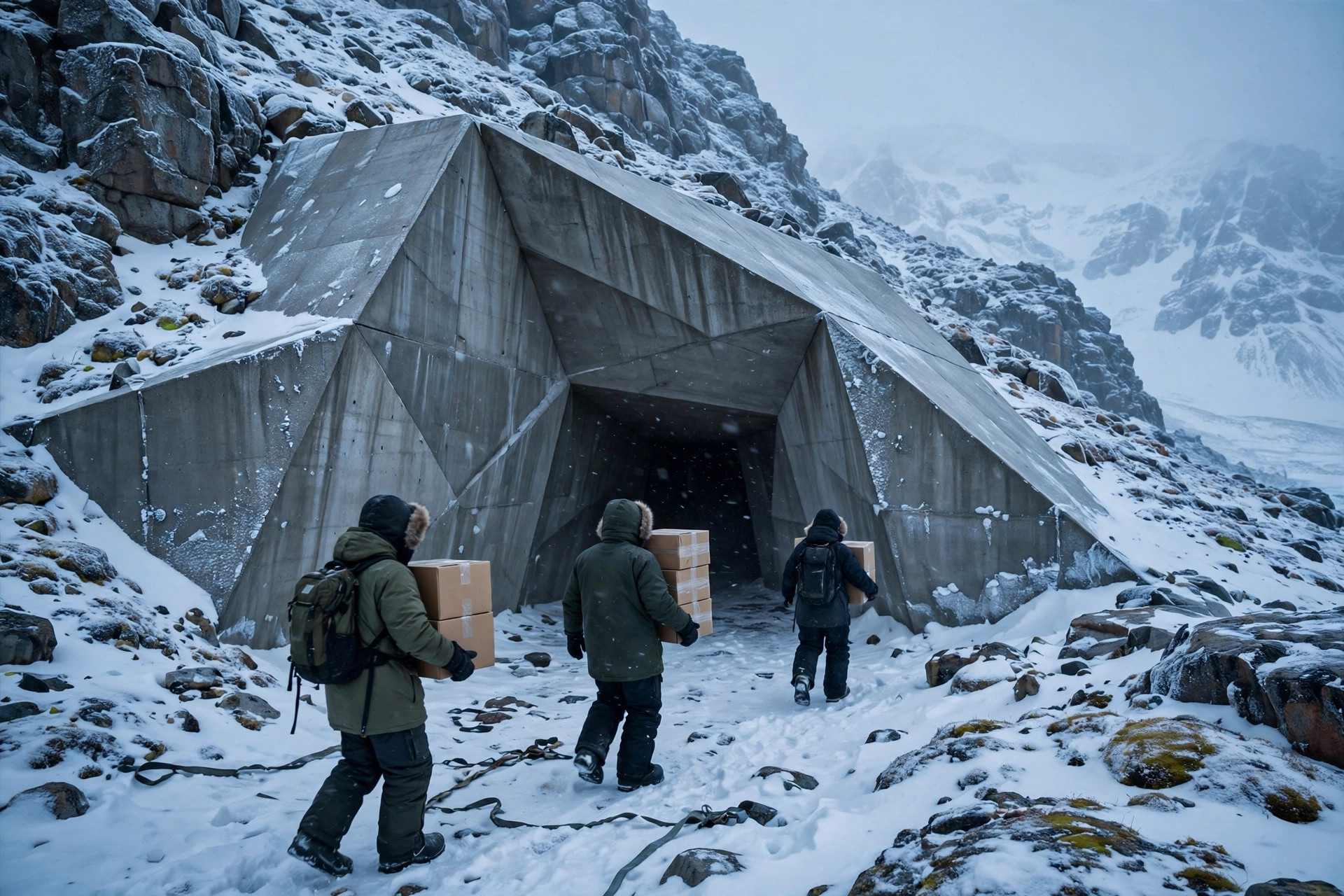
The Svalbard Global Seed Vault has added more than 16,000 seed samples to its Arctic collection, after 21 genebanks from four continents took part in the final deposit of 2026 on 13 October. Among them was Ukraine's national genebank, which deposited 773 seed samples, including buckwheat, sunflower and cereals, in its first shipment to the vault since the war began. The deposit, announced by Norway's government, the Crop Trust and NordGen, is a reminder of what the vault is for: a backup copy of the world's crop diversity, held in a mountainside on a Norwegian Arctic island, so that no war, disaster or accident can erase the seeds that future food depends on.
The Svalbard Global Seed Vault works like a safety deposit box. Genebanks around the world send duplicate samples of their unique collections to Svalbard free of charge, and the seeds remain the property of the depositing institution. The vault now holds more than 1.4 million seed samples belonging to over 130 genebanks, making it the world's largest secure repository for the diversity of cultivated crops. It is established and funded by the Norwegian government, and operated in partnership with NordGen and the Global Crop Diversity Trust, with guidance from an international advisory council.
This October deposit was the last of 2026, and it carried a particular resonance. Ukraine is often called the breadbasket of Europe, and its national genebank collection, maintained by the National Academy of Agrarian Sciences, contains more than 150,000 seed samples according to the Food and Agriculture Organization. After Russia's full-scale invasion in 2022, the genebank in Kharkiv faced bombing damage, and its collection was relocated to western Ukraine with support from FAO, the Crop Trust and NordGen, funded in part by the Novo Nordisk Foundation. That a wartime shipment of 773 samples could be prepared and sent to the Arctic at all is, in the words of Ukraine's ambassador to Norway, an investment in the resilience of Ukrainian agriculture and a contribution to global food security for future generations.
What the Svalbard Global Seed Vault deposit included
The Svalbard Global Seed Vault deposit in October 2026 was notable for its breadth. Six international genebanks of the CGIAR, the global agricultural research partnership, contributed 8,917 samples between them. The largest single contribution came from CIMMYT in Mexico, which deposited 3,370 samples of common, durum and emmer wheats, triticale and maize. Ukraine's 773 samples included buckwheat, sunflower, cereals and forage crops. Italy joined as a new depositor, with the Council for Agricultural Research and Economics depositing historic wheat and rice varieties.
Each sample in the vault is a duplicate of a sample held in a genebank collection elsewhere. That duplication is the whole point. If a genebank's own collection is lost to war, fire, flood or funding collapse, the Svalbard copy can be withdrawn and used to rebuild it. The vault has been used for exactly that purpose before: in 2015, seeds were withdrawn to re-establish a genebank collection that had been based in Aleppo, Syria, and moved to Lebanon and Morocco. The system is designed for emergencies that no one can predict, which is why the deposit of seeds that may never be needed is treated as seriously as the deposit of seeds that will.
The ceremony on 13 October was attended by a Ukrainian delegation including representatives of the genebank and the FAO office, as well as Ukraine's ambassador to Norway, Oleksiy Gavrysh, and Karen Ellemann, secretary general of the Nordic Council of Ministers. Norway's agriculture minister, Nils Kristen Sandtroen, said the deposit demonstrated that the vault's founding vision, a secure safeguard for the world's crop diversity and a shared resource for humanity, was more relevant than ever. NordGen director Lene Krol Andersen called it a powerful reminder of why the vault exists.
Why the Svalbard Global Seed Vault matters for food security
Crop diversity is the raw material of food security. The varieties that feed the world today were bred from thousands of traditional varieties and wild relatives, each carrying traits for drought tolerance, disease resistance, yield or nutrition. As climates shift and new pests emerge, breeders need that diversity to develop crops that can survive conditions their predecessors never faced. When a variety is lost, the traits it carried are lost with it, permanently. The vault's role is to make that loss as unlikely as possible.
The October deposit illustrates the point concretely. Historic Italian wheat and rice varieties carry traits shaped by centuries of Mediterranean farming. Ukrainian buckwheat and sunflower varieties carry traits shaped by the black earth soils of eastern Europe. CIMMYT's wheats and maizes underpin breeding programmes across the developing world. None of these samples is individually famous, but together they represent a library of genetic options that plant breeders can draw on for decades. The vault's cold, dry, permafrost-cooled chambers are designed to keep those options viable for centuries, with seeds stored at minus 18 degrees Celsius.
The deposit also comes ahead of a moment of recognition: the Svalbard Global Seed Vault is the recipient of the 2026 Princess of Asturias Award for International Cooperation, with the ceremony due at the end of October. The vault's partners have directed the 50,000 euro prize money to the Emergency Reserve for Genebanks, a fund that supports genebanks in crisis. That decision connects the award directly to the vault's practical mission: not just storing seeds, but helping the institutions that collect and protect them to survive the emergencies that make storage necessary.
What happens next for the Svalbard Global Seed Vault
With the last deposit of 2026 complete, the vault's gates will not open again for deposits until next year. The samples deposited in October will be catalogued, sealed and stored, joining the 1.4 million samples already inside the mountain at Longyearbyen. The vault's operators will continue their quiet work of monitoring, testing viability and maintaining the facility, most of it invisible to the public. That invisibility is deliberate: the vault is designed to be boring, stable and uneventful, because its value lies in being there when it is needed, not in being in the news.
For Ukraine, the deposit is also a signal to its own agricultural sector and to its international partners. It shows that even during war, the country is taking concrete steps to preserve the genetic resources its future agriculture will depend on. For the wider world, it shows that international cooperation on food security can continue even when the politics of the moment is fractured. Twenty-one genebanks from four continents, including countries with very different interests, sent seeds to the same Arctic mountain in the same week. That is the vault's achievement, and it is why a deposit of 16,000 small packets of seeds deserves to be treated as major news.
The Svalbard Global Seed Vault will be needed more, not less, in the years ahead. Climate change is shifting growing conditions faster than breeding programmes can respond without access to diverse genetic material. Conflicts and disasters will continue to threaten genebank collections. The October 2026 deposit, with Ukraine's return at its heart, is a reminder that the insurance policy for the world's food is only as good as the deposits made into it, and that this year, the world made a substantial one.
Sources: Government of Norway, October 2026; Crop Trust; NordGen; Seed Vault. Links: climate change explained, Europe deadly summer heat, Canada wet harvest crop damage.