
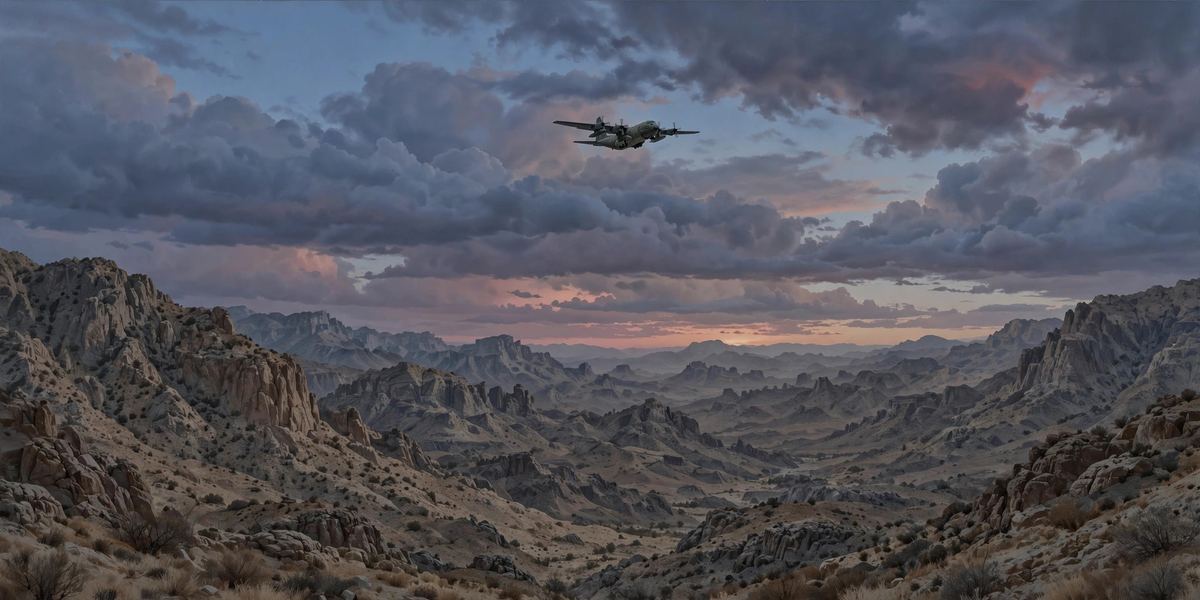
The United States has drawn up military plans that could include dropping the GBU-43/B Massive Ordnance Air Blast — better known as the “mother of all bombs,” or MOAB — on targets in Iran if President Donald Trump orders renewed combat operations, according to reports trending per news coverage. CNN first reported the planning on Thursday, 15 October 2026, and CBS News separately confirmed that the White House and Pentagon had prepared plans involving the weapon. Trump himself discussed the MOAB in a Newsmax interview on Thursday evening, stressing that it is not a nuclear weapon while declining to say whether he had authorised its use.
The reports do not say a strike is imminent. Military planning is not the same as a presidential decision, and the White House has pointedly refused to confirm or deny the existence of specific plans. But the emergence of the MOAB in the planning — a weapon used only once in combat, in Afghanistan in 2017 — is a signal of how far the options under consideration have escalated as the long-running confrontation with Iran grinds on.
What the reports say
According to CNN, citing US officials familiar with military planning, the Pentagon has developed strike packages that could include the MOAB against Iranian energy infrastructure and nuclear sites if Trump orders a resumption of combat operations. CBS News, citing sources familiar with the matter, reported that the White House and Pentagon had prepared plans to use the bomb against military sites in Iran if ordered by the president.
One site reportedly under consideration is Pickaxe Mountain, a deeply buried facility near the Natanz nuclear complex that has drawn growing attention from analysts because of its suspected connection to Tehran’s nuclear programme. The reports also mention Iranian energy infrastructure as a possible target set. CNN reported that military planners were also preparing for possible Iranian retaliation if further strikes were ordered.
A Pentagon official told CBS News: “The Department of War plans for a wide range of operational scenarios to execute Presidential and Secretary level direction and to ensure mission success in any operational environment.” A White House spokesperson said: “We do not comment on sensitive military plans that may or may not exist. President Trump keeps all options on the table to ensure that Iran can never have a nuclear weapon.”
Speaking to Newsmax on Thursday, Trump said the MOAB “is not nuclear at all. This is just an extremely large bomb,” adding: “It’s like a tiny nuclear bomb. The mother of all bombs is one big bomb, but it’s not nuclear.” He did not say whether he had authorised the weapon’s use, nor did he identify a potential target. He predicted the war could end soon, either through negotiations or by other means.
What is the MOAB?
The GBU-43/B Massive Ordnance Air Blast is the largest non-nuclear bomb in the US arsenal. It weighs approximately 21,600 pounds — nearly 10 tonnes — and carries around 18,700 pounds of high explosives, producing a blast equivalent to roughly 11 tons of TNT. It is GPS-guided, detonates in the air just before reaching the ground, and is delivered from a specially configured military transport aircraft rather than a bomber.
Developed in 2002–2003 and first tested in 2003, the MOAB was designed to devastate large surface areas, caves, tunnels and enemy fortifications, and to deliver a psychological shock to enemy forces. Its nickname, “mother of all bombs,” is a play on its acronym.
Despite its fearsome reputation, the weapon has been used in combat only once. On 13 April 2017, during Trump’s first administration, the US military dropped a MOAB on an Islamic State tunnel and cave complex in the Achin district of Nangarhar province, Afghanistan, near the Pakistan border. US officials said the strike destroyed a large complex used for storing weapons and explosives and killed 36 members of the Islamic State’s Khorasan branch. US authorities said there were no civilian casualties in that strike.
What the MOAB can and cannot do
The most important technical point about the MOAB is what it is not: it is not a bunker-buster. The weapon is designed to produce a devastating blast over a wide area rather than to penetrate deep underground. It is highly effective against exposed targets, tunnel entrances and fortifications near the surface, but military analysts note it was not designed to destroy deeply buried, hardened facilities.
That distinction matters for Iran, whose most sensitive nuclear installations are buried beneath substantial layers of rock. The US has a different weapon for hardened underground targets: the GBU-57 Massive Ordnance Penetrator, a bunker-buster designed to burrow through rock and concrete before detonating. The MOAB and the GBU-57 are entirely different weapons, and confusing the two overstates what a MOAB strike could achieve against a deeply buried complex.
Analysts quoted in recent reporting have argued that even if a MOAB could not destroy the underground complex at Pickaxe Mountain, strikes could seal or bury its tunnel entrances, raising the political and practical cost to Iran of digging the site back out. In other words, the weapon’s value in such a scenario would be denial and disruption, not outright destruction.
Why Pickaxe Mountain matters
Pickaxe Mountain sits roughly two kilometres from Natanz and contains multiple tunnel entrances leading into a deeply buried underground complex. Construction began in 2020, after sabotage damaged an advanced centrifuge assembly facility at Natanz; Iranian officials subsequently said a replacement underground facility was being built for advanced centrifuge production. Analysts estimate portions of the complex may lie at least 100 metres beneath the mountain. Iran has said there is no nuclear activity at the site, and there has never been any public indication of enrichment there — though experts say the complex is large enough to hold a centrifuge enrichment plant.
Recent satellite imagery analysed by experts has shown Iran fortifying the site. Earthen piles were placed across roads to the western tunnel entrances in late July and early August 2026, and imagery confirmed they remained in place in September, while eastern tunnel portals were partially filled with dirt. The assessment is that Iran currently cannot enter the underground facility with vehicles and would need to clear the roadblocks to resume construction or other activity inside.
Some analysts believe the window for a straightforward strike on Pickaxe Mountain may already have passed because the facility has been dug several times deeper than Fordow, another Iranian nuclear site. Trump has previously said Washington was watching the site closely and could “take out Pickaxe” if diplomacy failed.
The wider context
The MOAB reports land in a conflict that has already run on and off for months. US strikes on three Iranian nuclear sites in June 2025 — at Isfahan, Natanz and Fordow — slowed the nuclear programme and effectively paused enrichment activities, according to analysis of the aftermath, while Iran ended international oversight of its programme after the expiry of the 2015 nuclear deal. In recent weeks, the confrontation has also spilled onto the seas, with attacks on shipping in the Strait of Hormuz and a US strike in which an Iranian surveillance dhow was destroyed. The regional fallout has rattled markets, with Gulf stocks falling as Houthi threats and IMF warnings mounted.
At the same time, diplomacy has not stopped. Trump has said the US would not attack Iran before the midterm elections on 3 November and has touted “productive conversations” with Tehran, without providing specifics. In a speech to the United Nations General Assembly last month, he said he had a “big decision to make” on whether to strike a deal with Iran or “annihilate the Islamic Republic.” The MOAB planning sits alongside that diplomatic track: contingency preparation that the White House can use as leverage, or discard if talks progress.
What happens next
Nothing in the reporting suggests a strike has been ordered or is imminent. The inclusion of the MOAB in military planning does not mean Trump has authorised its use, and the president’s own public remarks have kept both paths — negotiation and renewed strikes — open. The key things to watch are whether the diplomatic channel produces anything concrete before the midterm elections, whether Iran responds publicly to the reports, and whether US force posture in the region changes in ways that suggest a decision is approaching.
For now, the story is best understood as a measure of escalation risk: the world’s most powerful conventional bomb is on the table, the target list includes some of Iran’s most hardened sites, and both sides know that the next move — a deal, a strike, or more drift — could reshape the Middle East for years.
The planning has continued in parallel with the diplomacy: the US and Israel have drafted post-midterm Iran strike plans, according to a New York Times report.