
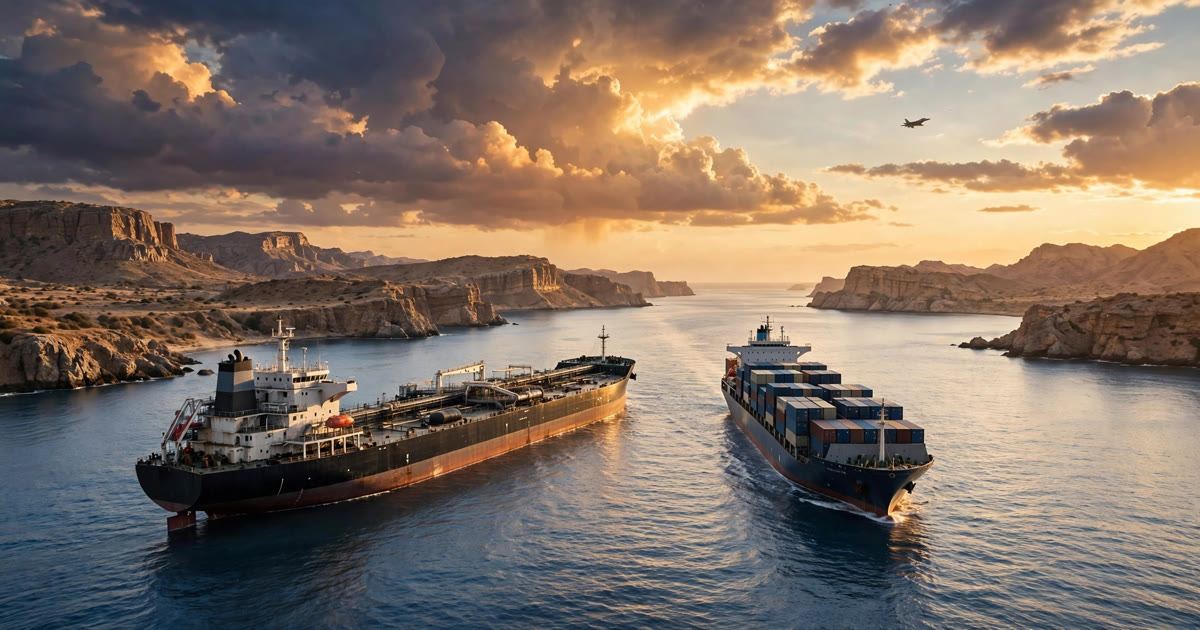
On Saturday, 10 October 2026, the long-running naval confrontation between the United States and Iran entered a new phase: a US military fighter jet fired a precision munition at the stern of a commercial cargo vessel in the Gulf of Oman, fully disabling the ship's propulsion, after its crew ignored repeated warnings and attempted to run America's naval blockade on Iran. Hours later, a supertanker in the Strait of Hormuz caught fire under disputed circumstances, and Tehran issued its starkest warning yet about the world's most important oil shipping lane. This story is trending per news coverage across major international outlets this weekend — here is what is actually known, and what it means.
What happened in the Gulf of Oman
US Central Command (CENTCOM) announced that the vessel, the Panama-flagged M/V Ocean Molica (also known as the Arika Sun), was struck after it attempted to transit regional waters following its departure from an Iranian port. "A U.S. military fighter jet struck the stern of Panama-flagged M/V Ocean Molica with a precision munition, fully disabling the ship's propulsion without harming the crew," CENTCOM said in a post on X. The command shared video of the strike hitting the stern of the bulk carrier, and Reuters reported that the vessel's operator could not immediately be reached for comment.
The details matter. This was not a sinking: disabling the propulsion leaves the ship without the ability to move under its own power but afloat. It was also not a claim made in a vacuum — CENTCOM says the crew ignored repeated warnings before the strike was authorised, and the command immediately warned mariners in the Gulf of Oman and the approaches to the Strait of Hormuz to heed blockade warnings, monitor notice-to-mariners broadcasts, and contact US naval forces.
The blockade: America's three-month enforcement campaign
The Ocean Molica strike is the visible tip of a much larger enforcement campaign. CENTCOM says US forces resumed America's blockade against all ships entering or departing Iranian ports on 14 July 2026, and in roughly three months of strict enforcement it reports four commercial vessels disabled and 135 ships turned around. The command also says US forces have destroyed 10 tankers it describes as linked to the Islamic Revolutionary Guard Corps' (IRGC) multibillion-dollar shadow shipping network over the same period.
In other words, Washington's approach has combined turning back compliant vessels, disabling those that refuse instructions, and targeting what it identifies as sanctions-evading IRGC-linked tankers. The Gulf of Oman, which connects with the Strait of Hormuz as the exit passage from the Persian Gulf, is one of the most sensitive points in the global energy transportation system — which is precisely why the blockade is enforced there.
The same Saturday at Hormuz: a supertanker and an Iranian warning
On the same day, the IRGC Navy's press office said a supertanker struck a mine while passing through the Strait of Hormuz, according to the state-run Fars News Agency. The UK Maritime Trade Operations (UKMTO) reported separately that a vessel was hit on its port side by an unknown projectile, causing a fire to break out. Iran's Revolutionary Guard Corps claimed the tanker had struck one of its naval mines and exploded, and shared video of the vessel ablaze while restating its threats toward ships crossing the strait.
Tehran paired the claim with a threat: Iranian officials warned Washington that if the conflict continues, "not even one drop of oil will be exported" out of the strait or anywhere else in the Persian Gulf. The IRGC warned that a "devastating fire" awaited any oil tanker that violated what it calls the security rules of the Strait of Hormuz.
It is worth keeping the reports separate in your mind: the US strike on the Ocean Molica was confirmed by CENTCOM with video; the supertanker mine claim comes from Iranian state media and is disputed. But taken together, they show a strait where both sides are now striking shipping — and where the risk of a miscalculation is climbing.
Why the Strait of Hormuz matters so much
The Strait of Hormuz is the narrow waterway between the Persian Gulf and the open ocean, and before the current conflict it carried around 20 percent of the world's oil consumption. There is no alternative route of comparable capacity for much of this crude, so disruption in the strait tends to push up global oil prices and raise shipping and insurance costs.
Those costs are already visible. The US Energy Information Administration estimated that crude and petroleum-liquids flows through Hormuz fell from an average of 21.6 million barrels per day in the last quarter of 2025 to just 4.9 million barrels per day in the second quarter of 2026. Analytics firm Kpler reported that only seven commodity vessels passed through the strait on Tuesday, 6 October — the lowest number since 23 July. And the United Nations' International Maritime Organization says at least 11 tankers came under attack during the week ending 4 October, the most strikes on commercial ships in the strait since the war began. For more on the earlier wave of attacks, see our explainers on the coordinated October strikes on tankers and Riyadh airport and the UAE rescue of 22 crew from a burning tanker.
The war so far: eight months in
The conflict between the United States and Iran has now stretched into its eighth month, after the US and Israel launched the war on Iran in late February 2026. Iran has launched near-daily attacks on shipping in the strait in recent weeks, and the confrontation has spread beyond the waterway — a Houthi missile strike on Riyadh's airport killed 12 people, an attack covered in our earlier explainer, which prompted several countries including Canada to warn against travel to Saudi Arabia and a second reported strike on the airport.
At the political level, there are conflicting signals. President Trump said Thursday that discussions with Iran had been "productive" and — after days of speculation — that he would not attack the Iranian regime before the November midterm elections. That comment sits uneasily alongside a steady drumbeat of strikes at sea, and it is one reason analysts are watching both the diplomacy and the waterway so closely.
Why it matters: energy markets and fuel prices
Every new incident in the strait is priced into oil markets, and Saturday delivered two in one day. Crude prices have found support in recent weeks as attacks on tankers reached their highest level since the war began, and the combination of a US strike on a commercial vessel and an Iranian mine claim — with an explicit threat to oil exports — adds a fresh risk premium. For context on how governments are cushioning fuel markets, see our explainer on the G7 diesel reserves release.
Beyond oil, shipping insurers have been repricing risk in the Gulf for months, and each attack pushes freight and insurance costs higher — costs that eventually filter into the price of almost everything that moves by sea.
What could happen next
Three things are worth watching. First, whether the Ocean Molica strike becomes a template — CENTCOM's statement reads like a warning that the next ship to ignore the blockade will meet the same fate. Second, whether Iran's "not even one drop of oil" threat translates into action against escorted crude flows, which have continued at around pre-war levels under US military escort. Third, whether the diplomatic track Trump described as "productive" produces any de-escalation before the November midterms — or whether the next week brings another attack in the strait.
Key facts
Ship struck by the US: Panama-flagged M/V Ocean Molica (also known as Arika Sun), a cargo vessel that had departed an Iranian port. Weapon: a precision munition fired by a US fighter jet at the ship's stern. Casualties: none reported by CENTCOM. Blockade: resumed 14 July 2026; 4 vessels disabled, 135 ships turned around, 10 IRGC-linked tankers destroyed, per CENTCOM. Same-day incident: supertanker fire in the Strait of Hormuz — UKMTO says hit by an unknown projectile; IRGC claims it struck an Iranian naval mine. Oil flows: ~21.6M bpd (Q4 2025) → ~4.9M bpd (Q2 2026) through Hormuz, per the EIA. War: began late February 2026, now in its eighth month.
The enforcement campaign has now emptied Tehran's offshore reserves, as Iran's shadow tanker fleet has run dry under the US naval blockade.
Sources
This explainer is based on trending news coverage from major international outlets, including Reuters reporting on the CENTCOM announcement; CENTCOM's public statement on X; the IRGC Navy statement reported by the state-run Fars News Agency; UK Maritime Trade Operations incident reporting; the UN International Maritime Organization's shipping-attack figures; US Energy Information Administration flow data; and Kpler vessel-tracking data.