
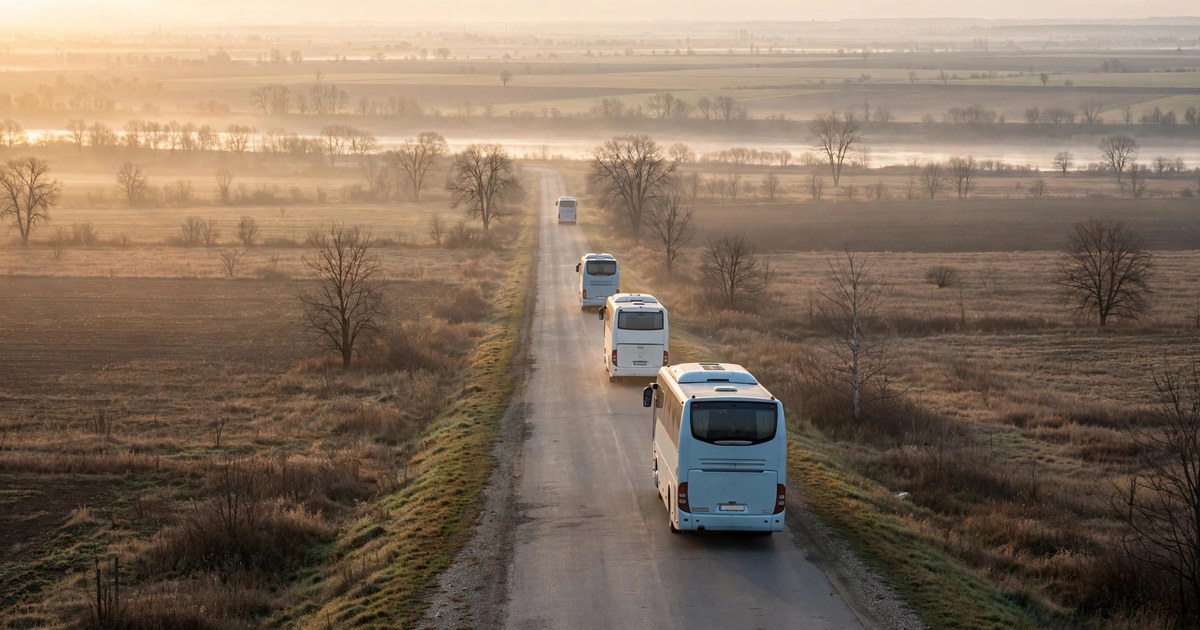
The Oleshky evacuation ended on Saturday, 31 October 2026, when hundreds of starved and exhausted civilians from the Russian-occupied town of Oleshky crossed back into Ukrainian-held territory, completing a journey that took them by bus through occupied Crimea, by plane across Russia to Belarus, and finally by bus to the Ukrainian border. The operation was the first humanitarian evacuation of its kind in more than four years of war, made possible by a rare six-day local ceasefire brokered with the help of US First Lady Melania Trump and called for by Pope Leo XIV.
For the people of Oleshky, a town in Ukraine's southern Kherson region, the Oleshky evacuation ended years of being trapped with almost no food, electricity, gas or medicine. Some of the evacuees had not seen their families since Russia seized the town in the first days of the full-scale invasion in April 2022. One couple, Dmytro and Larisa, both 54, were reunited at the border after 1,711 days apart. Hundreds of people, and many pets, arrived back in Ukraine on Saturday afternoon, CNN reported, as relatives waited with Ukrainian flags at the border crossing in the Chernihiv region.
What happened in the Oleshky evacuation
The Oleshky evacuation began on Friday afternoon, 30 October, when 25 buses with 750 seats left the town carrying residents who had chosen to return to Ukrainian-controlled territory. Ukraine's human rights ombudsman, Dmytro Lubinets, travelled with them, becoming the first high-profile Ukrainian official to openly travel to occupied areas under Russian control since the start of the war. The buses took the evacuees through occupied Crimea to Anapa, in Russia's Krasnodar region, where four planes carried them to Gomel in Belarus. From there, buses brought them to the Ukrainian border, where medical teams, aid tents and volunteers were waiting.
President Volodymyr Zelenskyy announced the evacuees' arrival on Telegram, thanking the United States and Melania Trump for the mediation, and thanking everyone who had drawn attention to what he called the genuine humanitarian catastrophe in the occupied territory. Neither side has disclosed the exact number of people evacuated. Melania Trump said on Friday that the humanitarian convoy could safely evacuate more than 750 people, and Ukrainian officials said hundreds had arrived by Saturday afternoon.
The youngest evacuee was a baby just over one year old, and the oldest was 94, according to Lubinets. Volunteers from the Red Cross, Doctors Without Borders and the World Central Kitchen were at the border, along with aid tents, coffee stands and provisions to feed the pets the evacuees had brought with them. One elderly man in a wheelchair told Reuters he had lost 20 kilograms over the past year and was so weak he needed hospital treatment. Larisa, reunited with her husband Dmytro after 1,711 days, had lost a third of her body weight under the occupation, CNN reported.
Why the Oleshky evacuation took the long way home
There was no direct road home for the people of Oleshky. The town sits on the Russian-held side of the Dnipro River, only a few kilometres from the front line, and the routes out were heavily mined and littered with drone and vehicle debris. Evacuation across the Dnipro directly into Ukrainian-controlled territory was not possible, officials on both sides said, which is why the journey had to go the long way round: south through Crimea, east into Russia, north by air to Belarus, and then south again by road to Ukraine.
The six-day ceasefire made the route possible. It began at 3am on Tuesday, 27 October, and both Ukrainian and Russian officials said it had held without violations. Every leg of the Oleshky evacuation had to be agreed in advance, because a single breakdown anywhere along the route could have stranded hundreds of people far from safety. During the pause, the two sides cleared mines from the access roads and brought food and medicine into the town. Two people taking part in the clearing operation were killed, according to the authorities. Demining was announced complete on Thursday, and the buses rolled out on Friday afternoon.
Who brokered the Oleshky ceasefire
The ceasefire was reached after mediation efforts by US First Lady Melania Trump, with the involvement of Pope Leo XIV, who had called for the humanitarian pause. The White House announced the agreement on 23 October, saying Mrs Trump had worked with Russian and Ukrainian representatives to define its terms, timing and technical procedures. Her office described her as the exclusive intermediary between the two governments. The Oleshky evacuation was only possible because both sides agreed to stop shooting for six days. Russia's ombudswoman and lead representative on the mission, Yana Lantratova, worked alongside Ukraine's ombudsman Lubinets on the ground.
Reuters described the six-day pause as the longest local pause in fighting since Russia's full-scale invasion in 2022, and the first humanitarian truce of its kind in more than four years of war. It was strictly local: it covered Oleshky and the surrounding Kherson sector, and it did not stop military operations elsewhere in Ukraine. It also does not establish a broader peace process, but it showed that even a narrow, locally brokered pause can save lives when both sides keep to it.
Life under occupation in Oleshky
Oleshky had a pre-war population of about 24,000. About 40 percent managed to flee to Ukrainian-controlled territory early in the fighting, according to the Institute for the Study of War. An estimated 1,700 to 2,000 people remained when the truce began, most of them elderly. The town was devastated by the destruction of the Kakhovka Dam in 2023, and the humanitarian situation had deteriorated badly in recent months.
By the time the Oleshky evacuation began, the town's remaining residents had been living for months without basic supplies. Ukrainian authorities said the town ran out of food and other supplies in September, with no access to electricity, gas, medicine and other essentials. Some residents said food deliveries had stopped in May, and evacuees speaking to CNN on Saturday said there had been no food deliveries since the summer. The ceasefire brought the first relief: during the pause, food and medicines reached the town, and residents who chose to stay were left with replenished supplies. Some residents decided to go to Russia instead, while others elected to remain in Oleshky despite the lack of gas, electricity and running water.
What happens when the Oleshky ceasefire ends
The Oleshky ceasefire is due to end on Sunday evening, 1 November. What happens to the people who stayed behind after that is unclear. The town's remaining residents have food and medical supplies delivered during the pause, but the fighting around Kherson, which has been under near-constant drone attacks, is expected to continue. The wider war goes on: the same week, talks involving Ukraine, Russia and the United States were being prepared in Abu Dhabi, while Ukraine paused strikes on Russian refineries and the United States approved 500 Patriot missiles Ukraine needs.
For now, the Oleshky evacuation stands as a rare moment of cooperation in a war that has offered few. Hundreds of people who had been cut off for years are home, or on their way to new lives, because two governments, a first lady and a pope agreed to stop shooting for six days. Whether that model can be repeated in other frontline towns is the question the next weeks will answer.
Why the Oleshky evacuation matters
The Oleshky evacuation matters because it proves a point that four years of war had made easy to doubt: that humanitarian corridors can still work, even between enemies, when the terms are narrow, the timing is agreed in advance, and both sides see a reason to keep them. It also matters because of who it saved. These were not soldiers or officials. They were elderly residents, small children, people in wheelchairs and on stretchers, and families carrying their pets, who had survived months without basic supplies in a destroyed town.
It matters, too, as a test. The ceasefire held without a reported violation, the demining was completed, and the evacuation ran without a major disruption, according to officials and reporters who followed it. That record may encourage similar local truces elsewhere on the front line. But its limits are clear as well. The pause was local, temporary and tied to one town. It did not change the course of the war, and when it ends on Sunday evening, the fighting around Oleshky resumes. The Oleshky evacuation saved hundreds of lives. It did not end the war that put them in danger.
Sources: CNN; Reuters; Associated Press.