
In September 2026, Britain spent more money keeping its electricity grid stable than it ever had in a single month. The bill came to just over £505 million, according to analysis by energy consultancy LCP Delta — a figure that surpasses even the peaks seen during the 2022 energy crisis. And October has been even more dramatic in miniature: a single Tuesday in the month cost £38.4 million, or about $51.2 million, a daily record for the cost of keeping the lights on.
This story is trending per news coverage from Bloomberg and Utility Week, and it matters because it reveals something important about the energy transition. The problem is not that Britain lacks electricity. It is that the electricity is often in the wrong place — and moving it, or working around the fact that it cannot be moved, is becoming extraordinarily expensive.
Background
Every power grid in the world operates on a simple but demanding principle: the amount of electricity being generated must match the amount being consumed at every moment. In Britain, that balance is measured at a frequency of 50 hertz. If generation exceeds demand, the frequency rises; if demand exceeds generation, it falls. Even small deviations can damage equipment or, in extreme cases, trigger cascading failures like the islandwide blackout seen in Sri Lanka earlier this month.
The organisation responsible for keeping Britain at 50Hz is the National Energy System Operator, or NESO. It does not own power stations or wires. Instead, it runs a constant, second-by-second marketplace, paying generators to ramp up or down, switch on or off, and sometimes importing or exporting electricity across interconnectors to France, the Netherlands, Belgium and other neighbours. This is the "balancing market," and it operates every minute of every day.
Balancing costs are one of the invisible layers of an electricity bill. They sit on top of the wholesale cost of the energy itself, the cost of maintaining the wires and pipes, and the supplier's own margin. When the wind is blowing steadily across the whole country and demand is predictable, balancing is cheap. When conditions are complicated — gusty weather in one region, calm in another, unexpected demand spikes, or bottlenecks on the network — NESO must intervene more aggressively, and the costs climb.
For years, those costs crept steadily upward. The LCP Delta analysis shows that September's £505 million figure marks a genuine record, beyond anything recorded during the energy crisis of 2022, when wholesale gas prices surged to historic highs. In other words, Britain is now spending more on the logistics of moving and managing electricity than it did on the emergency measures of the crisis years.
What Happened
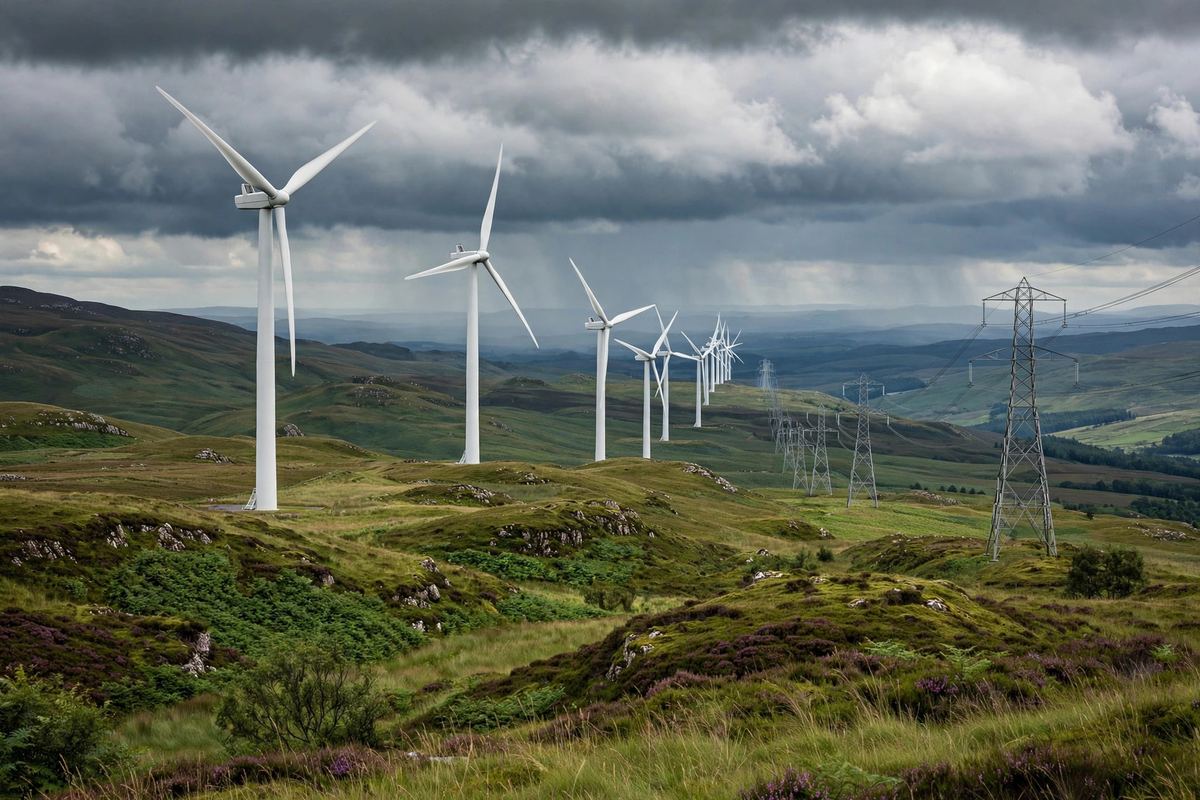
The immediate trigger was weather and geography working against the grid. October brought strong winds in the north of Scotland, where Britain has built some of its largest wind farms, both on land and offshore. At the same time, electricity demand was concentrated where it always is: in London and the southeast of England, home to tens of millions of people and the country's financial and commercial heartland.
The transmission network that connects the two could not keep up. Network bottlenecks — the limited capacity of high-voltage lines running north to south — meant that a significant share of the Scottish wind power could not physically reach the population centres that needed it. NESO therefore had to take two expensive actions at once. First, it paid wind farms in Scotland to switch off, curtailing generation that could not be delivered. Second, it fired up gas power stations much closer to London and the southeast, paying them to generate the electricity that demand required.
This is the cruel arithmetic of the balancing market: NESO pays for power it deliberately does not use, and then pays again for replacement power from a different source. Economists call this "curtailment," and it has been rising year after year as wind capacity has grown faster than the wires needed to carry it.
This week, the situation was severe enough that NESO had to request emergency electricity imports from France through the cross-Channel interconnectors — a sign that domestic supply could not be shuffled into the right places in time. When a grid operator reaches for emergency imports, it is a signal that the normal tools have been stretched to their limits.
The single-day cost of £38.4 million is striking on its own, but it is the September monthly total that tells the deeper story. More than £505 million in one month means the balancing market is no longer a quiet background cost. It is becoming one of the most significant pressures on the entire British energy system, and it arrives at a moment when policymakers are under intense pressure over energy prices across Europe.
Why It Matters
The most direct reason this matters is money: these costs land on household bills. Balancing charges are recovered through the system costs that appear on every electricity bill in Britain, which means that the record spending of September 2026 is ultimately paid for by ordinary homes and businesses. At a time when households are already dealing with elevated living costs, an additional upward pressure from grid management is politically and economically sensitive.
The deeper reason it matters is structural. Britain's predicament is a preview of a challenge facing every country racing to build renewable energy. The physics of the grid have not changed: electricity must be generated where it can be delivered. But the geography of the new energy system is very different from the old one. Coal and gas plants were built near cities, mines and ports, close to the people who used their power. Wind farms are built where the wind is strongest — often remote coastlines, hilltops and offshore zones far from demand centres. That is simply where the resource is, and it is also the cheapest place to build large-scale renewable capacity.
What has not kept pace is transmission infrastructure: the pylons, high-voltage lines and subsea cables needed to move that power to the people who need it. Building new transmission is slow, expensive and often controversial, with local opposition to new pylons and lines stretching planning processes over years. The result is a growing gap between where power is made and where it is needed — and the balancing market is where that gap shows up as a cash bill.
There is also a climate dimension. Paying wind farms to switch off while firing up gas plants is an outcome nobody wants: it wastes zero-carbon electricity and burns fossil fuels instead. The curtailment problem is, in effect, a measure of how much clean energy Britain's grid cannot absorb, and it sits uncomfortably alongside the country's net-zero ambitions. For readers wanting to understand the wider context of the energy transition, our explainer on climate change, its causes and solutions covers why grids like Britain's are being rebuilt in the first place.
Key Facts
Here are the core numbers from the analysis, all worth keeping in mind. In September 2026, Britain spent just over £505 million on balancing its power grid — a monthly record, exceeding the peaks of the 2022 energy crisis. On one Tuesday in October, the daily cost reached £38.4 million, equivalent to about $51.2 million — a daily record.
The body doing the spending is NESO, the National Energy System Operator, which must keep the grid at 50 hertz at all times. This week it had to request emergency electricity imports from France because network bottlenecks prevented Scottish wind power from reaching London and the southeast. That meant paying wind farms in Scotland to switch off while simultaneously paying gas plants near the cities to start up — the textbook example of how curtailment costs multiply.
The root cause, according to analysts, is a mismatch between generation and transmission: wind farms have been built far from demand centres, while the pylons and lines needed to connect them have lagged behind. The investment required to fix it is estimated at £65 billion in transmission infrastructure through 2031.
On the oversight front, regulator Ofgem is examining NESO's performance — a sign that the record costs have attracted the attention of the body responsible for protecting consumers. For its part, NESO says supplies remain secure and there is no increased risk of blackouts this winter. Separately, whistleblower allegations about a near-blackout during a June heatwave are under independent investigation, a story we will continue to follow.
What Happens Next
The long-term answer to the balancing bill is steel in the ground: new high-voltage transmission lines carrying power from where it is generated to where it is needed. The projected £65 billion of transmission investment through 2031 is one of the largest infrastructure programmes in Britain's history, and its pace will determine whether curtailment costs keep climbing or begin to fall. Every mile of new line that opens up reduces the need for NESO to pay generators to switch off — and reduces the gas burn that currently fills the gap.
In the shorter term, attention will turn to Ofgem's examination of NESO's performance. The regulator's role is to make sure the system operator runs the balancing market as efficiently as possible, and record costs inevitably raise questions about whether more could have been done — whether through better forecasting, smarter use of interconnectors, or faster action on bottlenecks. NESO's position is that it is managing a system under extraordinary strain and that security of supply is intact. The independent investigation into the whistleblower allegations about the June heatwave near-blackout adds another layer of scrutiny, and its outcome could shape how the system operator is overseen in future.
For households, the practical question is what all this means for bills. Balancing costs are one component among many, but they are a growing one, and at record levels they are hard to ignore. Policymakers face an uncomfortable trade-off: the transmission investment that would bring the costs down must itself be paid for, and much of that will also flow through to bills over time. The political debate over who pays, and how fast the grid should be rebuilt, is likely to intensify.
There is a broader lesson for the rest of the world. As countries build vast amounts of wind and solar power — and our guide to how solar panels work explains how quickly the technology is advancing — the limiting factor is increasingly not generation but the grid itself. Britain's record £505 million month is a measure of what happens when the two fall out of sync. The energy transition is, in the end, a construction project as much as a technology project — and the pylons are running behind the turbines.
Households are feeling the system's costs directly: the energy price cap rose to £1,723 in October, with a far worse January forecast.
Sources: Bloomberg, Utility Week — October 2026