
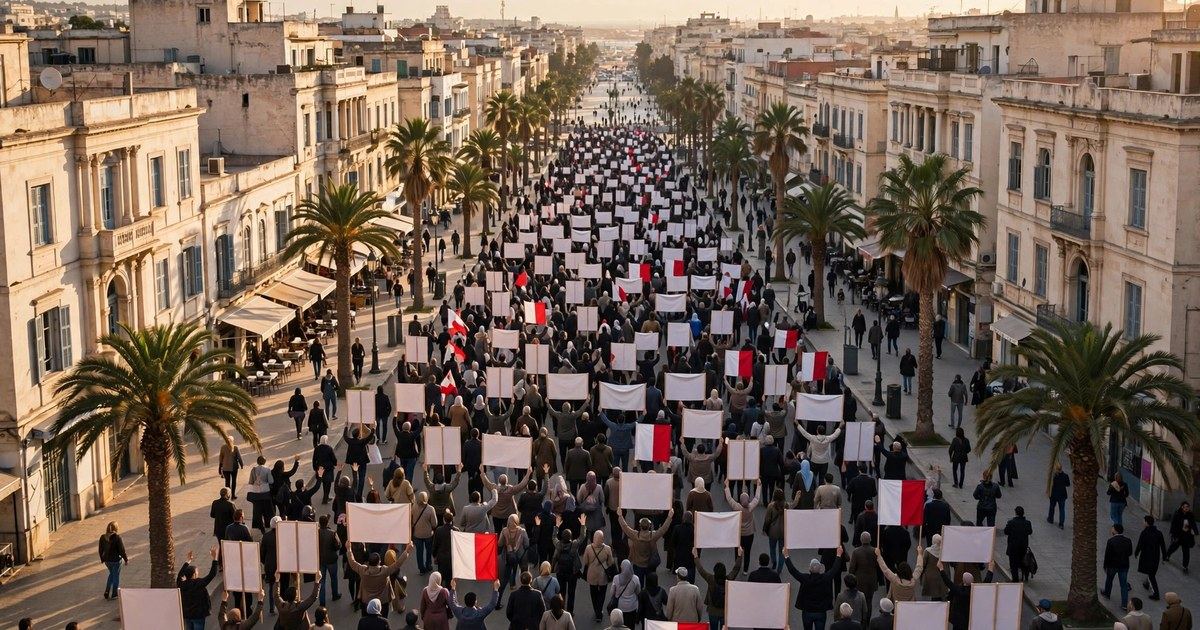
On Saturday 17 October 2026, the main avenue of Tunisia's capital filled with thousands of marchers in what news agencies described as the largest protest against President Kais Saied in years. Led by the country's powerful UGTT labour union and joined by opposition parties, lawyers, doctors, journalists, unemployed workers and civil society groups, the demonstration turned the centre of Tunis into a stage for grievances that have been building for years: a deepening economic crisis, failing public services, and a concentration of political power that critics say has hollowed out the democracy Tunisia won in 2011. The story is trending per news coverage.
The march was striking not only for its size but for its breadth. After years in which divisions kept the opposition fragmented, parties from across the political spectrum walked together on Saturday, alongside trade unionists and ordinary citizens who had travelled to the capital from towns across the country. Hundreds of police officers were deployed across Tunis, but the initial wire reports described a demonstration defined by its slogans and its scale rather than by confrontation.
What happened in Tunis on Saturday
Thousands of protesters marched along Habib Bourguiba Avenue, the broad boulevard at the heart of Tunis that has served as the country's symbolic public square since the 2011 uprising. They carried banners expressing frustration over unemployment and pollution, and they chanted slogans that echoed the revolution that made Tunisia famous around the world.
Among the chants reported by Reuters were "No fear, power belongs to the people!" and "The prisons are full, people are hungry!" Marchers also revived the most iconic slogan of the 2011 uprising: "The people want the fall of the regime!" The choice of words was deliberate. Fifteen years after Tunisians forced a dictator from power, many protesters argue that the country is once again governed by one man holding nearly all the levers of the state.
Speaking at the rally, Slah Eddine Salmi, head of the UGTT, told the crowd: "Silence will no longer be acceptable ... the state cannot [be] built by concentrating all powers in the hand of one person." The protesters called for the release of Saied's critics and demanded an end to what they described as attacks on trade union rights.
One marcher, Yassine Gharseli, who had travelled from Sfax, about 250 km (155 miles) south of Tunis, summed up the mood in terms that had little to do with abstract constitutional arguments. "Enough is enough! The country is collapsing. We suffer from power and water cuts, and one crisis after another," he said.
Who was on the streets — and why their unity matters
The demonstration was led by the UGTT, the Tunisian General Labour Union, an organisation whose weight in Tunisian public life is hard to overstate. Founded in 1946, the UGTT has long been one of the country's most powerful institutions, with a membership that reaches deep into the public sector. In 2015 it shared the Nobel Peace Prize as part of the Tunisian National Dialogue Quartet, which helped steer the country through a political crisis after its revolution. When the UGTT calls a march, Tunisia pays attention.
What made Saturday different was who marched alongside the union. Opposition parties that have spent years disagreeing with one another joined the demonstration, together with lawyers, doctors, journalists, unemployed people and civil society groups. That rare show of unity is the detail that gives the protest its political significance. The opposition's inability to mobilise large crowds in recent years has been one of Saied's greatest advantages; a divided opposition is easy to ignore. A united one, marching in the country's most symbolic location, is much harder to dismiss.
The Tunis march came on the same day as nationwide protests in France over the cost of living and working conditions, and days after student-led protests in Albania — a weekend in which street politics was visible on several continents at once, while in the United States the No Kings coalition staged vote-early events aimed at turning protest energy into ballots.
The economic crisis behind the anger
The protest's immediate fuel was economic. Tunisia is grappling with an economic crisis that touches daily life in concrete ways: worsening public services, recurring water and power cuts, and shortages of medicines and essential goods. For many Tunisians, the political argument about democracy and the practical argument about living standards have merged into a single complaint — that the state is failing at its most basic jobs while concentrating power at the top.
Unemployment has long been one of the country's most stubborn problems, and banners at the march reflected frustration over jobs and pollution as well as politics. The economic squeeze has been felt across the region and beyond, as energy prices and inflation have climbed through 2026, but Tunisia's crisis has its own domestic roots: years of slow growth, strained public finances, and a political system that has struggled to deliver the economic dividends that the 2011 revolution promised.
That gap between revolutionary promise and everyday reality is the emotional core of Saturday's march. The 2011 uprising was driven as much by dignity and jobs as by abstract democratic ideals. When protesters in 2026 chant that prisons are full and people are hungry, they are arguing that both halves of that promise have been betrayed.
How Saied came to hold so much power
To understand Saturday's protest, it helps to retrace how Tunisia arrived at this point. Kais Saied, a former constitutional law professor, was elected president in 2019 as an outsider promising to clean up a political system that many Tunisians saw as corrupt and ineffective. In July 2021, amid political deadlock and public frustration over the handling of the pandemic and the economy, he suspended parliament, dismissed the prime minister and began ruling by decree. He went on to dissolve parliament, dismiss dozens of judges, and push through a new constitution in 2022 that cemented sweeping presidential powers.
His opponents described those moves as a coup. His supporters argued that they were a necessary corrective to a dysfunctional system. Saied himself has consistently rejected the charge that he is a dictator, and he has accused his opponents of engineering economic crises to fuel social unrest.
Human rights groups, meanwhile, say the president has intensified a crackdown on civil society, journalists and opposition figures, and protesters on Saturday demanded the release of his critics. That dispute — over whether Tunisia is being governed firmly or being pushed toward authoritarian rule — is the central argument of the country's politics today, and it is why a protest about water cuts and medicine shortages can also be a protest about the nature of the state itself.
Why Habib Bourguiba Avenue matters
The location of Saturday's march was part of its message. Habib Bourguiba Avenue, named after Tunisia's first president, was the focal point of the 2011 protests that forced longtime ruler Zine El Abidine Ben Ali from power and helped trigger the Arab Spring uprisings across the region. Tunisia was the one country where that wave of revolt produced a democratic transition that lasted, and the avenue has remained the place where Tunisians go to be heard.
Marching there, and reviving the slogans of 2011, was a way for Saturday's protesters to claim the legacy of the revolution — and to argue that its work is unfinished. It was also a signal to the rest of the region and the world. Tunisia's democratic experiment has long been watched as a test case for whether the Arab Spring's hopes could survive. Saturday's protest suggests that the experiment's most important question is still open.
What happens next
The immediate question is how the authorities respond. The large police deployment on Saturday did not, in initial reporting, produce the kind of clashes that have marked protests elsewhere, but the days ahead will show whether the government treats the march as a legitimate expression of grievance or as a challenge to be contained. The second question is whether Saturday's rare opposition unity holds. A single large march is a statement; a sustained movement is something else, and it requires the parties and unions that marched together to keep cooperating after the crowds go home.
The third question is economic. Protests driven by water cuts, power cuts and shortages tend to recur as long as the underlying conditions persist. If public services continue to deteriorate, the pressure that produced Saturday's turnout is unlikely to ease, whatever the government's political response.
For now, Saturday's march stands as a marker: the largest protest against Kais Saied in years, led by the country's most powerful union, carried out on the avenue where Tunisia's modern history has repeatedly been written. Whether it becomes a turning point depends on what happens next — in the presidential palace, in the union halls, and on the streets. Sources: Reuters, via SRN News, WNCY, Jack FM, MIX-FM, WNFL and 94.1 Duke FM (17 October 2026); Al Jazeera live news coverage (17 October 2026).
Frequently asked questions
What was the protest in Tunis on 17 October 2026?
Thousands of Tunisians marched along Habib Bourguiba Avenue in Tunis in what news agencies described as the largest protest against President Kais Saied in years. It was led by the UGTT labour union and civil society groups, with opposition parties, lawyers, doctors, journalists and unemployed people joining in.
Who is Kais Saied?
Kais Saied is Tunisia's president, elected in 2019 as a political outsider and former constitutional law professor. In 2021 he suspended parliament and began ruling by decree, later dissolving parliament and dismissing dozens of judges. A new constitution adopted in 2022 cemented sweeping presidential powers. His opponents call his power grab a coup; he denies being a dictator and says his opponents manufacture crises to stir unrest.
What is the UGTT and why does it matter?
The UGTT, the Tunisian General Labour Union, is one of Tunisia's most powerful institutions, founded in 1946 with deep membership in the public sector. It shared the 2015 Nobel Peace Prize as part of the Tunisian National Dialogue Quartet, which helped the country through a post-revolution political crisis. Its decision to lead Saturday's march gave the protest unusual weight.
Why are Tunisians protesting now?
Protesters cite two linked grievances: an economic crisis marked by worsening public services, recurring water and power cuts, and shortages of medicines and essential goods; and a political system in which power is concentrated in the president's hands. They also demand the release of Saied's critics and an end to what they describe as attacks on trade union rights.
What could happen next?
Three things are worth watching: how the authorities respond to the march, whether the rare unity between opposition parties and the UGTT holds, and whether the economic conditions driving the anger — water and power cuts, shortages, unemployment — improve or worsen. If services keep deteriorating, further protests are likely.
Tunisia is not the only North African country wrestling with the question of how long one man should rule: in Cairo, President Sisi has announced that his presidency will end in 2030, promising to train a new generation of leaders.