
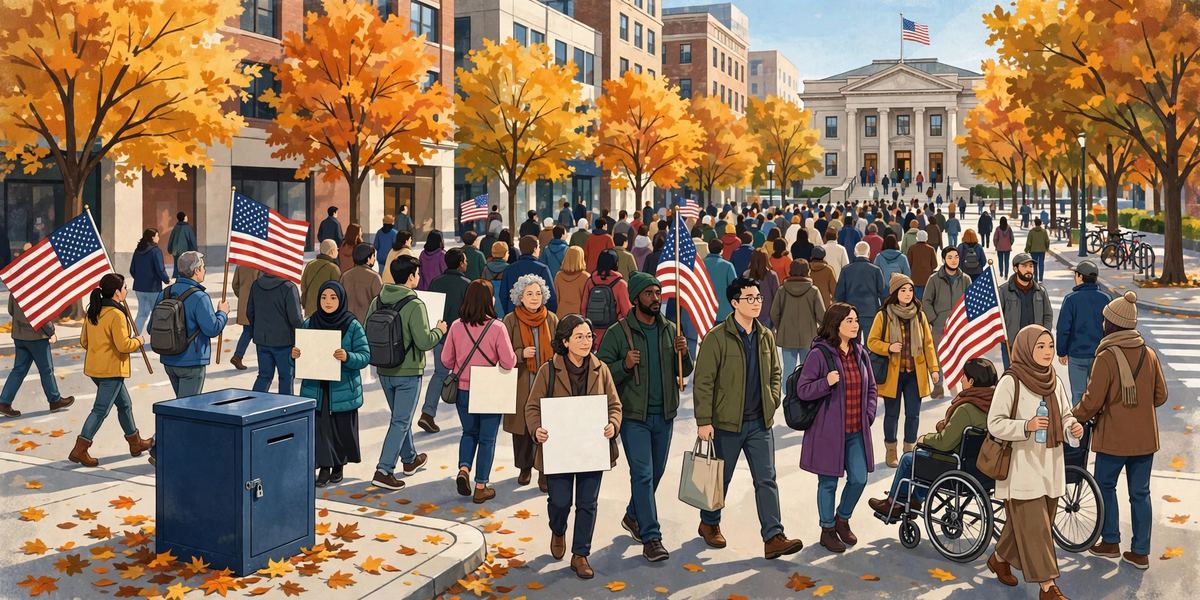
On Saturday 17 October 2026, the No Kings movement took a deliberate turn. Instead of the mass street marches that defined its first three days of action, the coalition behind the protests staged what it called "No Kings: Vote Early" — more than 3,000 events across all 50 states and Washington, D.C., aimed at converting protest energy into early-voting turnout ahead of the midterm elections on 3 November. The story is trending per news coverage.
The scale was familiar. The purpose was new. Organizers said millions of Americans were expected to take part in events ranging from marches to polling places and ballot drop boxes, to block parties, cookouts, voter-registration booths and vehicle parades to voting locations. But unlike the earlier No Kings days, which were designed to send a message, Saturday's events were designed to produce a measurable outcome: more early votes, and a trained volunteer force to watch over the election.
What happened on 17 October
Events took place in big cities and small towns alike. In downtown Phoenix, protesters planned to march from Grant Park to the Maricopa County Tabulation and Election Center to drop off their ballots. In Indianapolis, two groups planned to march to the governor's residence. In Atlanta, Black Voters Matter hosted a party with food trucks and music before moving as a group to a polling location. In Ferndale, Michigan, and Eagle County, Colorado, participants in superhero costumes rode decorated bikes or wagons on their way to vote. In Chester, Pennsylvania, there was a tailgate party at a ballot drop-box location. In Palm Beach County, Florida, live coverage followed events through the day, including a Vietnam veteran who told reporters he had come because he believed democracy itself was at stake.
Organizers said the day included more than 3,000 actions in total, with 46 events in Arizona alone, and events listed in every state. As events were still under way at the time of writing, organizers had not yet released a turnout figure for the day, and no independent crowd count was available.
From protest to participation
The shift in strategy was explicit. "The time for sending a message is over," Indivisible co-founder Ezra Levin told USA TODAY. "Now we are headed into an important point in a democracy, which is whether the people stand up and refuse to allow an authoritarian to consolidate power. And the way to do that in a democracy is by exercising your right to vote and by exercising your right to organize to prevent any sabotage in that election."
Levin said the coalition set the date in October because organizers believed President Donald Trump would try to undermine the election. "How do you prevent the sabotage of an election using the tools available to you? Well, you vote like hell," he said.
Public Citizen co-president Lisa Gilbert described the day as "a strategic move and a critical one to help people exercise the most tangible aspect of their power that counters all the abuses we've been seeing, which is voting. So it's a massive day of voter participation, one where we are helping folks lean into voter power as a statement on what democracy is and should be."
The coalition set out two aims for the day. The first was to help produce what organizers hope will be the largest midterm early-voting turnout in American history. The second was to recruit and train poll watchers and election-protection volunteers, amid organizers' concerns about the failed SAVE America Act — which would have required proof of citizenship when registering to vote — fears about immigration officers at polling places, and attempts to restrict voting by mail.
Who is behind No Kings
No Kings is not a single organization but a coalition. Its partners span labor unions, progressive advocacy groups, civil rights organizations and faith leaders, including the American Federation of Teachers, Black Voters Matter Fund, Voto Latino, Indivisible, MoveOn and Public Citizen, alongside civil liberties groups such as the American Civil Liberties Union and local partners including the League of Women Voters.
The name comes from the organizers' belief that President Trump is acting like a monarch rather than the leader of a democracy. The movement began with an anti-Trump demonstration to mark Presidents' Day in February 2025 and has grown through three previous nationwide days of action that organizers say drew millions of participants and that were consistently nonviolent — a record organizers stress as a core principle, with participants expected to de-escalate confrontations and act lawfully.
Organizers describe Saturday's events as nonpartisan and say they are designed to increase participation from all eligible voters. The events themselves were not ballot sites: volunteers provided voter registration help, information on how and where to vote, and help making a voting plan, rather than collecting ballots. Critics dispute the nonpartisan framing, pointing to the movement's origins in opposition to the Trump administration — a tension that has followed the coalition since its first marches.
What the White House and Republicans say
The White House dismissed the events. "The fact that the 'No Kings' organizers are talking about voting in the upcoming election proves they should change their name," White House spokeswoman Lauren Bis said. "This November, Americans have a clear choice between President Trump and Republicans' commonsense policies or the extreme Democrats' radical socialist, open-border policies." In an earlier statement, Bis had called the action "more Trump derangement syndrome" and said, "What King are they protesting? ... We are lucky to have a President who works around the clock to Make America Great Again."
House Speaker Mike Johnson referred to the protests as the "Hate America Rally," and Republicans broadly labelled them anti-American. Members of the Trump cabinet have accused Democrats of prolonging the government shutdown until after the No Kings events to show liberal groups they are pushing back against the administration.
The exchange captures the political stakes of the day. For organizers, heavy early turnout is both a mobilization tactic and a defensive step: they argue that a large, early vote makes it harder to dispute the result afterward. For the administration and its allies, the events are partisan activism dressed up as civic participation. Voters will render their own verdict on 3 November.
Why early voting matters in the midterms
The 3 November midterms will decide control of Congress and thousands of state and local offices, and early voting has become a central battleground in how those elections are fought. In Arizona, where more than 80 percent of voters cast ballots by mail, Saturday arrived ten days into the early-voting period. In states across the country, the rules differ sharply: some offer weeks of in-person early voting, others rely mainly on mail ballots, and voter ID requirements vary by state.
That patchwork is one reason organizers focused Saturday on practical help — checking registration status, understanding state ID rules, finding polling places and ballot drop boxes, and knowing what to do if a voter encounters a problem. Election officials generally advise voters to verify their registration early, confirm their polling place or drop-box location, and check deadlines for mail ballots, which in many states must be received — not merely postmarked — by Election Day.
The day also unfolded against a tense election-security backdrop. Federal agencies have warned of AI-powered election scams targeting voters ahead of the midterms, and the FBI has investigated more than 100 suspicious letters sent to election offices and senators. Organizers say their poll-watcher recruitment is a response to that climate; officials say voters should rely on their local election office or state election website for authoritative information.
A global echo
Saturday's American mobilization was not the only mass action of the day. In France, tens of thousands marched in a nationwide day of action bringing together students, unions and Yellow Vests, in a separate protest over living costs and public services. The two movements share no organization, but their coincidence on the same Saturday underlined how street politics and election politics are running in parallel in 2026.
What happens next
Three questions will decide whether 17 October mattered. The first is turnout: whether the early-vote numbers in the coming days show a measurable surge, and whether organizers' hopes for a record midterm early vote are borne out. The second is durability: whether the volunteer poll-watcher networks recruited on Saturday stay engaged through Election Day on 3 November. The third is political: whether the day's energy translates into votes — and whether the result, whatever it is, is accepted.
The No Kings coalition has already shown it can put people on streets in large numbers. Saturday was its attempt to prove it can put them in voting booths. The answer will not be known until the ballots are counted. Sources: USA TODAY (15 and 17 October 2026); NPR, via World Right Now (17 October 2026); Democrat and Chronicle (17 October 2026); AZ Central (17 October 2026); Palm Beach Post (17 October 2026); Kitsap Sun (16 October 2026); Particle News (15 October 2026).