
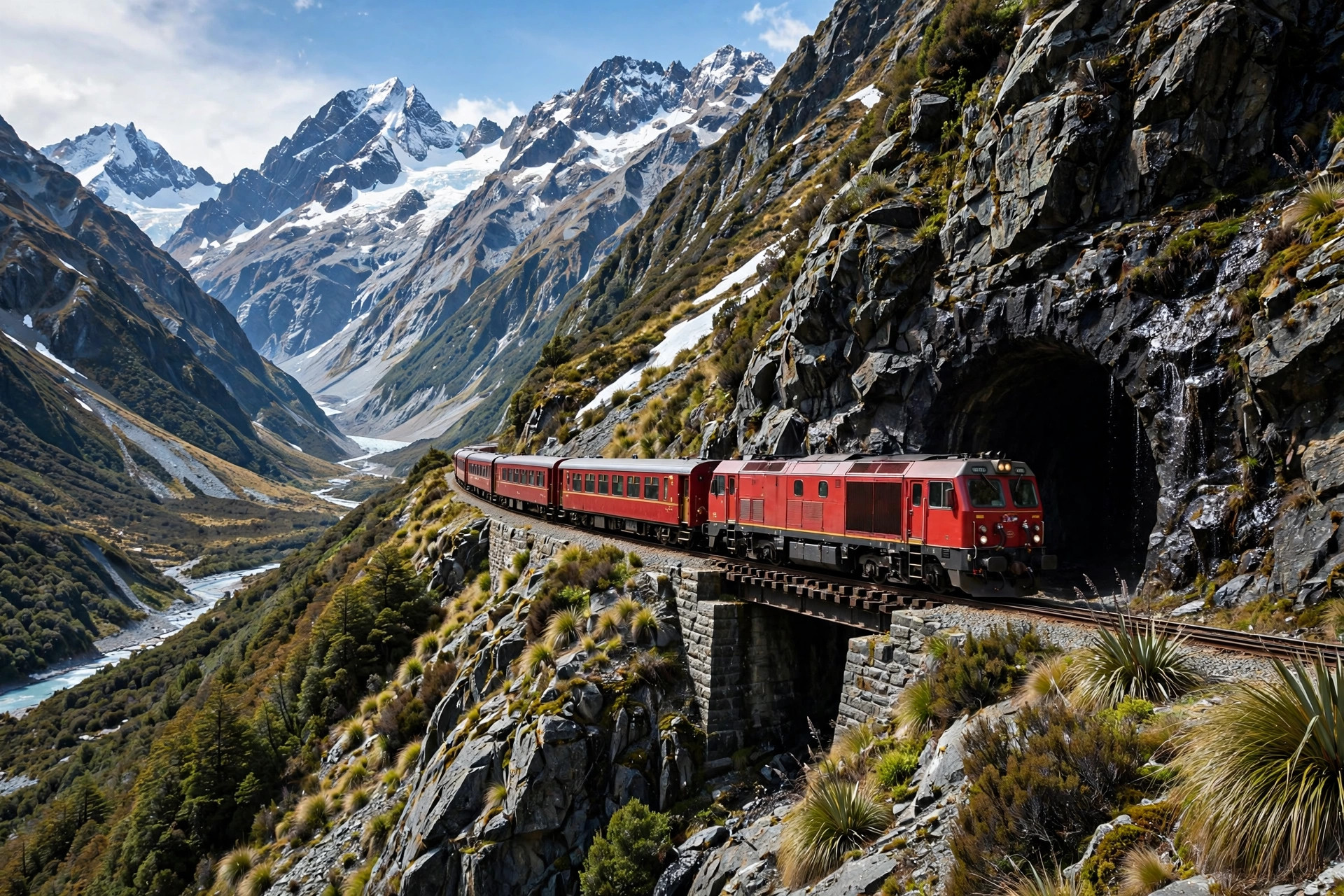
The TranzAlpine TAIC report has finally put the full story of a frightening morning on New Zealand's Midland Line on the public record. The Transport Accident Investigation Commission (TAIC) published an interim report on 12 November 2026 into an incident that happened almost six months earlier: on 30 May 2026, a TranzAlpine passenger train carrying 177 passengers stalled inside Tunnel 9 near Springfield, Canterbury, and sat there for 76 minutes after a locomotive failure triggered a toxic gas alarm. Nobody was hurt. That is the good news. The TranzAlpine TAIC report's value lies in what it shows about how a routine scenic journey became a serious emergency in a dark, enclosed tunnel — and what still has to be answered before the final report.
The TranzAlpine is one of New Zealand's best-known tourist trains, running daily between Christchurch and Greymouth across the Southern Alps. It is owned by KiwiRail Holdings and operated by Great Journeys New Zealand, KiwiRail's tourism business, according to TAIC. The route crosses the Midland Line, a stretch of railway that threads through the mountains in a series of tunnels. Tunnel 9, about 10 kilometres north of Springfield, is one of them. On the morning of 30 May 2026, it became the scene of the line's most serious passenger incident in years.
What the TranzAlpine TAIC report found
The TranzAlpine TAIC report, published as inquiry RO-2026-104, sets out what investigators have established so far. The Commission approved the final interim report for publication on 28 October 2026, and released it on 12 November. Its core finding is mechanical: an engine fault caused the locomotive's electrical system to overheat, the train lost power, and it came to a stop inside the tunnel. The train was secured, an emergency was declared, and a locomotive from Springfield was sent to recover it. None of the crew or the 177 passengers was harmed, TAIC said.
The TranzAlpine TAIC report is interim, not final, and that distinction matters. TAIC says its full inquiry is continuing, and a final report setting out findings, safety issues and recommendations will be issued when it is complete. What the TranzAlpine TAIC report gives us is the factual sequence — what broke, when, and what the crew did — without yet answering the wider questions about maintenance, equipment, training and communication that the final report will examine.
The 76 minutes inside Tunnel 9
The sequence began early. At 08:15 on 30 May 2026, Train 803, operating as the TranzAlpine service, departed Addington Station in Christchurch with 162 passengers, one locomotive engineer and six on-board crew, the TranzAlpine TAIC report says. The train was hauled by locomotive DXC 5391. By the time it approached Tunnel 9, after picking up passengers at stops along the way, it was carrying 177 passengers.
At 09:44, the locomotive suffered a rectifier fault while travelling at 30 kilometres per hour, the TranzAlpine TAIC report records. A rectifier converts alternating current to direct current, and when it failed, the locomotive stopped providing tractive effort — the pulling force that moves the train. At 09:46 the train entered Tunnel 9 at 22 kilometres per hour, and at 09:47 it came to a stop inside the tunnel, at about the 65.73 kilometre mark on the Midland Line. The whole train, with 177 passengers, one locomotive engineer and six on-board crew, was inside Tunnel 9.
The cause, as TAIC describes it, began in the cooling system. The Traveler, reporting on the interim report, said a gear in the equipment blower fan drive train failed, cutting off the flow of cooling air and leading to an electrical rectifier fault. With key components overheating, a "Hot Diode" warning lit up in the cab — the fault code TAIC's report records on the engine control panel — and the locomotive's pulling power was lost. The train coasted to a stop entirely inside the tunnel, coming to rest about 100 metres from the western portal and about 250 metres from the eastern entrance, according to The Traveler.
The 177 passengers spent approximately 76 minutes inside Tunnel 9, the TranzAlpine TAIC report states. The locomotive was eventually restarted with authorisation from train control, and the train moved slowly out of the tunnel to Staircase, a remote stopping point between Springfield and Arthur's Pass, where a waiting recovery locomotive coupled to the coaches. From there it hauled the train back toward Christchurch. Passengers finally disembarked at Christchurch Railway Station at about 2:23pm local time, The Traveler reported — several hours after the morning departure.
The toxic gas alarm: what it did and did not mean
The detail that gives the incident its edge is the gas alarm. As the locomotive engineer shut the failed engine down, the driver's personal gas monitor — a portable device that continuously samples air quality — sounded an alarm indicating increased levels of potentially toxic gases, The Traveler reported, drawing on the TranzAlpine TAIC report. In a tunnel, with air circulation restricted and a diesel locomotive shut down inside, that alarm changed the character of the emergency. The crew were no longer dealing only with a broken train. They were dealing with a confined space where the air itself might be dangerous.
KiwiRail classified the situation as a Level 3 emergency, triggering a full recovery response, according to The Traveler. That is the highest level of operational emergency response, and it explains why a recovery locomotive was dispatched from Springfield and why the train was moved only under close supervision once the locomotive could be restarted.
What the alarm did not mean is equally important. Subsequent reporting indicates that measurable gas concentrations did not reach levels that resulted in injuries, The Traveler noted, and TAIC confirms that none of the crew or the 177 passengers was harmed. The alarm signalled elevated risk, not a confirmed poisoning. Investigators are now examining exactly what the monitor detected and why, as part of the continuing inquiry. Until the final report, the gas readings remain one of the open questions — and one of the reasons the interim report describes the incident as serious even without injuries.
Why the TranzAlpine TAIC report matters for tunnel safety
The TranzAlpine TAIC report describes the incident as a serious occurrence, and the reasoning is straightforward: 177 people, many of them tourists unfamiliar with the railway, spent more than an hour inside a dark tunnel with a toxic gas alarm sounding and no way to move. The outcome was good. The risk was not small. A stalled train in a tunnel is one of the hardest emergencies in rail transport, because the usual answer — get everyone off the train — can be more dangerous than keeping them on it, especially in a narrow tunnel with limited light and ventilation.
The TranzAlpine TAIC report notes that passengers remained on board until the train could be moved, and that there were no mass self-evacuations onto the track, The Traveler reported. That is a credit to the crew's handling of the situation, and it is also a point the final report will return to: how quickly should a stranded train in a tunnel be evacuated, and who decides? The debate matters beyond this one incident, because New Zealand's scenic rail routes run tourists through tunnels every day, and the same question would arise anywhere else in the world.
The final report is expected to examine whether maintenance regimes, equipment specifications, crew training or communication protocols require changes, The Traveler reported. Those are the systemic questions — the ones that decide whether this was a one-off mechanical failure or a sign of something that needs fixing across the fleet.
A second Midland Line incident: the Otira coal train derailment
The TranzAlpine's troubles did not end with the May incident. On 3 November 2026, a separate event on the same line cut the service short. TAIC said coal train 834, run by KiwiRail, was travelling toward Christchurch on the Midland Line at about 10pm on 3 November when at least one of its wagons left the rails. The train came to a halt inside the Otira Tunnel. No one was reported hurt, but the commission said the train and the rail infrastructure had reportedly suffered extensive damage.
The effect on passengers was immediate. From 4 November until an estimated 20 November, TranzAlpine trains run only between Christchurch and Arthur's Pass, and buses carry passengers between Arthur's Pass and Greymouth, railway.supply reported. Until then, TranzAlpine trips between Arthur's Pass and Greymouth cannot be booked. TAIC has opened a separate inquiry into the derailment, with Chief Investigator of Accidents Louise Cook saying a team of investigators had been appointed and was already collecting evidence. The cause of the derailment remains unknown.
The two incidents are different in kind — a locomotive failure and a derailment, five months apart — but they share a line, a tunnel, and a spotlight. Together they have made November 2026 a difficult month for the Midland Line. For background on other recent rail incidents, see our reports on the train collision near Cairo and the Spanish train crash investigation.
What happens next
Two inquiries are now running. TAIC's investigation into the 30 May Tunnel 9 incident continues toward a final report with findings, safety issues and recommendations, and the inquiry into the 3 November Otira derailment is gathering evidence at the scene. Neither has a published completion date, and TAIC's previous final reports on the Midland Line have taken roughly 8 to 17 months after the occurrence, railway.supply calculated from the commission's published record.
For travellers, the practical position is this: the TranzAlpine continues to operate, but only between Christchurch and Arthur's Pass until about 20 November, with buses covering the rest of the route to Greymouth. No broad safety warning has been issued against travel on the line, The Traveler reported. The TranzAlpine TAIC report's publication means the 76 minutes in Tunnel 9 are now a matter of public record, with names, times and a fault sequence attached. What remains is the final report — and whether it finds that a gear, a fan and a rectifier were the whole story, or whether the way the railway maintains, equips and trains for tunnel emergencies needs to change.