
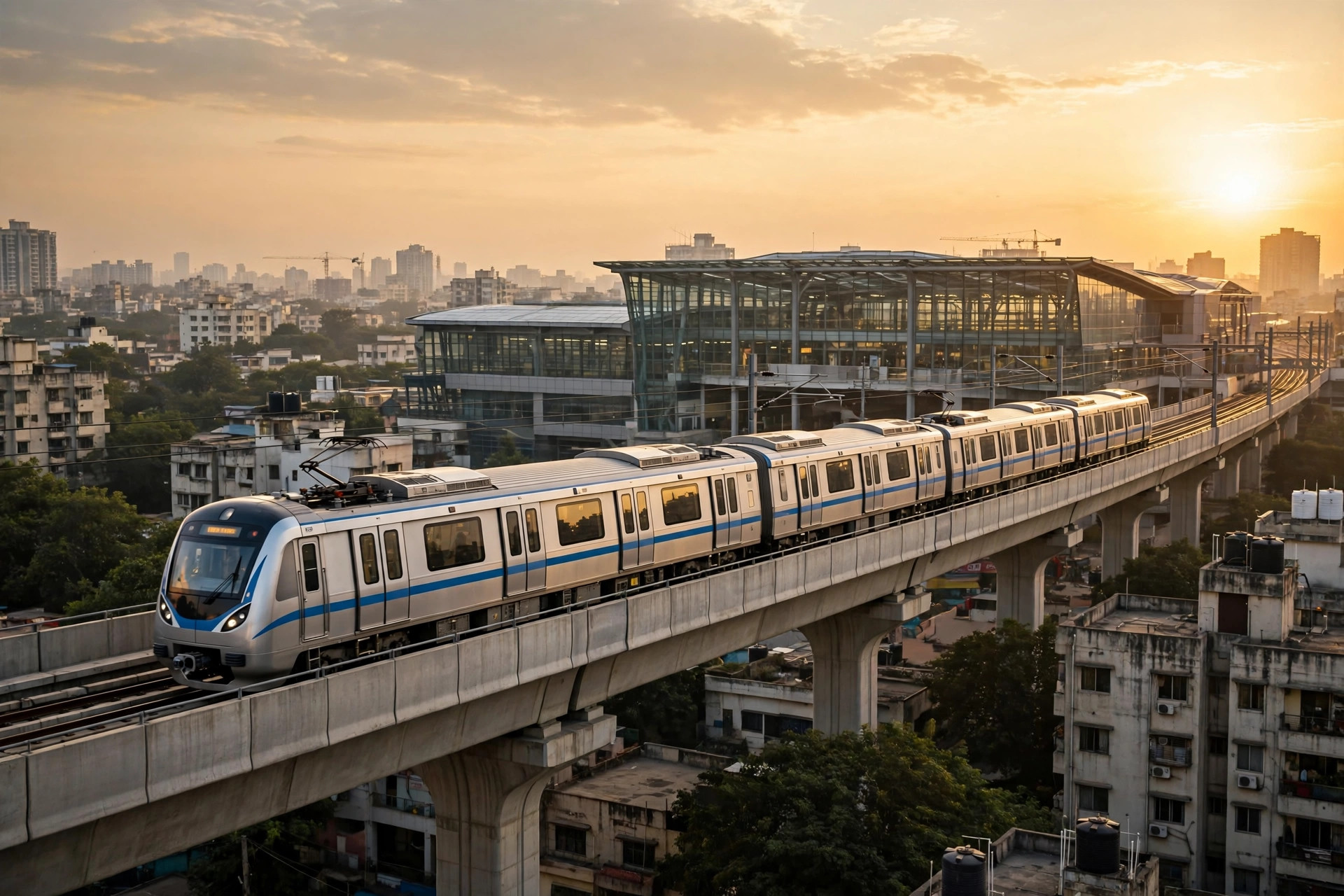
The Pune Metro Pink Line has opened, giving Pune's technology workers and commuters a new way across one of India's most congested cities. Prime Minister Narendra Modi virtually inaugurated Pune Metro Line 3, the Pink Line, on 3 November 2026, and passenger services began at 6am on 4 November 2026. The Pune Metro Pink Line runs 23.203 kilometres from Maan, in the Hinjawadi IT Park, to District Court station in Shivajinagar, and it is the first metro line in India built under a public-private partnership model. For the thousands of people who travel every day between Hinjawadi and central Pune, the line promises to cut a journey that can take more than 90 minutes by road to about 45 minutes by metro.
The opening is a milestone for Pune, a city whose growth as an information technology hub has long outpaced its transport. Hinjawadi is home to one of India's largest IT parks, and the road between it and the city centre is notorious for traffic jams that can turn a short distance into a long ordeal. The Pink Line is designed to take cars off that road, to connect the IT park with the rest of the city's metro network, and to show that private investment can build public transport in India. This explainer covers the route, the stations, the fares, the timings, the partnership model behind the line, and the four new corridors whose foundation stones were laid on the same day.
Pune Metro Pink Line: The Route at a Glance
The Pune Metro Pink Line is a 23.203 kilometre fully elevated corridor from Maan, in the Hinjawadi IT Park, to District Court station in Shivajinagar. The corridor passes through Wakad, Balewadi and Baner, and it serves some of the busiest parts of western Pune, including the Rajiv Gandhi Infotech Park in Hinjawadi, the Balewadi sports complex area, Aundh, Pune University and Shivajinagar, a major administrative and commercial hub.
The line has 23 stations in total, of which 17 opened initially when passenger services began on 4 November 2026. The remaining six stations will open in phases by January 2027, so the full corridor will not be complete on day one, but the core of the route is already running. At District Court, passengers can change to the existing Purple Line and Aqua Line, creating a connected network across the city for the first time.
The corridor aims to halve travel time between Hinjawadi and Shivajinagar. A full ride from Maan to District Court takes about 45 minutes by metro, compared with more than 90 minutes by road during peak hours. That time saving is the line's most important promise: for daily commuters, 45 minutes saved in each direction is 90 minutes a day, or more than seven hours a week, returned to their lives.
Pune Metro Pink Line: Stations, Fare and Timings
The Pune Metro Pink Line opened with 17 stations, including Maan, Hinjawadi Phase II, Hinjawadi Phase I, Wakad Chowk, Mahalunge, Balewadi, Aundh, Savitribai Phule Pune University, Agriculture College and District Court. The remaining six stations will open in phases by January 2027, extending the line's reach and filling the gaps in the initial service.
Passenger services began at 6am on 4 November 2026, and trains run at a peak frequency of about every 6 minutes, with services roughly every 12 minutes at other times. The full-ride fare is 62 rupees, with shorter journeys costing less: fares start at 12 rupees for journeys of up to 2 kilometres and rise with distance. The operator plans to review fares after six months, so passengers should check the fare chart at the station before travelling.
One of the most striking features of the line is that its trains are operated entirely by women operators. The project authorities have described this as a first-of-its-kind initiative in gender-inclusive public transport, and it is a deliberate part of the line's identity: the Pink Line is not only a transport project but a statement about who runs Pune's public services.
A First for India: The PPP Model
The Pune Metro Pink Line is the first metro project in India built under the public-private partnership Design-Build-Finance-Operate-Transfer model, known as DBFOT. Under this model, a private company designs, builds, finances and operates the line for a fixed period, and then transfers it back to the public authority. The model is designed to bring private money and private efficiency into public infrastructure, and its success or failure on the Pink Line will be watched by cities across India that are considering the same approach.
The line was built by Pune IT City Metro Rail Limited, a special purpose vehicle formed as a joint venture between Siemens and Tata TRIL Urban Transport, under a 35-year concession from the Pune Metropolitan Region Development Authority, known as PMRDA. The project cost about 8,313 crore rupees, including land acquisition and utility shifting, a large sum that reflects the scale of building a 23.203 kilometre elevated corridor through a built-up city.
The concession lasts 35 years, during which the operator will run the trains, maintain the line and collect the fares. At the end of that period, the line transfers to the public authority. For passengers, the model should be invisible: what matters is whether the trains run on time, the stations are clean and safe, and the fares stay affordable. For policymakers, the Pink Line is a test of whether the private sector can deliver a metro line on time and on budget, and whether the DBFOT model can be repeated elsewhere.
Phase II: Four More Corridors
The opening of the Pink Line was not the only metro news on 3 November. Prime Minister Narendra Modi also laid the foundation stones for four Phase-II corridors, Lines 2A, 2B, 4 and 4A, with a combined investment of about 21,800 crore rupees. Those corridors will extend Pune's metro network further, connecting more of the city's neighbourhoods and employment centres to the lines that are already running.
The Phase-II investment is more than two and a half times the cost of the Pink Line itself, which shows the scale of Pune's ambition for its metro network. When the new corridors are complete, the city will have a network that reaches far beyond the current three lines, and the District Court interchange will become one of the busiest stations in the system, linking the Pink Line with the Purple and Aqua lines and with the future corridors.
What the Pink Line Means for Pune
For Pune, the Pink Line is more than a new train service. It is the first direct rapid-transit link between the city's largest employment cluster and its centre, and it is expected to carry large numbers of passengers once fully operational. It should take cars off the Hinjawadi road, reduce air pollution from traffic, and make it easier for employers in the IT park to attract workers who live across the city.
It also matters for India's cities more broadly. If the DBFOT model works in Pune, other cities will follow, and private money could help build the metro lines that India's growing cities need but that public budgets cannot fund alone. And if the line's women operators become a model for other systems, the Pink Line will have changed more than Pune's commute: it will have shown that a metro can be both modern and inclusive. The test now is delivery. The 17 stations that opened on 4 November 2026 must run reliably, the remaining six must open by January 2027 as promised, and the fares must stay within reach of the commuters the line was built for. If they do, the Pune Metro Pink Line will be remembered as the day Pune's traffic problem finally met its match. For other changes taking effect in India this month, read our guide to the new rules in India from 1 November 2026 and our explainer on Japan's new tax-free shopping rules.