
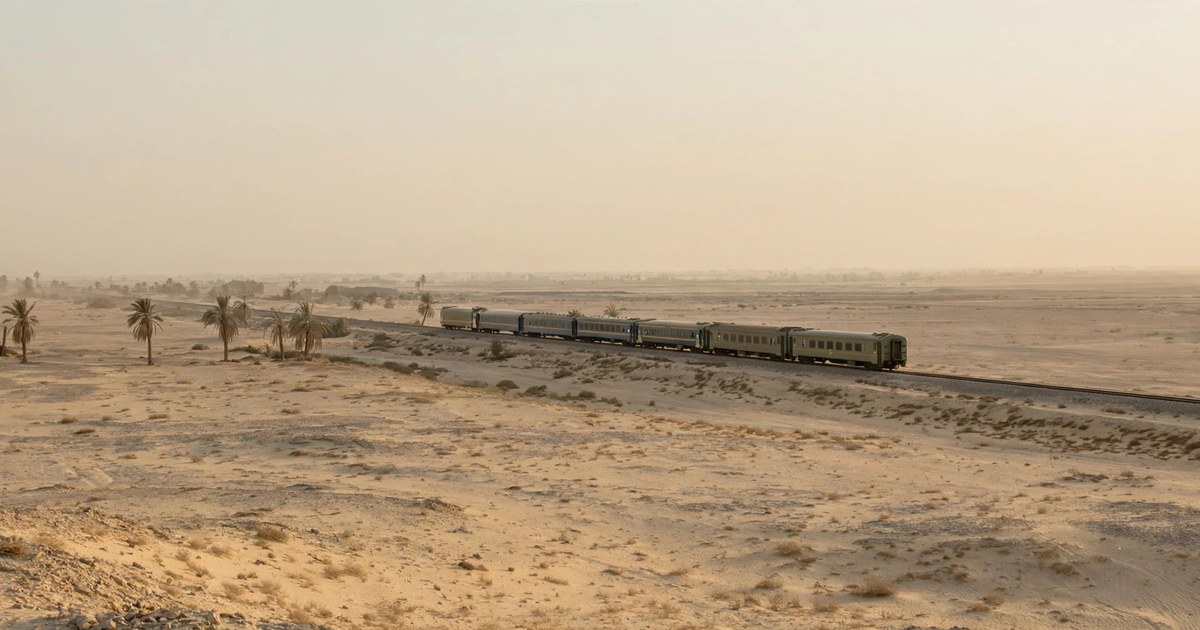
An Egypt train collision south of Cairo killed seven people and injured more than 100 on Sunday, 8 November 2026, when a passenger train ran into the back of another service standing on the same track. The crash happened between Kafr Ammar and Al-Raqqa stations in Giza's Al-Ayyat district, about 50 kilometres south of the capital, on a stretch of line that has already seen some of the worst rail disasters in Egypt's history.
Both trains were heading south. Train No. 134, a Tahya Misr service travelling from Giza to Fayoum, struck the rear of Train No. 2010, a Cairo-to-Aswan service that was stationary on the track, the Egyptian National Railways Authority said. Several carriages derailed, and some left the track and plunged down an embankment.
What happened in the Egypt train collision
The collision happened on Sunday afternoon, 8 November, on the main Cairo-to-Aswan line. The Giza-to-Fayoum train hit the last carriage of the Cairo-to-Aswan service, which was standing between the two stations. The force of the impact derailed several carriages, and rescue teams worked for hours at the site, in the Al-Ayyat area of Giza province.
Egypt's Health Ministry said 72 ambulances took part in the rescue, carrying the injured to hospitals in Giza and the neighbouring Beni Suef governorate. Cranes were brought in to lift the wrecked carriages clear, and train services between Giza and Upper Egypt were suspended while the line was cleared. The driver of the Giza-to-Fayoum train was among the seven people killed, according to reports from the scene.
President Abdel Fattah al-Sisi said he was following the incident closely and had ordered an urgent investigation, adding that anyone found negligent would be held accountable. Egypt's Public Prosecution has opened its own inquiry into the cause and circumstances of the crash. No cause had been announced by Monday morning, and investigators were expected to examine the trains' operating records, the signalling on the stretch, and whether the drivers were at fault.
Seven dead, more than 100 injured: the casualty figures
The casualty figures moved several times through Sunday as hospitals reported in. Egypt's Health Ministry first reported four people dead and 88 injured. That toll was later raised to seven dead and 112 injured, CNN reported, and Egypt's chief prosecutor's office later put the injured figure at 125. The two injured counts have not been fully reconciled by the authorities, which is why the confirmed figure used here is "more than 100 injured".
Of the injured, 45 people had been discharged from hospital by Sunday evening after their condition improved, the Health Ministry said, and seven more were expected to be discharged soon. The remaining patients were still receiving treatment, with injuries including broken bones, head trauma, fractures of the pelvis and vertebrae, and chest injuries.
The death toll of seven was confirmed by both the Health Ministry and the prosecutor's office, and it includes the driver of the Giza-to-Fayoum train. The victims' identities had not all been publicly released by Monday morning.
Why the Egypt train collision happened in Al-Ayyat
Al-Ayyat is not a random spot on Egypt's railway map. It is the site of the country's deadliest ever rail disaster: on 20 February 2002, a fire swept through an overcrowded passenger train carrying holiday travellers south of Cairo, killing more than 370 people. The official count in the list of rail accidents in Egypt puts the toll at 383.
The same district has seen repeated crashes since. In 2009, separate train collisions in the Al-Ayyat area killed dozens of people, including a rear-end collision near Kafr Ammar in October 2009 that killed 18. As recently as September 2026, two freight trains collided in the same district, injuring a driver and his assistant and derailing a locomotive and two wagons.
That history is why the location matters as much as the crash itself. A rear-end collision on a busy intercity corridor raises the same questions every time: was the stationary train properly protected by signals, did the approaching driver have warning, and was the signalling system working as it should? The prosecutor's investigation will have to answer those questions, and until it does, no cause can be stated as fact.
Why Egypt's trains keep crashing
Egypt's railway is the oldest in Africa and the Middle East, and one of the largest networks on the continent. Around 110 million people depend on it, and it carries millions of passengers every day on ageing tracks and rolling stock. Over the past decade Egypt has poured billions of dollars into transport infrastructure, including new highways and high-speed rail lines, but much of the older network has yet to be overhauled, and the results show in the accident record.
The pattern is grimly familiar. In March 2021, a passenger train ran into the rear of another near Sohag, killing at least 18 people and injuring 200; prosecutors ordered the arrest of eight rail officials. In February 2019, a runaway locomotive smashed into a barrier at Cairo's Ramses Station, causing an explosion and fire that killed 25 people. In April 2021, four carriages derailed at Tukh, killing 23 people and injuring 139. Sunday's crash in Giza follows the same shape as Sohag: one train running into the back of another on a main line.
Spain faced a similar reckoning this autumn, when a train crash near Urda in Toledo killed 69 people and investigators later pointed to a signalling failure. The comparison matters because it shows what a serious investigation looks like: not just who was driving, but whether the system that was supposed to stop two trains sharing one stretch of track actually worked.
What happens next: investigation and accountability
Two investigations are now running. The transport ministry and the railway authority are examining the crash itself, while the Public Prosecution is conducting a separate inquiry into the cause and the circumstances. President Abdel Fattah al-Sisi has publicly ordered that anyone found negligent be held accountable, a promise Egyptians have heard after previous crashes.
What to watch is whether this investigation goes beyond the drivers. After Sohag in 2021, eight rail officials were arrested, but the crashes continued. The questions that will decide whether Sunday's crash changes anything are the ones about the system: the signalling on the Al-Ayyat stretch, the maintenance record of the trains involved, and the staffing and safety procedures on one of the busiest corridors in the country.
Services between Giza and Upper Egypt were suspended after the crash, and passengers were left waiting for the line to reopen. The railway authority had not given a firm time for services to resume by Monday morning.
What the Giza crash means for passengers
For the millions of Egyptians who ride the trains every day, the Giza crash is not an abstract statistic. It is the latest proof that the journey they make daily still carries a risk that wealthier countries engineered away decades ago, and that the risk is worst on exactly the corridor where the country's worst disaster already happened.
The test of this crash is not the death toll, terrible as seven deaths are. It is whether the investigation answers the Al-Ayyat question: why does the same stretch of track keep producing the same kind of accident? If the answer stops at one driver, nothing will have changed. If it reaches the signalling, the maintenance backlog and the safety culture on the line, Sunday's crash could be the one that finally forces the overhaul Egypt's railway has needed for a generation.
Sources: CNN; Reuters; the Associated Press; Al Jazeera; Sky News; Egypt's Ministry of Health and Population; the Egyptian National Railways Authority; Egypt's Public Prosecution; Wikipedia, List of rail accidents in Egypt.