
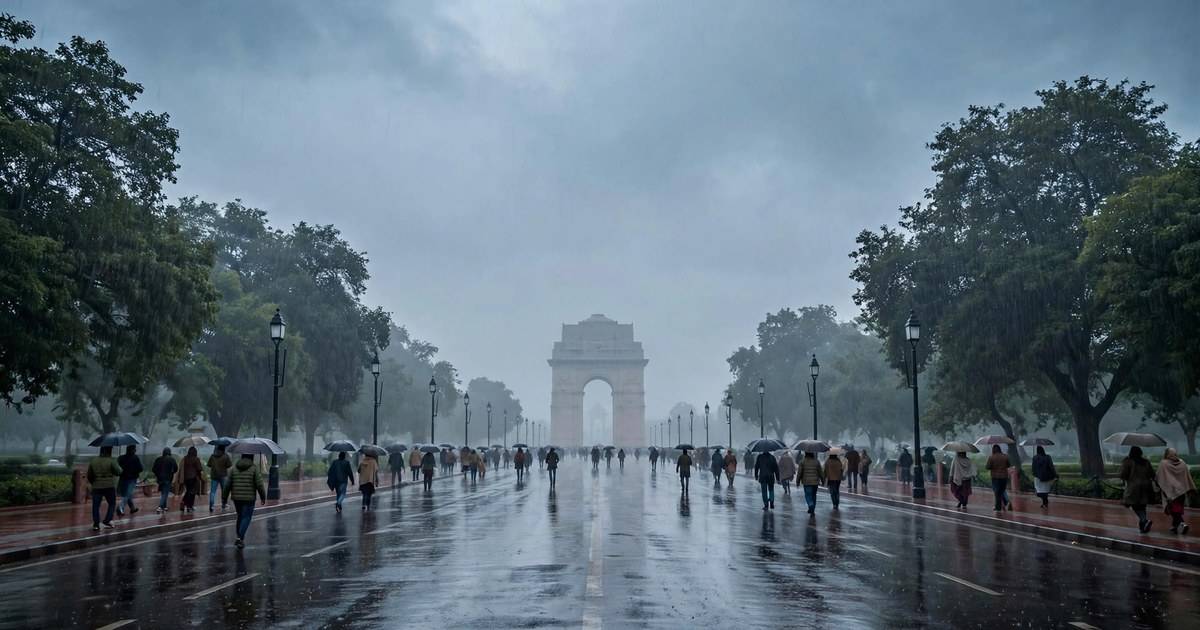
Delhi has recorded its coldest October day in 75 years. On Friday, 30 October 2026, the maximum temperature at Safdarjung — the capital's base weather station — settled at 20.7°C, a full 10.3 degrees below the seasonal normal and the lowest October maximum the city has seen since 1951. The Delhi coldest October day in 75 years capped two days of persistent rain that also scrubbed the capital's air dramatically cleaner. Search interest surged across India, where the cold snap topped Google's trending searches. Here is what happened, why it happened, and what comes next.
Delhi Coldest October Day: What the 20.7°C Reading Means
The headline number is a daytime figure. The 20.7°C recorded at Safdarjung on Friday was the maximum temperature — the highest the mercury reached all day — and it was 10.3 degrees below the seasonal normal of about 31°C. According to the India Meteorological Department (IMD), it was the lowest maximum temperature recorded in October at the station since 1951, breaking a record that had stood for 75 years. The previous record was 21.5°C, set on 25 October 1975.
There is one important distinction worth making. The night was not unusually cold at all: the minimum temperature on Friday was 17.2°C, one degree above normal. Because of that, the IMD did not classify Friday as an official "cold day" — that classification needs the minimum temperature to fall below 10°C as well as a maximum at least 4.5 degrees below normal. So "coldest October day" and "cold day" are two different things. The record is real, but it is a record for the daytime high, not an IMD cold-day declaration. What made Friday extraordinary was a daytime temperature that behaved like December, while the night stayed mild.
Why Delhi Turned So Cold: Cyclone Arnab Meets a Western Disturbance
The cold arrived with the rain. The remnants of severe Cyclone Arnab interacted with a western disturbance over northern India, producing two days of persistent rainfall and dense cloud cover across the capital. The cloud blocked the sun, the rain cooled the air, and daytime temperatures collapsed. The same weather system brought rain to Uttar Pradesh, Bihar, Madhya Pradesh and Punjab, and the IMD issued red and orange alerts for thunderstorms across Delhi-NCR, Uttar Pradesh and much of northern India.
The scale of the rain was itself record-breaking. Safdarjung recorded 61.4 mm of rain in the 24 hours ending at 8.30 am on Friday, making it the sixth-wettest October day at the observatory since records began in 1951, according to IMD scientist D R Pattanaik. It was also the wettest October day in four years — the last time Delhi received more rain on an October day was 9 October 2022, when the station recorded 74 mm.
Thursday vs Friday: Two Record Days in a Row
Friday's record followed a record the day before, which explains why early reports carried a different figure. On Thursday, 29 October, the maximum temperature at Safdarjung settled at 25.4°C, about 5.6 degrees below normal. That was already Delhi's coldest October day in four years, beating the 23.4°C recorded on 8 October 2022. Then Friday smashed Thursday's mark by 4.7 degrees, taking the temperature from a four-year record to a 75-year record in a single day.
Both reports were correct — they simply described different days. Thursday's 25.4°C was the coldest October day since 2022; Friday's 20.7°C was the coldest since 1951. The two-day spell worked as a pair: Thursday's cloud and rain set the pattern, and Friday's heavier rain pushed the daytime temperature down to a level Delhi had not seen in October for three-quarters of a century.
Delhi Coldest October Day Brings Cleaner Air: AQI Falls to 60
The downpour did what Delhi's air needed most. The city's air quality index (AQI) fell to 60 on Friday as the rain washed pollutants out of the air. The wider picture is just as striking: October's average AQI of 167 was the lowest monthly October average since 2015, according to the Centre for Research on Energy and Clean Air (CREA). For a city that usually spends October choking on smog, it was an unusually clean month.
The relief is already fading. On Saturday morning, 31 October, Delhi's AQI stood at 110 at 8 am, back in the "moderate" category, and the Air Quality Early Warning System forecast that it would drop to "poor" from 1 November. The timing matters: Delhi's winter action plan takes effect from 1 November, just as the clean-air window closes and the capital heads into its usual winter pollution season.
What Happens Next After Delhi's Coldest October Day
The cold will not last. Forecasters expect daytime temperatures to climb back to between 29 and 31 degrees Celsius by Monday, with minimum temperatures holding between 15 and 17 degrees. The cold snap was a weather event, not the arrival of winter — the systems that caused it are clearing, and a more sustained cooling trend is not expected until the second week of November.
That makes the record a snapshot of an extraordinary weekend rather than a new normal. Delhiites who reached for windbreakers and shawls on Friday will be back in lighter clothes within days, and the air quality is forecast to slip back to poor from 1 November. The records, though, will stay in the IMD's books: a 75-year temperature record and one of the wettest October days on record, both set within 24 hours of each other.
What the Cold Snap Means for Delhi's Winter
The numbers put the month in perspective. Cumulative rainfall at Safdarjung reached 123.3 mm by 8.30 am on Friday, against a monthly normal of just 15.1 mm — more than eight times the normal October rain, and the wettest October in four years. October is normally one of Delhi's driest months, coming after the monsoon has withdrawn, so a month that delivered eight times its usual rain is a genuine anomaly.
For Delhi, the episode is a reminder of how quickly the weather can swing. A cyclone's remnants and a western disturbance combined to deliver a December-like day in October, the cleanest October air in a decade, and a set of records that will be quoted for years. Then, almost as quickly, the city returns to near-normal temperatures and its familiar winter pollution. The 75-year record is the headline, but the real story is the contrast: one of the coldest and cleanest Octobers Delhi has known, followed immediately by the start of the season the city dreads most.
Sources: IANS; Hindustan Times; The Times of India; Mirror Now; The Hindu BusinessLine; India Meteorological Department (IMD); Centre for Research on Energy and Clean Air (CREA).