
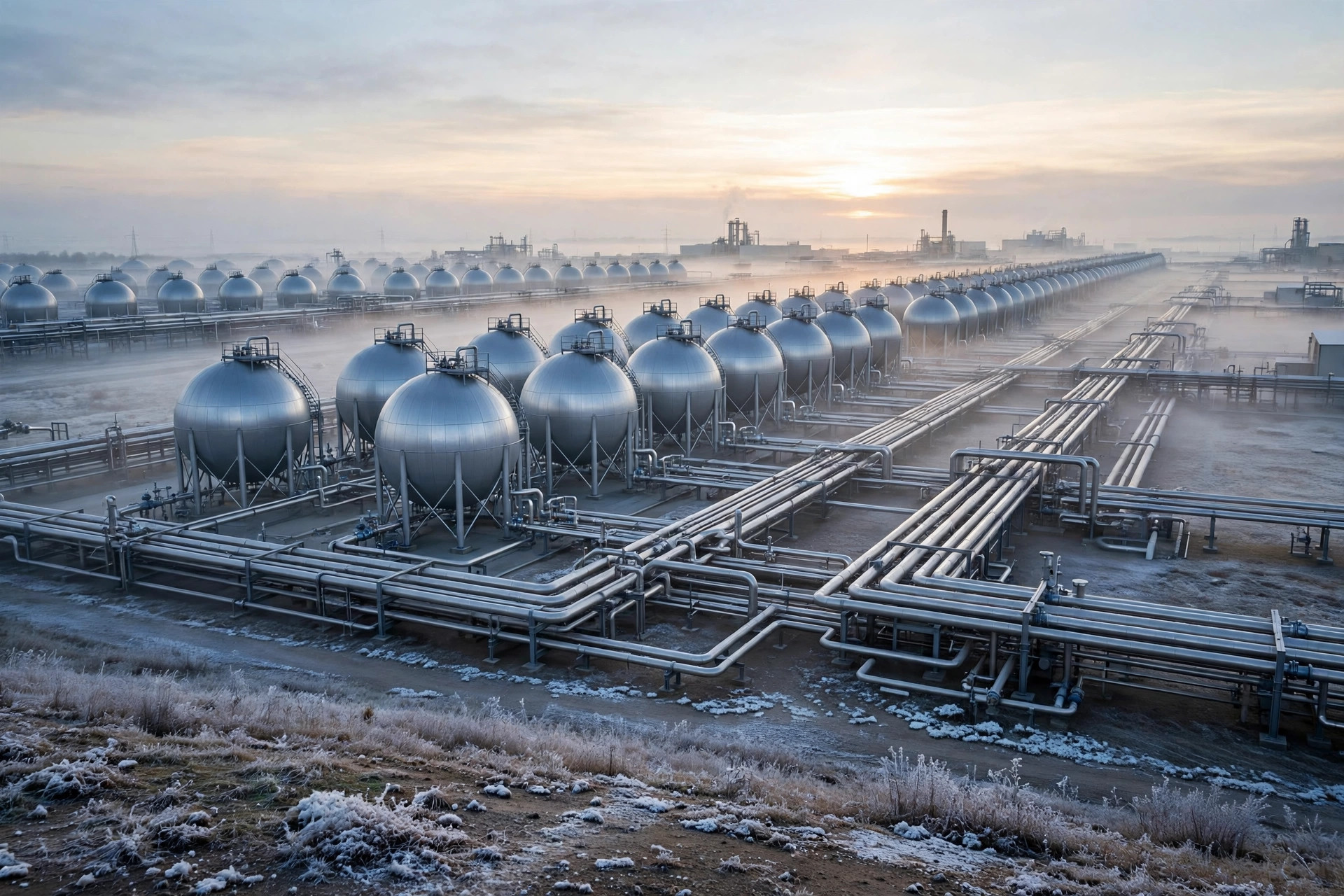
Background: the storage machine Germany built after 2022
Germany's gas story cannot be understood without the winter of 2022. When Russian pipeline gas stopped flowing, Europe's largest economy was forced to reinvent its energy supply almost overnight: building floating LNG terminals, signing new import deals and, crucially, turning underground gas storage into a strategic instrument. Berlin passed storage laws requiring facilities to be filled to set levels ahead of winter, and handed the job of organising the market to Trading Hub Europe (THE), the operator responsible for the German gas market area.
Germany holds roughly 45 underground storage sites with about 24 billion cubic metres of working gas — around a quarter of the country's annual consumption. Storage is the buffer that smooths out winter: gas bought cheaply in summer is drawn down when heating demand peaks. The system worked. But it depends on commercial incentives — the gap between summer and winter prices — and in 2026 those incentives have been badly damaged by a year of energy shocks.
The backdrop is a volatile autumn. European gas prices touched €90 per megawatt-hour on 20 October for the first time in almost four years, driven by supply risks in the Middle East, disruptions from Norway and the effective halt of Qatari LNG shipments through the Strait of Hormuz. Attacks on vessels in the region and fears for LNG shipping have kept markets on edge, with European storage overall at only about 74% — the lowest for this point in the year in over a decade.
What happened: €245 million of insurance
On Friday 23 October 2026, Trading Hub Europe said it had awarded contracts worth nearly €245 million ($274 million) to secure additional gas supplies for the winter, amid significantly lower storage levels, Reuters reported.
The money breaks down into two parts. Special tenders aimed at safeguarding supply for February and March 2027 alone cost about €107 million — the coldest, riskiest tail of the heating season. That sits on top of approximately €137 million for the standard tenders through which THE secures gas supplies each year to address potential grid bottlenecks.
These contracts are a kind of insurance policy. They offer an incentive for participating companies to keep gas in storage longer and potentially store additional volumes, in case extra gas is needed during a cold snap or a supply disruption. THE, which runs the tenders, is effectively paying the market to hold a buffer the market would not otherwise hold.
The numbers explain why. As of 21 October, German gas storage facilities were only 61.1% full — compared with 75.4% at the same time last year, a gap of more than 14 percentage points. In August, levels had been as low as around 50%. Germany is the outlier among its neighbours: Italy sits near 90% full, France near 88% and Spain near 78%, while the Netherlands and Austria are also well ahead of Berlin.
Why it matters: a thin buffer in a nervous market
A storage level is not just a number; it is the margin between comfort and crisis. Gas in storage is what keeps homes heated and factories running if a cold wave coincides with an import disruption. At 61% with winter approaching, Germany has a thinner cushion than at any point since the 2022 emergency — and it is entering the season with European prices already at multi-year highs.
Why did filling stall? The sharp rise in global gas prices after military action involving Iran and the temporary blockade of the Strait of Hormuz collapsed the summer-winter price spread that normally rewards wholesalers for buying gas in summer and storing it. With little profit in filling caverns, commercial operators simply bought less. Germany's federal network agency, the Bundesnetzagentur, insists supply is secured, citing new pipeline links and growing LNG import capacity — but southern Germany remains the most exposed region, lacking nearby LNG terminals and relying on cross-border storage such as Haidach in Austria.
The strain is already visible in the retail market. Spiking wholesale prices have forced smaller German power suppliers out of business — startup retailers serving hundreds of thousands of customers have folded or been absorbed by larger utilities, a painful echo of the 2022 crisis. For households and industry, the energy-price squeeze that European leaders debated this month is not an abstraction; it is showing up in bills and in boardrooms.
Key facts
- The contracts: nearly €245 million ($274 million) awarded by Trading Hub Europe on 23 October 2026 — €107 million in special tenders for February–March 2027, plus ~€137 million in standard annual tenders.
- Storage level: 61.1% full as of 21 October 2026, versus 75.4% a year earlier; levels were as low as ~50% in August.
- The gap: Germany lags Italy (~90%), France (~88%) and Spain (~78%); EU storage overall is ~74%, the lowest for this season in over a decade.
- Price backdrop: European gas hit €90/MWh on 20 October, the highest in almost four years, driven by Middle East supply risks and Hormuz shipping fears.
- The mechanism: the contracts act as insurance, incentivising companies to keep gas stored longer and add volumes for late winter.
- The weak spot: southern Germany, far from LNG terminals and dependent on cross-border storage.
- Official line: the Bundesnetzagentur says supply is secured via new pipelines and expanded LNG capacity.
What happens next
The winter will be watched one gas day at a time. Europe's storage system is the most transparent in the world — every facility reports daily — so analysts, traders and governments will track Germany's drawdown against last year's curve through the coldest months. The special tenders specifically cover February and March 2027, the period when storage is at its emptiest and a late cold snap does the most damage.
The bigger question is structural. If price volatility keeps destroying the commercial case for filling storage, governments may have to make the insurance permanent — paying for strategic reserves year after year, as they are doing now, rather than relying on market incentives. Berlin is already moving in that direction, and Bavaria is pressing to keep local storage capacity earmarked for a planned national reserve.
For now, Germany has bought itself a buffer. Whether €245 million of insurance is enough will be decided by the weather, the Strait of Hormuz and the LNG market — the three variables no contract can control. Readers following the attacks on energy shipping and the sinking of tankers near Hormuz will understand why Berlin is not taking chances — and why the coming winter will be a test of everything Europe learned in 2022.
Sources: Reuters, Global Banking and Finance (Oct 2026).