
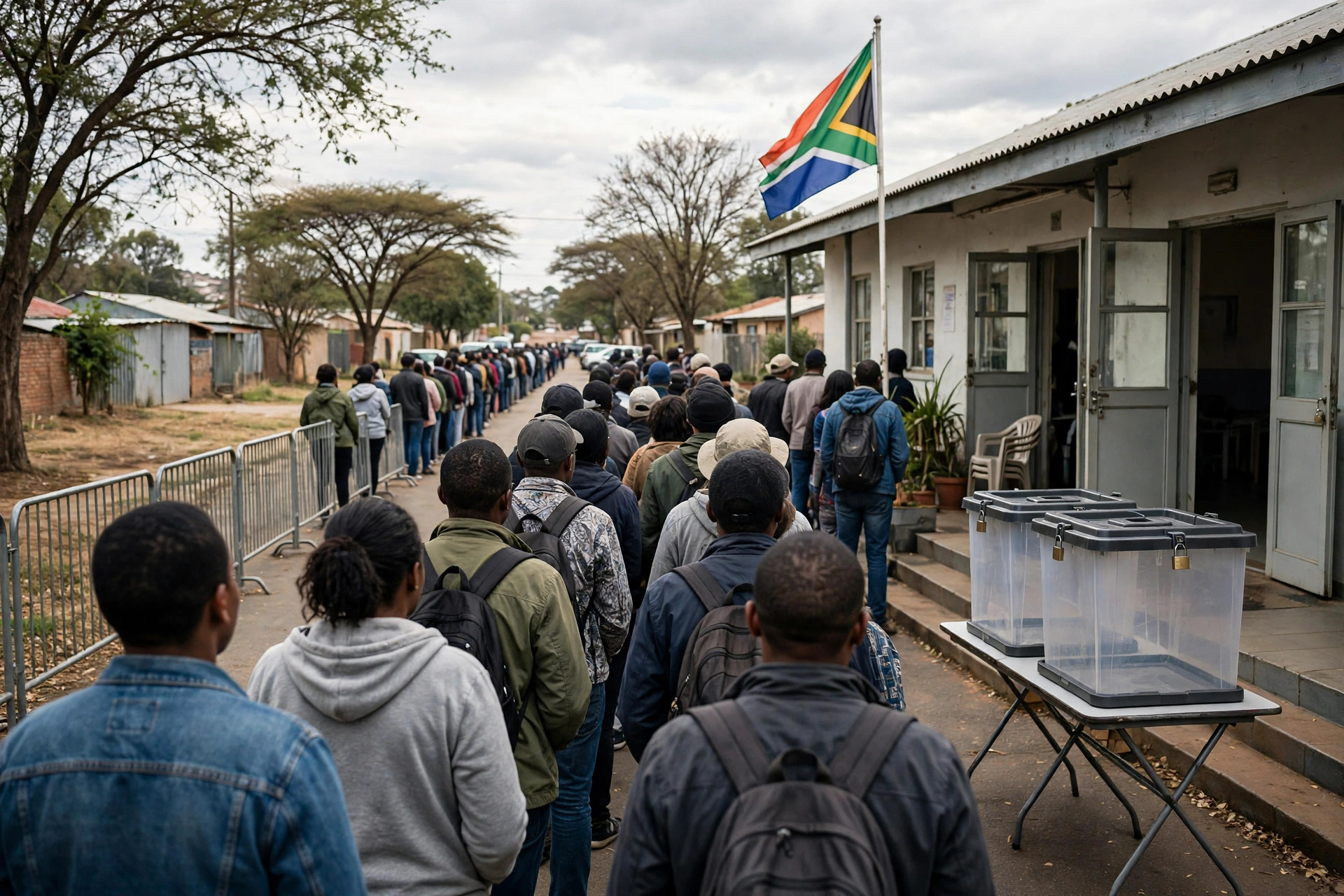
South Africa municipal election results 2026 are still provisional, and every figure in this article must be read with that warning in mind. With about 65 percent of voting districts counted, the African National Congress (ANC) leads the Democratic Alliance (DA) with 31.7 percent of the vote against 25.1 percent, according to the Electoral Commission's live results dashboard. Counting continues, the picture can still change, and the final declaration is expected on Sunday 8 November. What is already clear is the scale of the ANC's fall: it won 46 percent in the 2021 municipal elections, and it is now polling at about a third of the vote. Millions of South Africans voted on Wednesday 4 November 2026 to choose the councils that run their towns and cities, and the results so far point to a country in which no single party controls most councils, and coalition talks will decide who governs many of the biggest municipalities.
South Africa Municipal Election Results 2026: The National Picture at 65% Counted
At about 65 percent of voting districts counted, the live results from the Electoral Commission (IEC) show the ANC on 31.7 percent with 5,497,231 votes and 1,354 council seats, ahead of the DA on 25.1 percent with 4,356,437 votes and 717 seats. The uMkhonto weSizwe Party (MKP) is third on 8.5 percent with 245 seats, and the Inkatha Freedom Party (IFP) is fourth on 4.6 percent. A total of 3,096 of 8,825 council seats have been declared, and 17,357,502 valid votes have been counted across all ballots. These are provisional figures from the live dashboard, and they will move as the remaining districts report.
An earlier snapshot, taken at about 44 percent counted at 16:30 on Thursday 5 November, showed the ANC on 31.96 percent and the DA on 27 percent, with the MKP on 7.14 percent. The gap between the two leading parties has narrowed and widened at different stages of the count, because the districts that report first are not representative of the whole country. Turnout in the districts counted so far is about 53.5 percent. The Council for Scientific and Industrial Research (CSIR), working with the public broadcaster SABC, projects that the ANC will finish on about 32 percent and the DA on about 26 percent, but that projection is a statistical estimate, not an official result.
The election itself was one of the largest ever held in South Africa at local level. About 29.2 million voters were registered, there were 23,696 voting stations, 508 political parties contested the polls, and 10,526 council seats were up for election. The scale of the vote is part of why counting takes days, and why the final declaration is not expected until Sunday 8 November.
The Battle for the Big Cities
The most important story of this election may be what happens in South Africa's big cities, where the ANC has lost ground sharply. The DA leads in Gauteng, the country's economic heartland, with about 37 to 40 percent of the vote, and it has established a commanding early lead in Johannesburg. In the Western Cape, the DA leads with about 52 to 59 percent, and in Cape Town the projection is about 58 percent for the DA's Geordin Hill-Lewis, who announced the latest projection for the city. These are the areas where the DA has long been strongest, but the size of its leads, and the ANC's weakness in Gauteng, mark a shift in the country's political map.
At the council level, the ANC is leading in 39 councils and has outright control of 12, while the DA is leading in 13 councils and controlling 4. The MKP is leading in 4 councils and controlling 2. Those numbers show that outright control is rare: in most councils, no party has won a majority, and the result will be coalition negotiations. Parties will have two weeks after the declaration of results to form governing arrangements, and the talks in Johannesburg, Tshwane and other hung councils will be closely watched. For readers who followed the run-up to the vote, see South Africa local elections 2026: how to vote on 4 November.
South Africa Municipal Election Results 2026: What the Provinces Show
The provincial picture shows a country divided by region. The ANC leads in the Eastern Cape with 51.6 percent, and it also leads in Limpopo, Mpumalanga, the Free State, the North West and the Northern Cape. These are the provinces where the ANC has traditionally been strongest, and it remains ahead there, even though its national share has fallen sharply. The DA leads in the Western Cape with about 52 to 59 percent, a province it has governed for years, and in Gauteng with about 37 to 40 percent.
KwaZulu-Natal tells a different story again. There the MKP, the party led by former president Jacob Zuma, leads with about 31 to 32.7 percent, ahead of the IFP and the DA. The MKP's strength in KwaZulu-Natal is one of the defining features of this election, and it means the ANC faces a serious challenge in a province it once dominated. The provincial breakdown matters because municipal councils are where services such as water, electricity and refuse collection are delivered, and the party that controls a council decides how those services are run.
Why the ANC Share Has Fallen So Far
The headline of this election is the ANC's decline. In 2021, the party won 46 percent of the municipal vote, which was already its worst result in history at that level. At about 65 percent counted in 2026, it is on 31.7 percent, a fall of roughly 14 percentage points in five years. The CSIR/SABC projection of about 32 percent suggests the final figure will be close to the current one, but the count is not finished and the number could still move. The ANC has been South Africa's largest party since it led the country out of apartheid in 1994, and it has tended to do worse in municipal elections than in national ones. Even so, a result near a third of the vote would be a new low, and it would confirm that the party's dominance of local government is over.
The DA, by contrast, has held its position and strengthened it in the big cities, but it has not overtaken the ANC nationally. Its projected final share of about 26 percent is well below the ANC's, and the gap between the two parties reflects the DA's strength in the Western Cape and Gauteng against the ANC's broader base across the other provinces. The MKP's 8.5 percent, with 245 seats, makes it the third force in the country, and the IFP's 4.6 percent keeps it relevant in KwaZulu-Natal. Smaller parties, including the Patriotic Alliance and ActionSA, have also made gains in several municipalities, adding to the fragmentation of the vote. For the wider election picture this year, see New Zealand election 2026: cost of living set to decide vote, and for the security operation around the vote, see South Africa deploys 510 soldiers in KwaZulu-Natal.
Coalitions and What Happens Next
Because so few councils have an outright winner, the next stage of this election will be coalition talks. Parties will have two weeks after the declaration of results, expected on Sunday 8 November, to form governing arrangements. In councils where the ANC leads but does not control, and in the big metros where the DA leads without a majority, the negotiations will decide who runs the city. The talks are likely to be difficult, because the parties involved have very different policies and histories, and because the councils they will govern are responsible for basic services that millions of people depend on every day.
The final declaration on Sunday 8 November will confirm the national shares and the seat allocations, and it will settle the question of which councils are hung and which have outright winners. Until then, every figure remains provisional. The count continues, the remaining districts include some of the most populous urban areas, and the final numbers could differ from the 65 percent snapshot in this article. Readers should check the Electoral Commission's live dashboard for the latest figures, and should treat any claim about a final result before Sunday as premature.
How to Read These Provisional Figures
There are three things to keep in mind when reading these results. First, the count is incomplete: about 65 percent of voting districts have been counted, and the remaining districts are not a random sample. Early results were skewed by geography, with only a small share of districts reporting in populous Gauteng and KwaZulu-Natal at the start, and the same caution applies now. Second, the projections are estimates: the CSIR/SABC projection of about 32 percent for the ANC and about 26 percent for the DA is based on historical voting patterns and statistical modelling, and the organisation has stressed that its projections are not official results. Third, the council picture is separate from the national vote share: a party can lead nationally and still control few councils outright, as the ANC's 12 councils against 39 leads shows. The election will only be settled when the IEC declares the final results on Sunday 8 November, and the coalitions that follow will decide who actually governs South Africa's towns and cities for the next five years.
Sources: IEC live results dashboard via rateweb, maravipost, insidepolitic, November 2026