
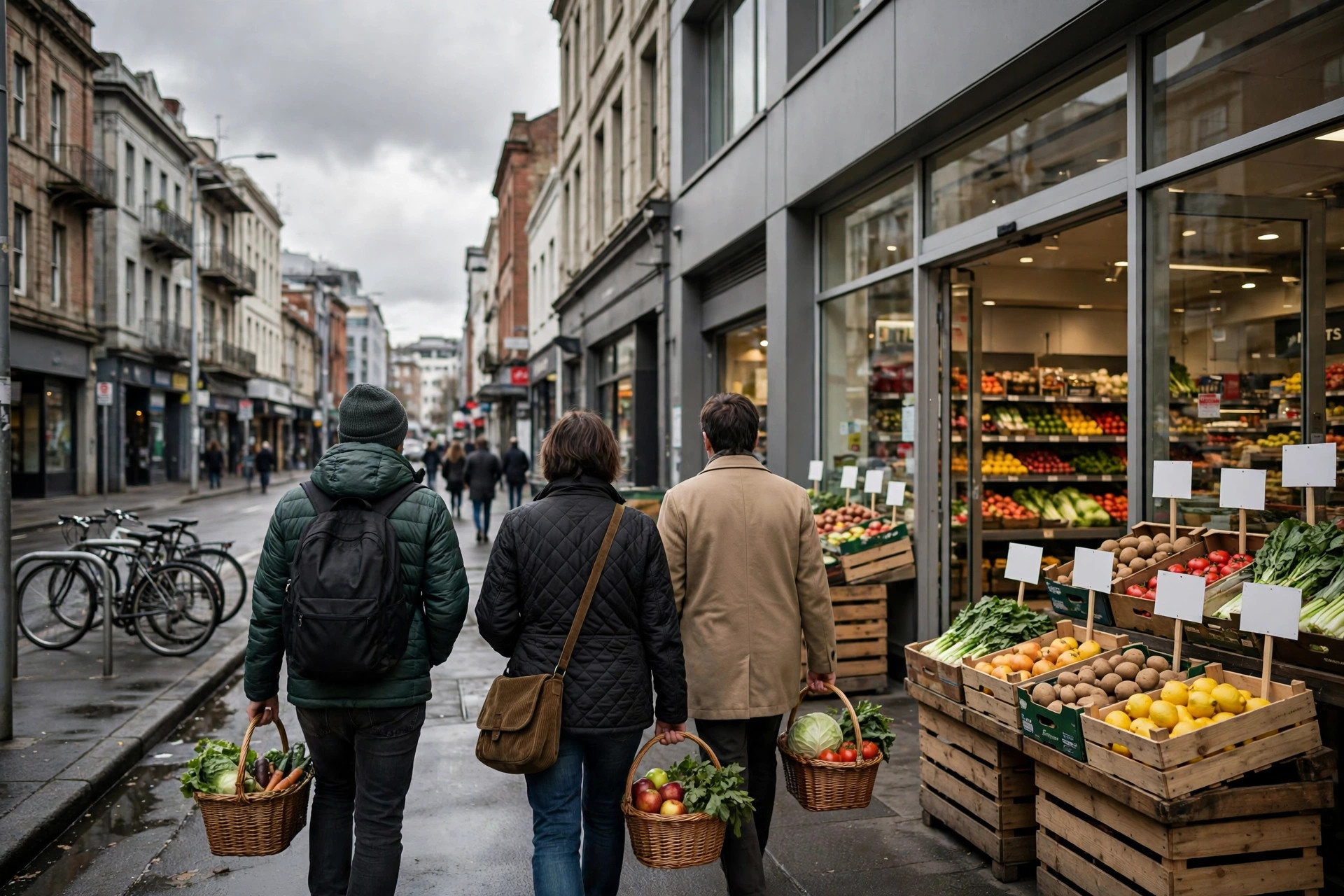
New Zealand votes on Saturday 7 November 2026, and the New Zealand election 2026 cost of living debate is set to decide the result. The cost of living is the top concern for 63 percent of voters, according to the Ipsos Issues Monitor, and both major parties have built their campaigns around who can ease the pressure on household budgets. Yet the country goes into election week split in two: the latest polls point in opposite directions, and the economy itself is running at two speeds, with the rural South Island doing well while the cities of the North Island struggle. This is not simply a contest between two parties. It is a vote on which version of the economy New Zealanders believe they are living in.
The election was announced on 21 January 2026 by Prime Minister Christopher Luxon, and advance voting is already under way. A total of 207 voting places opened on 26 October, rising to more than 2,300 on election day, and preliminary results are expected from 19:00 New Zealand time on 7 November. Under New Zealand's mixed-member proportional system, the result is rarely a simple win for one party: coalition deals are usually needed, and this time no coalition has a clear path back to government, according to the polls. That uncertainty is part of why the cost of living has become the central question — it is the issue that cuts across party loyalty and reaches into every household.
Why the New Zealand Election 2026 Cost of Living Debate Matters
The New Zealand election 2026 cost of living debate matters because it is the issue voters themselves have put first, by a wide margin. In the Ipsos Issues Monitor for September 2026, based on a survey of 1,003 people, the cost of living was named the top concern by 63 percent of respondents. Healthcare and hospitals came second at 44 percent, followed by the economy at 34 percent, unemployment at 21 percent, and petrol and fuel at 17 percent. The gap between the cost of living and every other issue is the story of this election: it is not one concern among many, but the concern that dominates all others.
Both leaders know it. Luxon has said the election will be "decided on economic issues" and argues that the National Party has "the best plan" to grow the economy and improve affordability. Labour leader Chris Hipkins has said he hopes to form a Labour-led government before Christmas and move swiftly to ease cost-of-living pressures. The two messages sound similar, but they point in different directions: National's case is that the economy must grow first and affordability will follow, while Labour's case is that the government should act directly and quickly on the prices people pay every week. Voters will decide which of those arguments matches their own experience of the last three years.
The cost of living has become the defining issue because it is felt every day, in every household, in a way that few other political questions are. Grocery prices, rents, power bills and petrol are the numbers that people see every week, and when those numbers rise faster than wages, the feeling of falling behind is immediate and personal. Kiwibank chief economist Jarrod Kerr put it plainly in a Reuters feature on the election: "The cost of living crisis is very real for many businesses and households." That sentence, from a bank economist rather than a politician, captures why the issue has cut through the campaign noise: it is not an abstract economic indicator, but a daily reality.
The Polls Disagree: Labour Ahead in One, National Ahead in Another
One of the most striking features of this election is that the two most recent major polls disagree with each other about who is winning. The RNZ-Reid Research poll, published on 28 October and based on an online survey of 1,000 eligible voters conducted from 20 to 26 October, put Labour on 30.6 percent and National on 24.8 percent — a lead of nearly six points for Labour. The 1News-Verian poll, released on 27 October, pointed the other way: National on 29 percent and Labour on 27 percent, a two-point lead for National. Both polls were taken in the same week, both are from reputable pollsters, and they cannot both be right about who is ahead. The honest conclusion is that the race is close and genuinely uncertain, and that no single poll should be treated as the definitive picture.
Older polls tell a similar story of a tight, volatile race. A 1News-Verian poll from 20 October had National on 32 percent and Labour on 27 percent, while a Post/Freshwater poll from 19 October had Labour on 28.7 percent and National on 27.6 percent. A poll-of-polls model from the Konrad Adenauer Stiftung, which averages recent surveys, put National on 29.4 percent and Labour on 26.9 percent — but that model was already 12 days old by the time the latest polls were published, and it cannot capture the movement of the final week. The pattern across all of them is the same: neither party has opened up a commanding lead, and the gap between the two has swung back and forth within the margin of error. For the latest polling detail, see our report on the RNZ-Reid poll putting National at 24.8 percent.
The disagreement between the polls is not a flaw in the polling; it is a reflection of a genuinely divided electorate. Different pollsters use different methods, different samples and different ways of allocating undecided voters, and when a race is close those differences can flip the lead from one party to the other. What the polls agree on is more important than where they disagree: neither major party is anywhere near a majority, the race is close, and the result will depend on the smaller parties and on which voters actually turn out on 7 November.
New Zealand Election 2026 Cost of Living: The Two-Speed Economy
That cost-of-living debate is inseparable from the two-speed economy that a Reuters feature, published on 2 November, described in detail. The country is not experiencing one economy but two. In the rural South Island, tourism and agricultural exports are doing well, and the economy is growing. In the urban North Island, where most people live, the picture is very different. The numbers tell the story: retail spending in the South Island rose 8.6 percent year-on-year in the second quarter of 2026, compared with 5.8 percent in urban areas. Over the same period, unemployment fell by 0.6 percentage points in the South Island while rising by 0.7 percentage points in the North Island. The two islands are moving in opposite directions.
House prices tell the same story of a country split apart. Prices have fallen by almost 30 percent from their peak in Wellington, by 24.7 percent in Auckland, and by 17 percent nationally. For homeowners in the capital, that is a devastating loss of wealth. For first-time buyers, it is a rare chance to get onto the housing ladder — but only if they can afford a mortgage, and only if they have a secure job. The two-speed economy means that the same national statistics can describe two completely different realities: a farmer in Southland whose export income is rising, and a family in Wellington whose house has lost nearly a third of its value and whose wages have not kept up with the grocery bill.
About 65 percent of New Zealand's 5.5 million people live in cities of 30,000 or more, which means the urban experience is the majority experience — and the urban experience right now is one of pressure. Political commentator Grant Duncan, quoted in the same Reuters feature, has pointed to the dilemma this creates for the National Party: it is asking voters to reward it for economic management at a moment when the economy feels, to most people, like it is not working for them. The counter-argument from the government is that the pain is the price of fixing what it inherited, and that growth is now returning — first in the regions, and eventually in the cities too. That is the argument the election will settle.
Interest rates are part of the same squeeze, and the cost of borrowing has been a constant backdrop to the campaign. The Reserve Bank's decisions on the official cash rate feed directly into mortgage rates and therefore into the monthly cost of housing — the single biggest cost for most households. For the latest on the central bank's stance, see our report on New Zealand interest rates being held at 2.75 percent in October 2026.
What Each Side Is Promising on the Cost of Living
The National Party, which has led a coalition with ACT and New Zealand First since the 2023 election, is campaigning under the slogan "Fixing the basics. Building the future." Its platform includes a "No New Taxes" pledge, compulsory KiwiSaver contributions, and measures to increase competition in the grocery sector — a direct response to the supermarket prices that voters complain about most. The argument is that competition will do what regulation cannot: bring prices down by forcing the big supermarket chains to compete harder. National's broader case is that three years of its government have stabilised the economy after a period of high inflation, and that the next term should be about growth — more jobs, more exports, more investment — which will in turn lift wages and ease the cost of living.
Labour, led by Chris Hipkins, argues that growth alone is too slow and too indirect, and that the government should act directly on the costs people face now. Hipkins has said he hopes to form a Labour-led government before Christmas and move swiftly to ease cost-of-living pressures, a promise designed to signal urgency to voters who feel they cannot wait for growth to trickle down. Labour's campaign has focused on the daily costs — groceries, rents, power and healthcare — and on the argument that the current government has made those costs worse rather than better. The party's task is to convince voters that it can deliver relief quickly without reigniting the inflation that caused the problem in the first place.
The two platforms frame the same question differently. National asks voters to judge it on the direction of the economy — is it improving, and will it keep improving? Labour asks voters to judge the government on their own household budget — are they better off than they were three years ago? The Ipsos finding that 63 percent of voters name the cost of living as their top concern suggests that the second question is the one most voters are asking themselves. But the polls' disagreement shows that the answer is not the same for everyone, and that the two-speed economy is producing two different verdicts.
The Opportunity Party and the Kingmaker Question
One of the most consequential questions of this election may not be about National or Labour at all, but about the Opportunity Party, a smaller party that is polling around or above the 5 percent threshold needed to enter Parliament. If it clears that threshold, it could become the first new party to enter government since 1996, and it could hold the balance of power in coalition negotiations — a kingmaker in an election where, as Reuters reported, "polls show no clear path back to government after the election for any potential coalition". In a close race, a party with a handful of seats can decide who governs.
The kingmaker question is a direct consequence of the mixed-member proportional system, under which no single party usually wins a majority and coalitions must be built after the votes are counted. The National-led coalition — National with ACT, led by David Seymour, and New Zealand First, led by Winston Peters — has governed for three years since the 2023 election, when National won 38.1 percent of the vote and Labour 26.9 percent. Both of the major parties will need partners this time, and the smaller parties will extract a price for their support. That price is likely to be paid in policy — which means the cost-of-living measures that actually get implemented may be shaped as much by the coalition negotiations as by the election result itself.
What Happens on 7 November
On Saturday 7 November, New Zealanders will vote in more than 2,300 voting places across the country, and the first results will begin to appear from 19:00 New Zealand time. The preliminary results released that evening will give a strong indication of the outcome, but the final result — including the special votes cast by people outside their electorates — will take days to confirm, and coalition negotiations could take weeks. The last election produced a government three years ago; this one will decide whether that government gets a second term, or whether Labour returns to power with new partners.
Whatever the result, the cost-of-living debate has already changed the country's politics. It has forced both major parties to campaign on household budgets rather than abstractions, it has exposed the two-speed economy that divides the country, and it has made the cost of groceries, rent and power the measure by which the next government will be judged. The voters who go to the polls on 7 November are not just choosing a government. They are delivering a verdict on whether the economy, as they experience it, is working — and the polls' disagreement suggests that the country has not yet made up its mind.