
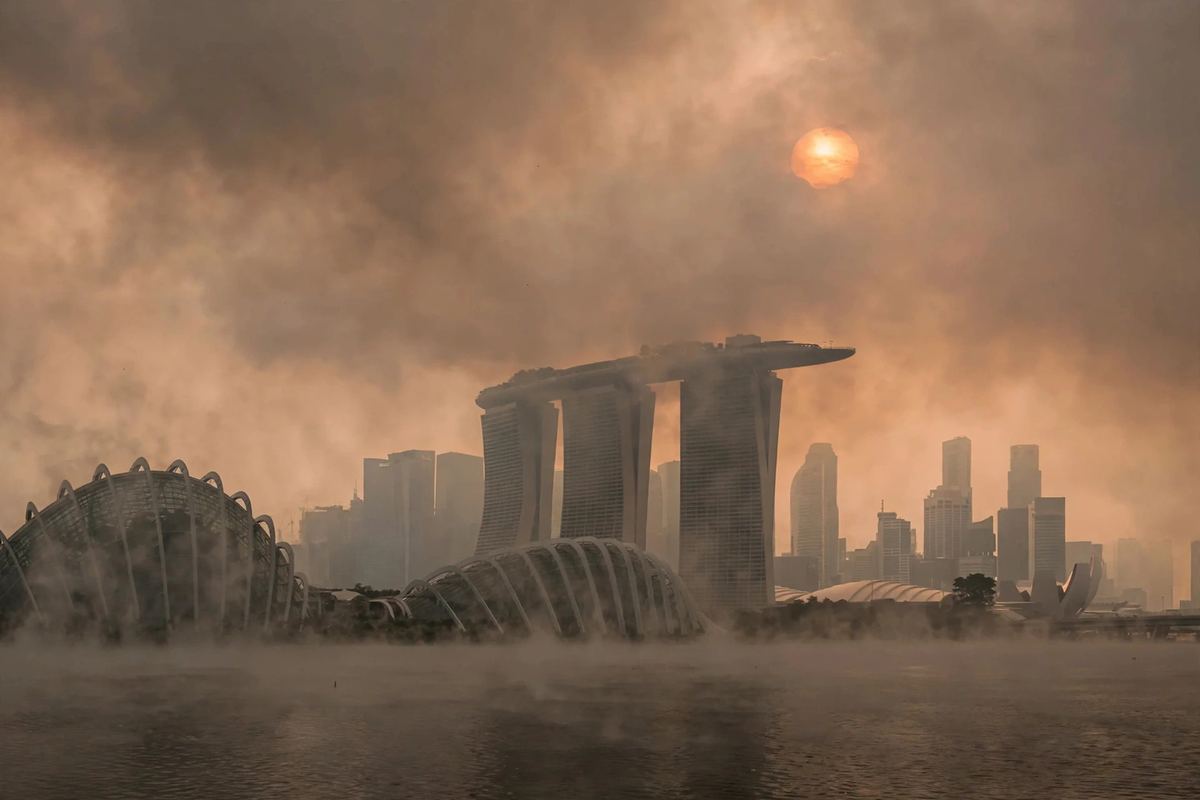
For the fifteenth day in a row, the sun over Singapore rose as a dim orange disc, its light filtered through a layer of smoke that has turned the city-state's skyline into a muted silhouette. The acrid smell of burning has become a familiar companion for residents going about their mornings, and the question on everyone's mind — when will this end — remains unanswered.
Singapore is enduring its longest stretch of unhealthy air since 2015. For 15 consecutive days, the tiny island nation has sat under a pall of transboundary haze drifting in from wildfires burning on the Indonesian islands of Sumatra and Kalimantan. Fueled by abnormally dry conditions linked to a strong El Niño, the fires have produced smoke that has disrupted flights, closed sports facilities, shut schools across the strait in Malaysia, and put public health systems on alert. This article explains where the smoke comes from, what has happened so far, why it matters, and what could happen next — based on news coverage trending across the region this week.
Background
The haze blanketing Singapore is a transboundary phenomenon: smoke generated by land and forest fires in parts of Indonesia is carried by prevailing winds across the Strait of Malacca and the Java Sea to Singapore and neighboring Malaysia. It is a recurring dry-season event in Southeast Asia, though its severity swings sharply from year to year depending on how dry the weather turns and how many fires ignite.
Much of the worst smoke originates from peatland fires burning in Indonesia. Peat is a layer of carbon-rich, partially decayed organic matter that builds up over thousands of years in swampy lowlands. When it dries out and catches fire, it can smoulder underground for weeks or even months, releasing enormous volumes of thick smoke long after the surface flames have died down. Peat fires are therefore far harder to extinguish than ordinary forest fires and produce disproportionately more haze per hectare burned.
This year's unusually dry conditions have been linked to a strong El Niño, the climate pattern in which warmer-than-average waters in the central and eastern Pacific alter rainfall patterns worldwide. El Niño typically suppresses rainfall across maritime Southeast Asia, extending the fire season and drying out peatlands that would otherwise stay too wet to burn. Against the backdrop of longer-term climate change, scientists note that warmer and more erratic conditions can make bad fire years more frequent and more intense.
The last time Singapore experienced anything on this scale was 2015, when a severe haze episode blanketed much of the region for weeks. Since then, governments and companies in the region have invested in fire prevention, early detection, and enforcement against illegal burning. But in a dry year, smoke still crosses borders — and this October, it has crossed in force.
The crisis also has a legal and diplomatic dimension. Singapore has a Transboundary Haze Pollution Act that allows it to take action against companies, Singaporean or foreign, whose fires cause haze in Singapore. On October 16, the National Environment Agency (NEA) issued preventive notices to seven companies, and Prime Minister Wong warned that action would be taken against those responsible. The notices signal that Singapore is prepared to use its enforcement tools, not just its diplomacy, as the haze drags on.
What Happened
The headline figure is stark: 15 consecutive days of unhealthy air, the longest such stretch since 2015. On October 19, 24-hour Pollutant Standards Index (PSI) readings across Singapore sat in the 100 to 190 range — every part of the island firmly in the unhealthy band. A day earlier, on October 18, western Singapore recorded a reading of 230, which falls into the "very unhealthy" category and marked the season's highest reading so far.
To understand those numbers: the PSI is a composite index built from six pollutants — particulate matter (PM10 and PM2.5), sulphur dioxide, carbon monoxide, ozone, and nitrogen dioxide. The scale runs from 0 to 500 and is divided into bands: 0 to 50 is good, 51 to 100 is moderate, 101 to 200 is unhealthy, 201 to 300 is very unhealthy, and anything above 300 is hazardous. The 24-hour PSI is the figure health authorities watch most closely, because it reflects sustained exposure rather than a passing spike.
The government's response has escalated alongside the readings. On October 16, the NEA served preventive notices on seven companies, and the Prime Minister publicly warned that action would follow against those responsible for the fires. The Haze Subsidy Scheme, which allows residents suffering from haze-related conditions to get subsidized treatment at participating clinics, has been running since October 12. N95 masks have been distributed to vulnerable residents, and all outdoor and non-air-conditioned ActiveSG sports facilities have been closed to keep people out of the worst of the air.
For ordinary residents, the episode has become part of daily life: a persistent smoky smell, stinging eyes, and a morning ritual of checking the latest PSI reading before deciding whether to go for a run, hang laundry outdoors, or keep children inside. Schools and workplaces have leaned on guidance issued during previous haze episodes — staying indoors, keeping windows closed, and using air purifiers where available.
Why It Matters
Public health is the most immediate concern. Prolonged exposure to haze — even in the 100 to 190 range recorded this week — can irritate the eyes, nose, and throat, and aggravate asthma and other respiratory conditions. The elderly, young children, pregnant women, and people with heart or lung disease face the highest risk. That is why the authorities have focused relief measures on vulnerable groups, from the Haze Subsidy Scheme for clinic treatment to the distribution of N95 masks, which filter out the fine particles that do the most damage.
Aviation has felt the disruption directly. Sixteen flights were diverted from Seletar Airport between October 5 and 11 because reduced visibility made normal operations unsafe. Seletar mainly handles regional services, business jets, and general aviation rather than the mainline traffic at Changi, but the diversions show how haze degrades one of the basic inputs of air travel: the ability to see. If visibility worsens further, the operational and economic costs would climb quickly.
The tourism and hospitality sector is adjusting too. Marina Bay Sands, the landmark integrated resort whose three towers are now barely visible through the smoke, suspended prolonged outdoor activities for guests and provided masks and air purifiers. For a city-state whose brand is built on gleaming skylines and outdoor attractions, weeks of grey-orange skies are both an economic and a reputational cost.
The haze has also crossed into Malaysia, where schools in Johor — the state directly across the strait from Singapore — were ordered closed for another five days starting October 19. The closure underscores that this is a regional event, not a Singapore-only one, with children on both sides of the border kept home by the same drifting smoke.
Timing has added another layer of anxiety: Singapore's main O-level written examination papers begin on October 19, exactly as the haze peaks. National examinations are high-stakes events for students, and exam authorities in past haze episodes have made contingency arrangements such as keeping examination halls well-ventilated and filtered. With readings deep in the unhealthy range on the very morning papers begin, students, parents, and schools are watching conditions closely.
Finally, the episode matters diplomatically. Transboundary haze has been one of the most persistent irritants in Southeast Asian relations for decades, flaring up in dry years and receding in wet ones. Singapore's move to issue preventive notices to seven companies, coupled with the Prime Minister's warning of action, shows a government willing to pair regional diplomacy with domestic legal pressure. Whether that pressure translates into faster fire suppression on the ground in Sumatra and Kalimantan remains the open question.
Key Facts
Here are the essential facts of the crisis, all drawn from this week's news coverage: Singapore has endured 15 consecutive days of unhealthy air, its longest stretch since 2015. On October 19, 24-hour PSI readings ranged from 100 to 190 — unhealthy across the island. On October 18, western Singapore hit 230, very unhealthy and the season's highest reading. The smoke is drifting from wildfires on Sumatra and Kalimantan in Indonesia, fueled by dry conditions linked to a strong El Niño.
On the response side: the NEA issued preventive notices to seven companies on October 16; the Prime Minister warned of action against those responsible; the Haze Subsidy Scheme for subsidized clinic treatment has been running since October 12; N95 masks have been distributed to vulnerable residents; and all outdoor and non-air-conditioned ActiveSG facilities have been closed.
On disruption: 16 flights were diverted from Seletar Airport between October 5 and 11 due to reduced visibility; Marina Bay Sands suspended prolonged outdoor activities and provided guests with masks and air purifiers; schools in Johor, Malaysia, were closed for another five days from October 19; and Singapore's main O-level written papers begin on October 19.
On the outlook: southerly winds and showers on October 19 may limit the transport of smoke toward Singapore, offering possible short-term relief. However, an east-south-easterly wind shift around October 20 to 21 could bring a fresh pulse of haze from the fire regions. Sources for this coverage include AnewZ, Particle, and Orbis Weather.
What Happens Next
The immediate forecast offers a glimmer of hope followed by a warning. Southerly winds and showers on October 19 may limit how much smoke reaches Singapore, potentially giving residents their first real break in over two weeks. Rain is the haze's natural enemy: it washes particles out of the air and dampens the fires producing them.
But the relief may be short-lived. Forecasters expect winds to shift to an east-south-easterly direction around October 20 to 21 — a direction that can carry fresh smoke from the burning regions of Sumatra and Kalimantan straight toward Singapore. If the fires are still burning strongly when that shift arrives, the island could see PSI readings climb again just as quickly as they fall.
The longer-term picture depends on three things: how fast Indonesian firefighting efforts can bring the blazes under control, when sustained rain returns to the fire regions, and how the strong El Niño evolves in the coming weeks. A prolonged dry spell would keep the risk elevated; a shift toward wetter conditions would end the episode.
For residents, the practical guidance remains unchanged: follow the NEA's advisories and 24-hour PSI readings, limit strenuous outdoor activity when readings are unhealthy, keep windows closed and use air purifiers indoors where possible, and wear a properly fitted N95 mask when exposure cannot be avoided. Vulnerable groups — the elderly, young children, and those with respiratory or heart conditions — should take extra care and seek subsidized treatment under the Haze Subsidy Scheme if haze-related symptoms appear.
For now, Singapore waits under a dimmed sun. Fifteen days of unhealthy air have tested the island's public-health machinery, its exam halls, its airports, and its patience — and with a wind shift looming on October 20 to 21, the test may not be over yet. The episode is a reminder that in a region bound together by shared winds, one country's fire season is every neighbor's air quality crisis.
Regulators are now going after the source of the smoke: Singapore has expanded its anti-haze crackdown to 10 Indonesian companies under its transboundary haze law.
Sources: AnewZ, Particle, Orbis Weather — October 2026
Across the region, anger over the same fires is boiling over, with protests erupting in Indonesia as choking haze from the forest fires spreads.