
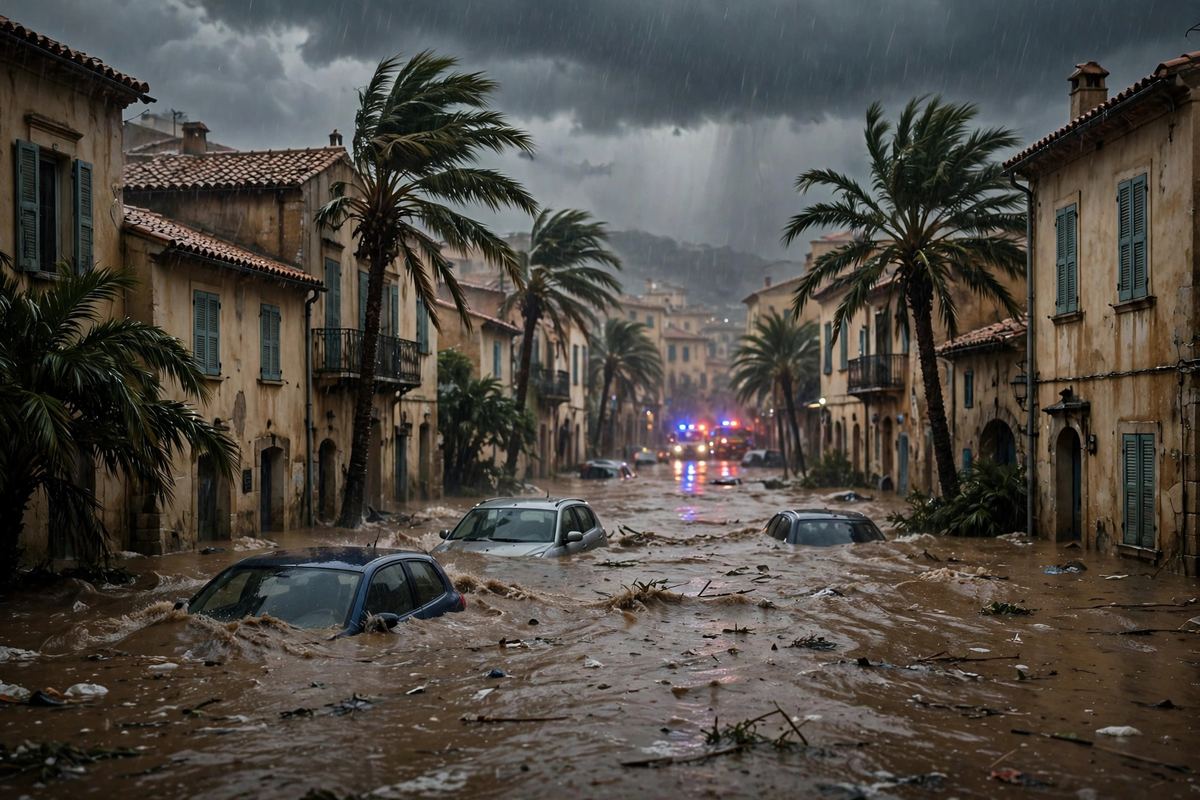
Storm Adam, the first named storm of the 2026-2027 season, battered eastern Spain and the Balearic Islands over the weekend of October 17-19, 2026, killing at least five people, forcing more than 2,000 evacuations and triggering hundreds of rescues, after dumping as much as 700 liters of rain per square meter in 24 hours in parts of the Valencia region, according to reports citing Spain's national weather agency AEMET and Al Jazeera. The devastation is trending in news coverage across Europe, and it has revived painful memories of the catastrophic Valencia floods of two years ago.
With more than 800,000 residents at one point ordered to shelter in place, military emergency teams deployed across the region, and flight disruption rippling as far as Amsterdam and Paris, Storm Adam became one of the most disruptive weather events of Spain's autumn — and a stark reminder of why Mediterranean autumn storms are among the most dangerous weather systems in Europe.
Background: why autumn storms hit Spain's Mediterranean coast so hard
Autumn is the most dangerous storm season on Spain's Mediterranean coast, and the reasons are rooted in geography and physics. After a long hot summer, the western Mediterranean holds a vast reservoir of warmth — and this year more than most. AEMET reported that Spain had just endured a record-hot September, following what the national weather agency described as the country's warmest summer between June and August. Warm sea water evaporates more readily, loading the air with moisture that storms can convert into extreme rainfall.
When a cold pocket of air aloft — a "cut-off low," known locally as a DANA or gota fría — parks itself over the Iberian Peninsula, it lifts that warm, moist air violently. The result is slow-moving, highly localized downpours that can dump months' worth of rain in hours onto terrain that channels water downhill fast: mountain slopes dropping to the coastal plain, dry riverbeds (ramblas) that become raging torrents, and towns and cities whose paved surfaces give floodwater nowhere to go.
Spain knows this pattern well. Two years ago, in October 2024, catastrophic flooding in the Valencia region killed more than 200 people — over 230 by some counts — in one of the deadliest weather disasters in Spain's modern history. That is why this weekend's scenes of rooftop rescues and cars piled on top of one another felt so familiar, and why local officials moved so fast this time, issuing sweeping shelter-in-place orders before the worst of the flooding arrived.
What happened
The downpour began on Saturday, October 17, and intensified rapidly over the weekend. The worst-affected areas were concentrated in the Valencia and Alicante regions of Spain's Mediterranean coast, along with Catalonia and the Balearic Islands of Mallorca, Ibiza and Formentera. AEMET recorded extraordinary rainfall totals: up to 700 liters of rain per square meter fell within 24 hours in parts of the Valencia region, with L'Atzúvia in Alicante registering 713 liters and Pego recording 632 liters over 36 hours. Anadolu reported 718 liters at Forna in just over 24 hours.
The human toll reflects how quickly extreme rainfall becomes an emergency. Early reports confirmed four deaths linked to the storm, and later reporting put the toll at five. When Spain's government declared disaster zones, government spokesperson Elma Saiz said the storm had left seven people dead, including a man whose body was found in waters off Menorca. The counts differ between sources: early reports gave four, later reports five, and the government said seven. Two people died in the coastal resort town of Oliva: a 79-year-old woman found in her home, and a man who suffered a fatal cardiac arrest at a campsite. A third person drowned at a beach in Sagunto, where a 55-year-old woman had gone swimming on Sunday night and was found dead at a nearby beach. A fourth victim died in Catalonia after falling into a rain-swollen stream. Officials said the numbers could still change as floodwaters recede and rescue crews reach cut-off areas.
The rescue effort was enormous. According to government representative Pilar Bernabe, security forces carried out more than 400 rescues in the Valencia region alone, with some stranded residents winched to safety from rooftops by helicopter as floodwaters cut off access routes, while others were brought to safety by boat. More than 2,000 people were evacuated, and in Els Poblets, northeast of Alicante, floodwaters piled cars and vans on top of one another as residents tried to salvage mud-coated belongings from inundated homes. In Oliva, residents were left stranded in their homes by rising floodwaters, and footage showed rescuers airlifting families from flooded houses and evacuating them in military vehicles.
Authorities moved aggressively to protect the population. At one point, around 800,000 residents across 100 municipalities were ordered to shelter in place. By late Monday afternoon, as conditions improved, the restrictions had been reduced to 87,000 people across eight municipalities. More than 100,000 pupils were kept out of school. Prime Minister Pedro Sanchez said military emergency teams were assisting with rescue efforts and pledged full government support, while Spain's Military Emergency Unit (UME) deployed helicopters, rescue vehicles and pumping equipment to the worst-hit zones.
The Balearic Islands also took a heavy hit. Schools were closed, transport was disrupted, and Ibiza airport was forced to close twice over the weekend as water cascaded through terminal ceilings and runway issues mounted, forcing flight diversions to Alicante and Mallorca. Civil protection teams sent automated emergency alerts to mobile phones across the islands and the southeastern coast, urging maximum precaution as orange and red weather alerts remained in effect.
The disruption rippled well beyond Spain. According to Travel and Tour World, citing flight-tracking data, 70 flight cancellations and 2,425 delays affected airports across Europe on October 20, with heavy rainfall linked to Storm Adam disrupting flights in Spain — particularly around Palma de Mallorca, which recorded 249 delays and two cancellations, making it the most delayed airport in the dataset. Barcelona-El Prat recorded 216 delays and two cancellations, while air traffic flow restrictions affected operations at Manchester and London Gatwick, and Amsterdam Schiphol also recorded significant disruption, though authorities had not confirmed the exact causes of every delay. Europe's autumn has been difficult on several fronts — from the deadly Istanbul flash floods earlier this month to the unrest in France that has strained emergency services — and Storm Adam has now added a major weather emergency to the continent's October.
Why it matters
Storm Adam matters first because of what it says about the trend. Spain's warmest summer on record, a record-hot September, and now one of the most extreme single-day rainfall totals the country has seen — the sequence fits exactly what climate scientists expect from a warming Mediterranean: more energy in the system, more moisture in the air, and more violent downpours when the right storm configuration arrives. Each autumn now carries the possibility of another event like 2024.
It matters second because of speed. The deaths in Oliva, Sagunto and Catalonia show how fast a rainstorm becomes a life-threatening emergency — a swimmer caught by a surge, a river that becomes uncrossable in minutes, floodwater rising through a home. Flash floods kill more people in Europe than almost any other weather phenomenon precisely because the warning window is so short. The contrast with 2024 is instructive: the massive, early shelter-in-place orders this time — 800,000 people at the peak — suggest authorities learned hard lessons about moving before the water does.
It matters third because of infrastructure and the economy. Roads, airports, rail and power networks across eastern Spain and the Balearics were hit hard; the tourism economy of the Mediterranean coast, still active in October, absorbed a direct blow. The continent-wide flight disruption — 2,425 delays on a single day — shows how a regional weather event in one corner of Europe cascades through the tightly coupled aviation system, stranding passengers from Athens to Amsterdam.
Key facts
- What it was: Storm Adam, the first named storm of the 2026-2027 season, struck eastern Spain and the Balearic Islands over the weekend of October 17-19, 2026.
- Deaths: Reported counts differ — four in early reports, five in later reporting, seven according to the Spanish government. The four first confirmed were two in Oliva (Valencia), one at a Sagunto beach, one in Catalonia.
- Rainfall: Up to 700 liters per square meter in 24 hours in parts of the Valencia region; L'Atzúvia (Alicante) recorded 713 liters; Pego recorded 632 liters over 36 hours (AEMET).
- Rescues and evacuations: More than 400 rescues in the Valencia region; over 2,000 people evacuated; some residents airlifted from rooftops.
- Shelter-in-place orders: Around 800,000 residents in 100 municipalities at the peak, reduced to 87,000 across eight municipalities by Monday afternoon.
- Schools: More than 100,000 pupils kept out of school.
- Air travel: 70 cancellations and 2,425 delays across European airports on October 20; Palma de Mallorca the most delayed airport in the dataset (249 delays, 2 cancellations); Ibiza airport closed twice over the weekend.
- Worst-hit areas: Valencia and Alicante regions, Catalonia, and the Balearic Islands (Mallorca, Ibiza, Formentera).
- Context: Came after a record-hot September and Spain's warmest summer on record; echoes of the October 2024 Valencia floods that killed more than 200 people.
What happens next
Emergency crews continued rescue and clean-up operations across the worst-hit areas on Monday and Tuesday, pumping water from submerged garages and basements, clearing mud and debris from streets, and checking on residents in cut-off areas. With red and orange weather alerts still in effect across Barcelona, Murcia, parts of Valencia and the Balearics into Monday, authorities were watching closely for any further heavy rain before standing down fully.
The next phase is assessment: counting the damage to homes, businesses, roads and agriculture, and working out what worked in the emergency response. The speed and scale of the shelter-in-place orders — covering 800,000 people at their peak — will likely be studied as a model for future events, though questions will also be asked about the areas where people were still caught out.
For travelers, the disruption is expected to ease as the storm system moves on, but airlines warned that knock-on delays could linger for days as aircraft and crews are repositioned. Anyone flying through Spanish airports this week should check flight status before heading to the airport.
And the longer question remains the one Spain faced after 2024: how to live with autumn storms that are getting more violent. Engineers talk about flood defenses, better drainage and stricter building rules on floodplains; meteorologists talk about earlier warnings and faster alerts. Storm Adam, like the Istanbul floods earlier this month, is another entry in a growing file of evidence that Europe's autumn weather is changing — and that adaptation, not just response, will decide how many lives future storms cost.