
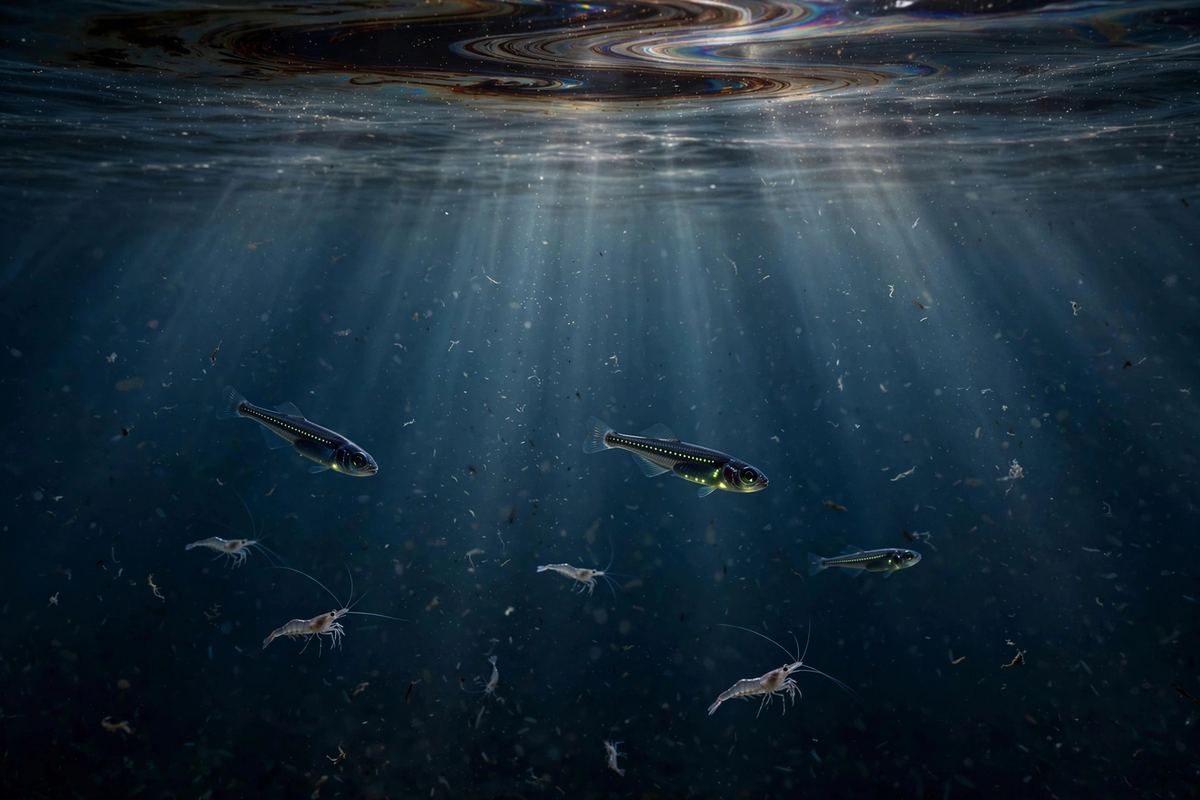
Sixteen years after the worst marine oil spill in United States history, the deep waters of the Gulf of Mexico are still telling a grim story. A major new study published in the journal PNAS has found that marine life in the deep "twilight zone" of the Gulf has dramatically declined since the 2010 Deepwater Horizon disaster — and, crucially, has not recovered. Fish numbers fell by more than 60%, and the creatures at the base of the food web have been hit hardest of all. The findings, reported by the Associated Press on October 20, 2026, are trending in news coverage worldwide.
Background: the 2010 Deepwater Horizon disaster
On April 20, 2010, an explosion aboard the Deepwater Horizon oil drilling platform, operating a BP well in the Gulf of Mexico, killed 11 workers and set off the largest accidental marine oil spill in history. The blowout discharged an estimated 4 to 5 million barrels of oil — about 134 million gallons (507 million litres) — along with more than 7 billion standard cubic feet of natural gas into the Gulf. The well sat at a depth of about 1,500 metres (5,000 feet), which made the wellhead almost impossible to control; the leak continued for 87 days before it was finally capped.
During the response, almost 3,000 cubic metres (around 770,000 gallons) of chemical dispersants were injected into the water column to break up the oil. At the time, much of the public attention focused on the visible damage: oiled beaches, dead birds, and devastated coastal marshes. But the new study suggests the invisible damage, far below the surface, has been far more severe and far more lasting.
What the new study did
The research was led by Tracey Sutton, a biological oceanographer at Nova Southeastern University, and focused on the ocean's "twilight zone" — the vast region between the sunlit surface and the darkest depths, stretching down to about 1,500 metres above the seafloor. This is where much of the Gulf's surface marine life, from dolphins to whales, feeds on the smaller creatures that live or migrate through it. Remarkably, this part of the Gulf had never been scientifically surveyed before the 2010 spill.
A post-spill exploration in 2011 gave scientists their first good measure of what lived there, using six sets of nets at different depths combined with acoustic sonar. Sutton's team then returned to the exact same location with the same equipment three and a half years later — and found that sea life was between one-third and one-quarter of what it had been in 2011. The researchers documented the decline with three independent lines of evidence: what the nets physically caught, what the acoustic sonar detected, and genetic studies showing that surviving species had lost genetic diversity through inbreeding — a sign of populations shrinking to dangerously small numbers.
What happened: the findings
The declines measured from the year after the spill to 2015 were steep across the board. The number of fish found dropped by 63.5%. Crustaceans — including shrimp and krill, a key food source for whales — declined by 62%, with krill alone down 72%. Larger animals such as squid and octopuses fell by 59.7%. Lanternfish, odd fish with blue-green light organs embedded along their bodies, are now at roughly a third of their former abundance. The striking dragonfish, with its sharp teeth, light organs, and lure attached to its head, also suffered heavy losses. Overall, marine animal numbers plummeted by about 60%.
Perhaps most importantly, the damage did not fade. The researchers kept sampling after 2015 and found the populations had not come close to recovering. A slight rise in 2022 and 2023 did not prove statistically significant or lasting, according to Sutton. The study authors conclude that a great deal of marine life died outright after the explosion and the nearly five months of leaking oil and gas — and that pollutants stored in the eggs of survivors left subsequent generations compromised and weaker.
As for the cause, Sutton was direct: "We saw this big decline. The question was then why? So we looked at all of the natural variables we thought could account for it, namely temperature, oxygen supply and food. None of those vary with the decline. The event that did was the oil spill. So we think that's the most likely cause of the decline." The team could not prove an exact causal chain, but by eliminating the alternatives and matching the timing, the spill emerged as the most logical explanation.
The study also raised pointed questions about the cleanup. Co-author Isabel Romero, a chemical oceanographer at the University of South Carolina, noted that both the oil and the dispersants hurt fish, but in different ways: oil is more toxic and the overall threat, while dispersants break oil into smaller droplets, increasing exposure for animals living in the deeper water column. Rita Colwell, the former National Science Foundation director who headed a 10-year, $500 million BP-funded programme to study the spill's effects, said future responses should avoid such chemicals and instead use agents that boost oil-munching microbes.
Why it matters: the twilight zone ecosystem
The twilight zone is one of the least understood habitats on Earth — scientists have suggested that in some ways we know more about outer space than the deep inner ocean. Yet it is enormous: the deep-pelagic biome is larger than all other ecosystems combined, and the creatures that live there are foundational to marine food webs. "These are foundational species," Sutton said of the lost krill, lanternfish, and crustaceans. "They're the things most things eat. So it's no wonder that we had wholesale changes across the community."
One of the study's striking broader findings is how interconnected the Gulf's water column is from top to bottom: predators at the surface dive deep, and deep-dwelling animals migrate upward at night, making it "one very large pulsing system" rather than a set of separate layers. That means damage in the twilight zone ripples outward in both directions. Outside scientists were shaken by the scale. "It's shocking how a single failure in a drilling rig can have this vast and sustained impact over thousands of square kilometres, with little visible recovery over 13 years after the spill," said Dalhousie University marine scientist Boris Worm. This is also not the first warning sign: a separate 2024 study found whale and dolphin declines in the Gulf of up to 83% for some species, and the H5N1 virus has recently been devastating elephant seals elsewhere, a reminder of how many compounding pressures marine life now faces.
Key facts
- The study: "Immense but not immutable: A sudden and sustained decline in deep-pelagic life in a large oceanic ecosystem," by Tracey T. Sutton and colleagues, published in the Proceedings of the National Academy of Sciences (PNAS) in October 2026 (DOI: 10.1073/pnas.2616554123).
- Where studied: the deep twilight zone of the Gulf of Mexico, between the surface and 1,500 metres deep, near where the Deepwater Horizon well failed.
- Fish: down 63.5% from the year after the spill to 2015.
- Crustaceans (shrimp, krill): down 62%; krill alone down 72%.
- Squid and octopuses: down 59.7%.
- Recovery: none — populations remained at catastrophically low levels through 2021, with no statistically significant rebound by 2023.
- Evidence: net catches, acoustic sonar surveys, and genetic studies showing inbreeding and lost genetic diversity.
- Exclusion of other causes: temperature, oxygen supply, and food availability did not vary with the decline.
- The spill: April 20, 2010; 11 workers killed; roughly 134 million gallons of oil and 7 billion cubic feet of gas released over 87 days; nearly 770,000 gallons of dispersant used.
What happens next
The researchers frame the findings as a warning with direct relevance to today's debates: both Worm and Colwell say this long-hidden damage should be kept firmly in mind as the world discusses deep-sea mining and expanded oil drilling in deep waters. If a single well failure can hollow out life across thousands of square kilometres for well over a decade with no sign of recovery, the true cost of deep-water extraction looks very different from what early assessments assumed.
The study also carries a practical lesson for future spill response: dispersants may reduce visible surface oil while worsening harm in the deep water column, and boosting oil-degrading microbes may be a better strategy. For the Gulf itself, scientists will continue monitoring the twilight zone to see whether the faint hints of stabilisation turn into genuine recovery. As Kaitlin Frasier of the Scripps Institution of Oceanography put it, "Because we can't see these regions, there is a tendency to assume everything is fine, but here we have a clear result showing that something went very wrong." The full picture of what happened in the deep Gulf is only now coming into view — 16 years later, and in a world still debating how much risk climate-driven extremes and industrial accidents pose to fragile systems.