
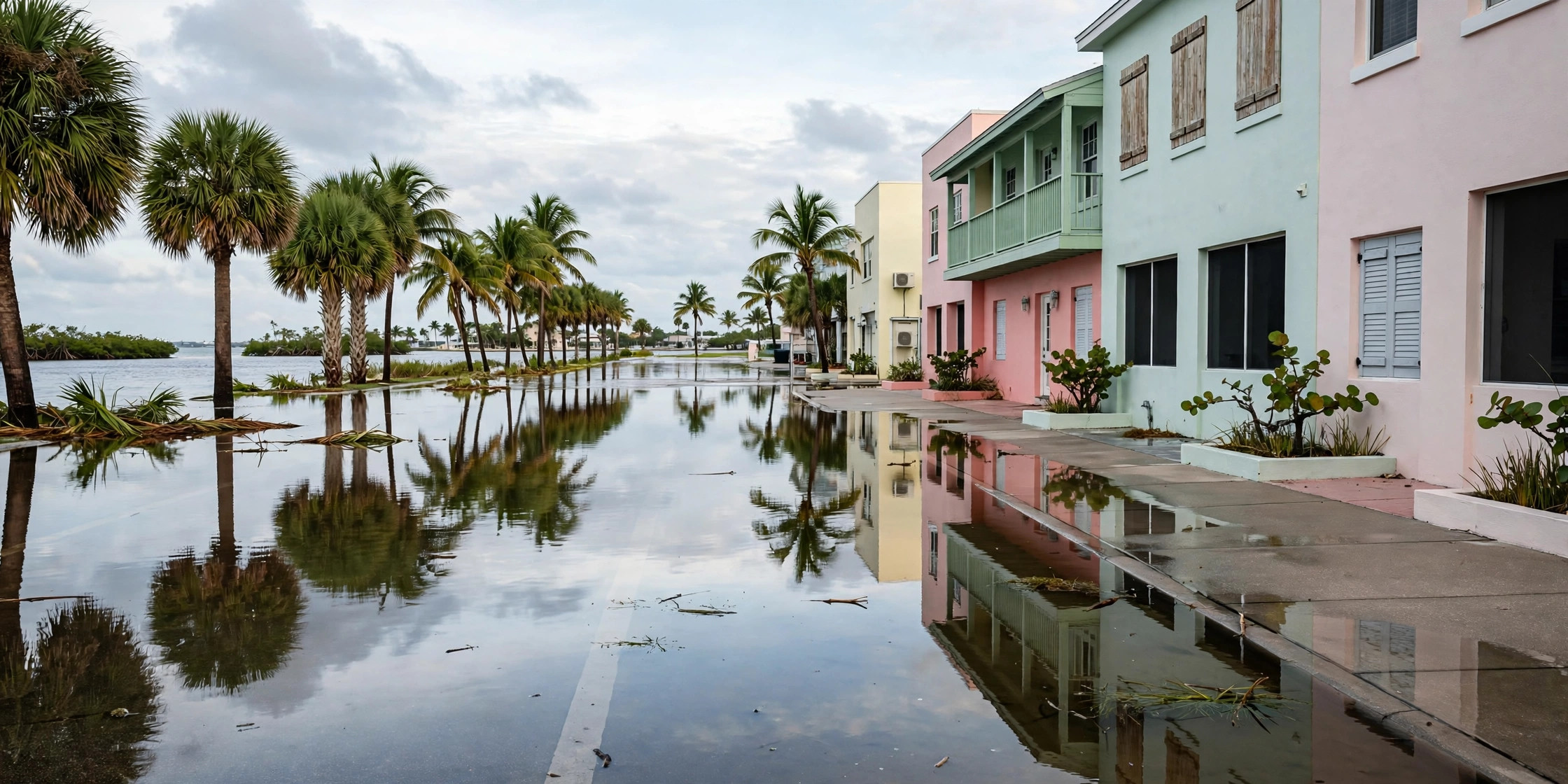
Record king tides flooding Florida in 2026 have turned ordinary coastal streets into shallow rivers, with seawater bubbling up through storm drains, overtopping seawalls and closing roads from Fort Lauderdale to Miami Beach. The flooding, trending per news coverage across the United States on 26 October 2026, is not a hurricane and not a storm surge in the usual sense. It is the sea itself arriving higher than the land in places built to cope with it — and forecasters say the worst of this event is still to come, with the highest tide expected on Tuesday morning.
Coastal flood warnings are in effect across parts of Florida, Georgia and North Carolina, and major to moderate flooding is forecast along the Southeast coast from the Carolinas to South Florida. As of the morning of 26 October, about 4.1 million people were under a coastal flood warning in Florida alone, with millions more under wind, high surf and rip current advisories. For residents of low-lying neighbourhoods, the pattern is now familiar: water at the morning high tide, water again at the evening high tide, and streets that stay wet in between because there is nowhere for the water to go.
What Is Happening on Florida's Coast Right Now?
On 26 October, king tides overwhelmed seawalls and pushed through storm grates along Florida's east coast, forcing road closures and traffic disruption. Flooding was reported in Fort Lauderdale and Miami Beach, and streets in several coastal communities became impassable around high tide. In Fort Lauderdale, high tides on Monday were scheduled for 9:33 a.m. and 9:40 p.m., while Miami's came at 9:19 a.m. and 9:24 p.m. and Key West's at 11:05 a.m. and 10:23 p.m. South Florida's coastal flood warning runs through Wednesday, with the most difficult conditions expected between about 8 a.m. and 11 a.m. and again between 8 p.m. and 11 p.m. each day.
The water is arriving with force as well as height. A low-pressure area over the Bahamas pressing against high pressure over the Mid-Atlantic has driven gusting winds of up to 46 mph and waves of 12 to 15 feet along the coast from Palm Beach County through Miami-Dade County. The National Weather Service warned of breaking waves that could reach 11 feet in places, causing beach erosion and dangerous rip currents. Businesses along Hollywood Beach put out sandbags ahead of the high water, and city crews in Fort Lauderdale spent the day monitoring roads, responding to reports and warning drivers that streets in tidal-flood zones could become impassable.
One detail explains why the flooding lingers long after the tide turns. Fort Lauderdale officials noted that the city's stormwater pumps cannot necessarily clear tidal flooding: unlike rainwater, tidal water moves inland through waterways and drainage systems or over seawalls, and when the water in those channels is already high, there is nowhere for the pumps to send it. Streets can therefore stay flooded until the tide itself recedes.
Why Are King Tides Flooding Florida in 2026?
A king tide is the popular name for the highest tides of the year, known technically as a perigean spring tide. It happens when three things line up: the Sun, Moon and Earth are aligned at a full or new moon, so their gravitational pulls combine; the Moon is at perigee, its closest point to Earth in its elliptical orbit; and seasonal conditions lift the baseline sea level. In the Southeast, warm autumn water and shifting winds raise sea level in the fall, which is why the region's highest tides tend to arrive at this time of year. The full moon falls on 26 October, with the Moon's closest approach, perigee, following on 28 October.
Notably, this particular event is not purely astronomical. Fox Weather hurricane specialist Bryan Norcross pointed out that this cycle's king tide is actually slightly less intense than average on the astronomical side, because the full moon and perigee are a couple of days apart rather than exactly aligned. What turned an already high tide into record flooding was the weather on top of it: persistent onshore winds, rough surf and the pressure pattern squeezing the coast. In other words, the Moon set the table, and the wind served the flood.
The same pattern has been building for days. Strong winds and rough surf from the Atlantic have been blowing onshore along the East Coast, pushing water higher in combination with the full-moon tides. That combination is also why the flooding is not confined to one city: it is a regional event stretching from South Florida up through Georgia and the Carolinas, with major flooding forecast from Miami to Charleston.
The Records Behind This King Tide Event
The numbers show why this event stands out even in a state used to high water. A high tide at Port Canaveral was the highest non-tropical-cyclone-related water level ever recorded there since the gauge was established in October 1994, according to the National Weather Service in Melbourne. In Miami, a tidal record set on 25 October was the fourth record in five days and the fifth-highest all-time tide at that gauge, according to Brian McNoldy, a senior research associate at the University of Miami's Rosenstiel School of Marine, Atmospheric and Earth Science.
The streak is what worries forecasters most. McNoldy noted that the Virginia Key tide gauge in Miami had exceeded the "moderate flooding" threshold for six consecutive days, and that his team's tide forecast model suggested the streak could reach an unprecedented 10 days before water levels start to fall. The highest peak of the event is expected on Tuesday morning at about 10:30 a.m. in Miami. Until then, each high tide is another chance for water to find the lowest road, the oldest seawall or the most tired drainage system.
Elsewhere on the East Coast, the same system is delivering record-breaking high tides and coastal flood advisories. The Weather Service's Melbourne office warned of gusty winds, elevated seas and high astronomical tides maintaining hazards along Florida's east-central coast, while flood advisories cover parts of Georgia and North Carolina. On the West Coast, the picture is different but related: Southern California faces chances of rainfall on Halloween weekend running as high as 250 percent of normal in some models, a reminder that autumn's coastal hazards arrive on both sides of the country.
King Tides Florida 2026: When Is the Peak and Which Areas Are Affected?
The peak of this king tide event is expected on Tuesday morning, 27 October, with Miami's highest tide forecast for about 10:30 a.m. South Florida's coastal flood warning extends through Wednesday, and the twice-daily high-tide windows — roughly 8 a.m. to 11 a.m. and 8 p.m. to 11 p.m. — are when roads are most likely to flood. Residents should expect the pattern to repeat rather than improve quickly: forecasters warn that conditions could become more widespread on Tuesday, and that water levels may not start a sustained retreat until later in the week.
The affected areas run well beyond Miami. Fort Lauderdale reported flooding on several roads on Monday morning, with warnings that streets in tidal zones could become impassable around high tide. Miami Beach and Hollywood saw water over roads and against businesses, while advisories extend north through Palm Beach County, the Treasure Coast and the Space Coast around Port Canaveral, and into coastal Georgia and the Carolinas. Major to moderate flooding is forecast along the Southeast coast from the Carolinas to South Florida, with beach erosion and dangerous surf adding to the hazard even where roads stay dry.
For anyone travelling in the region, the practical message is consistent across the official warnings: check local advisories before setting out, avoid driving through flooded streets, and never walk or swim in floodwater. Saltwater is corrosive to vehicles and can hide hazards beneath the surface, and forecasters specifically warned that marine conditions remain unsafe for boating or beach visits while gale warnings and high surf advisories are in force.
Why King Tides Keep Getting Worse Over Time
King tides are predictable — they can be forecast years in advance from astronomy alone — but their impact is growing because the baseline they sit on is rising. As sea levels rise, the floor beneath every tide gets higher, so a tide that once stopped at the seawall now spills over it. Scientists use king tides as a preview of future everyday conditions: today's exceptional flood is, in many coastal cities, tomorrow's routine high tide. That is why the same astronomical event produces more flooding now than it did a generation ago, even before wind and weather are added.
The same lesson applies far beyond Florida. Autumn storms elsewhere are already testing the same defences: the Storm Boelo warnings in the UK and Norway, the southern France floods linked to Storm Austen, and the Pacific season's Super Typhoon Champi in Taiwan all show coastal communities facing higher water from different directions. In each case, the immediate hazard is weather, but the rising baseline is what turns a high tide into a flooded street.
Cities are responding with higher roads, bigger pumps, raised seawalls and restored natural shorelines, but those projects take years and the sea does not wait. For now, the most useful adaptation for residents is information: knowing the high-tide times, understanding that a sunny day can still flood, and treating coastal flood warnings with the same seriousness as a storm warning.
How to Stay Safe During King Tide Flooding
First, do not drive through saltwater. Even shallow tidal flooding can stall a car, damage its electrics and underbody, and hide debris or open drains. If a road is flooded, turn around rather than testing its depth. Second, keep out of floodwater on foot: it may be deeper than it looks, it can carry sewage and sharp debris, and currents near drains and inlets can be strong. Third, protect property early — move vehicles to higher ground before the high-tide window, use sandbags at doorways where flooding is a known problem, and rinse vehicles and outdoor equipment with fresh water after any saltwater contact.
Finally, stay tuned to official sources rather than social media rumours. The National Weather Service and local city governments publish tide times and warning updates, and conditions can change with each tide. If a coastal flood warning covers your area, plan travel around the high-tide windows and allow extra time: a road that is clear at noon may be under water by the evening tide.
Record king tides flooding Florida in 2026 are a reminder that the ocean does not need a storm to reach into a city. A full moon, a close Moon, a warm autumn sea and a spell of onshore wind were enough to set records, close roads and push the Virginia Key gauge toward an unprecedented 10-day streak of moderate flooding. The peak is still ahead on Tuesday morning — and for coastal Florida, the question is no longer whether the sea will come higher, but how quickly communities adapt to a tide that keeps rising.
Sources: USA Today, Palm Beach Post, Fox Weather and National Weather Service forecasts and statements reported on 26 October 2026, including the National Weather Service Melbourne office and the University of Miami Rosenstiel School of Marine, Atmospheric and Earth Science.