
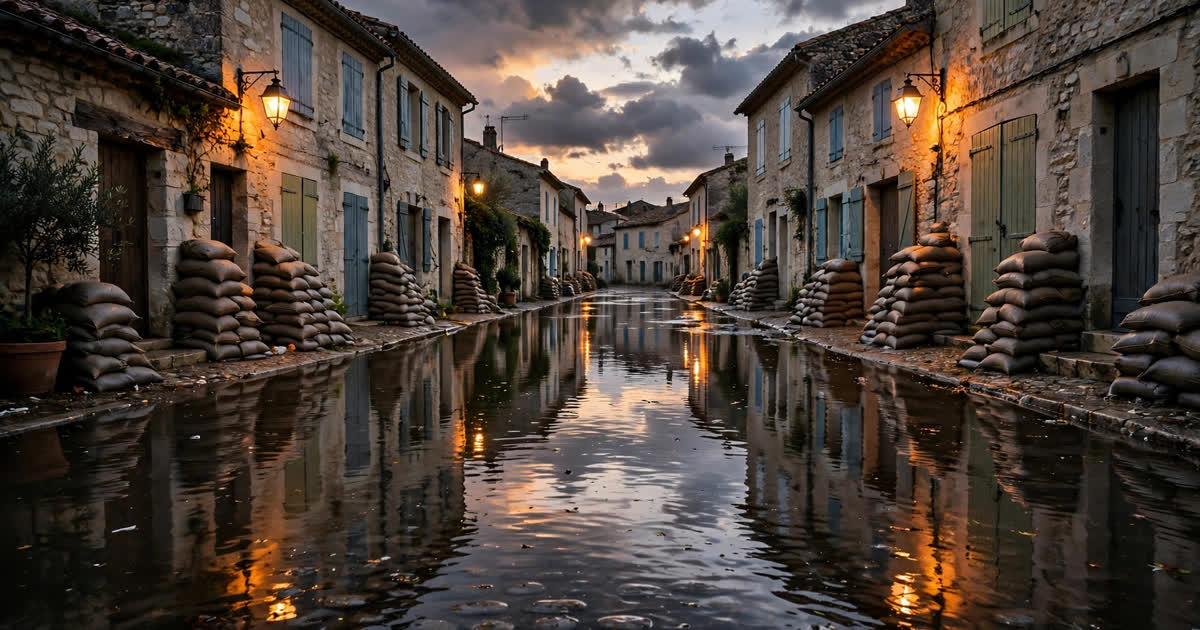
At least four people have died in storms and flooding in southern France, authorities said late on Wednesday, in one of the most severe weather events to hit the region in years — and a second storm is already bearing down on the country's northwest. The story is trending per news coverage, with Reuters leading the reporting as the death toll rose through the night.
The deaths were reported in and around Mouries and Saint-Martin-de-Crau, two small towns between Montpellier and Marseille in the Bouches-du-Rhône department, where torrential rain sent rivers and streams bursting their banks. At least one other person was injured, and dozens of residents were moved to emergency shelters, according to local authorities.
"Unprecedented" water levels
Jacques Witkowski, the prefect of the Bouches-du-Rhône region, said in a statement late on Wednesday that "the water has risen to unprecedented levels" — an unusually stark assessment from a French prefect, the state official responsible for coordinating civil protection at department level.
The two worst-hit towns sit in the low-lying plains near the Camargue, where Mediterranean downpours can turn quiet waterways into raging torrents within hours. Emergency crews worked through Wednesday evening and into the night to evacuate homes, check on isolated residents, and house displaced families in emergency shelters.
France's civil protection services are built for exactly this scenario — rapid-response teams, pre-positioned rescue boats, and departmental crisis cells that activate the moment river gauges cross alert thresholds — but the speed of the rise caught many by surprise, as the rainfall totals far exceeded what forecasts had flagged at the start of the day.
Transport and daily life disrupted
Roads and railway lines across the area were disrupted by floodwater, Transport Minister Philippe Tabarot said in a post on X, as authorities warned drivers to avoid low-lying routes, underpasses, and roads running alongside rivers. Rail services in the region faced delays and cancellations as flood warnings stacked up across the department.
Schools and local businesses in the worst-hit towns faced closures, and utility crews were on standby for power outages caused by flooded substations. For residents of Mouries and Saint-Martin-de-Crau — small communities unaccustomed to headlines — the night was spent in shelters or with neighbours on higher ground, waiting for waters to recede.
Storm Austen: the northwest is next
Forecasters said the weather was expected to calm in the south, but there is no breathing room nationally: Storm Austen, sweeping in from Ireland, is expected to bring heavy winds and lashing rain across northwestern France overnight on Thursday and into Friday, according to Météo France.
Authorities in western France were preparing for the storm's arrival — securing infrastructure, positioning emergency teams, and issuing wind warnings — even as their colleagues in the south continued clean-up and search operations. It is an uncomfortable one-two punch for a country whose weather service has repeatedly warned that extreme weather events are arriving more often and with greater intensity.
Named storms like Austen follow the seasonal naming lists used by western European weather services, which name impactful storms in advance to sharpen public awareness. The name signals that forecasters expect the system to bring damaging winds and disruption, not just ordinary rain.
Why southern France floods so violently
Autumn storms around the western Mediterranean are a known seasonal hazard. Warm, moisture-laden air rising from a still-warm Mediterranean Sea collides with cooler air masses over southern France, dumping enormous volumes of rain in a few hours over catchments that drain quickly through narrow river valleys. These events have a local name: the épisodes méditerranéens — Mediterranean episodes that can drop a month's worth of rain in a single day.
The result is flash flooding that arrives with terrifying speed, even in places that have not seen a drop of rain all summer. Rivers that are little more than trickles in August can become walls of brown water in October, sweeping away cars, collapsing bridges, and inundating ground floors before residents have time to react.
Climate scientists have long cautioned that a warmer atmosphere holds more moisture — roughly 7% more for every degree Celsius of warming — making such extreme rainfall events more likely and more intense. France has experienced this pattern repeatedly in recent autumns. Earlier this month, Storm Adam killed four people and flooded eastern Spain after hundreds of litres of rain fell per square metre, and Istanbul recorded its heaviest rainfall since 1942, killing six — a reminder that the entire Mediterranean basin is in the crosshairs of the same volatile weather pattern.
France's difficult autumn
The floods arrive during an already bruising autumn for France. The country has been gripped by political turmoil — violent protests led to localised curfews earlier in October — and its public finances are under strain, with bond yields hitting levels not seen since 2002. Now emergency services must stretch their resources between storm response in the south and storm preparation in the northwest.
For the French government, back-to-back weather emergencies pose a familiar test: coordinating prefects, mayors, firefighters, and the civil protection agency across departments that are hundreds of kilometres apart and facing different threats at the same time.
What happens now
Authorities have urged residents in the affected departments to obey flood warnings, stay away from riverbanks and low roads, never attempt to drive through flooded underpasses, and follow instructions from the prefecture. With Storm Austen approaching the northwest, a second wave of weather alerts — and possible further disruption to travel and power — is expected within hours.
Rescue teams will remain deployed in the south through the night, and damage assessments will begin as soon as waters recede. Insurers, meanwhile, will be bracing for claims: French flood damage bills routinely run into the hundreds of millions of euros for events of this scale.
This is a developing story. The death toll and damage figures are based on the latest official reports and are subject to revision as assessments continue.
Storm systems elsewhere have been just as destructive: Super Typhoon Champi shut down Taiwan, killing one person and injuring 94 as it roared in.
Sources: Reuters (reporting by Makini Brice), Météo France, the prefecture of Bouches-du-Rhône, statements by Transport Minister Philippe Tabarot.