
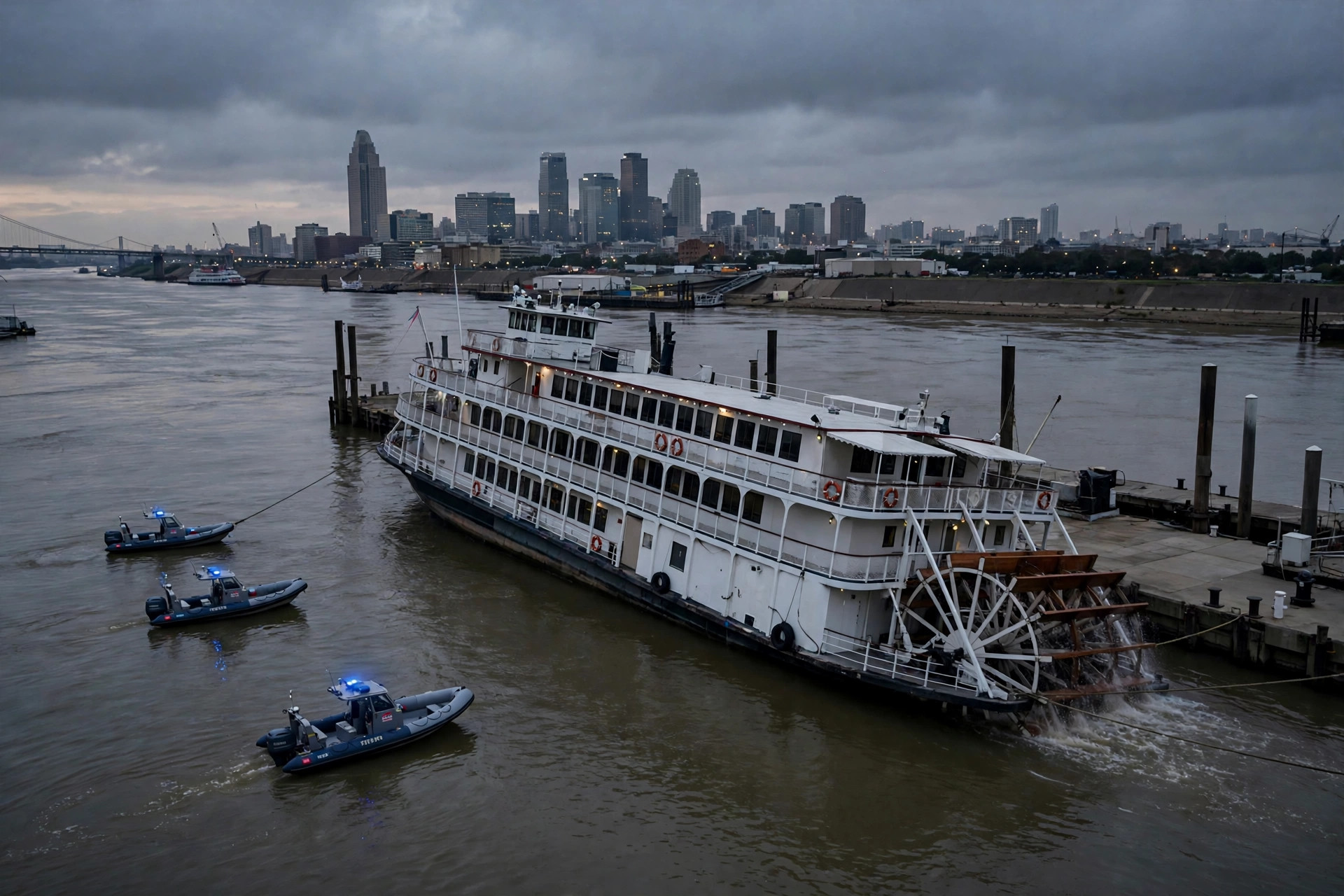
A tanker rammed a docked river cruise ship on the Mississippi River in New Orleans on Friday, 13 November 2026, turning an ordinary disembarkation into a major rescue operation. The New Orleans cruise ship collision happened at about 12:30 p.m. local time, when the asphalt tanker Atlantic Asphalt struck the American Cruise Lines riverboat American Heritage outside the Port of New Orleans headquarters. About 129 passengers, plus crew, were aboard the riverboat. The impact tipped the vessel onto its side, sent people into the river, and shut a stretch of one of America's busiest waterways while rescuers worked. By Friday evening, officials had confirmed multiple rescues — but not an injury count, and not a cause.
What happened in the New Orleans cruise ship collision
The American Heritage had tied up about two hours earlier so passengers could begin disembarking, the Port of New Orleans said. It was moored outside 1350 Port of New Orleans Place, below the Crescent City Connection bridge, when the Atlantic Asphalt came down the river and struck it. Video verified by NBC News and shared by CNN affiliate WDSU shows the tanker hitting the riverboat's port side; the smaller vessel then heels over, takes on water and rolls onto its side alongside the dock. gCaptain, the maritime news site, reported that the riverboat subsequently capsized at the dock.
Vessel-tracking data fills in the morning. MarineTraffic recorded the 81-metre American Heritage arriving from Natchez and docking in New Orleans at 16:53 UTC, about 10:53 a.m. local time, according to gCaptain. A proximity event involving the Atlantic Asphalt was logged at 18:29 UTC — 12:29 p.m. local time, matching the reported time of the collision almost to the minute. The port put the impact at about 12:30 p.m.
Within minutes the scene was a full emergency response. The U.S. Coast Guard, the New Orleans Fire Department, the New Orleans Police Department, emergency medical crews and Port NOLA Harbor Police all converged on the dock, the port said. Passengers were brought inside the Port of New Orleans Administration Building for triage and assistance. NOLA Ready, the city's emergency preparedness campaign, told people to avoid the area while crews worked.
The two vessels: American Heritage and Atlantic Asphalt
The American Heritage is a U.S.-flagged paddlewheel riverboat built in 2015, with room for about 150 passengers, according to Cruise Radio and gCaptain. It is one of American Cruise Lines' modern riverboats, which sail the Mississippi and other U.S. waterways. On Friday it was at the end of a sailing from Natchez, with passengers disembarking in New Orleans — which is why so many people were still aboard when the tanker struck.
The other vessel is far bigger. The Atlantic Asphalt is a 160-metre asphalt tanker flagged in the Marshall Islands, gCaptain reported. At roughly twice the riverboat's length and many times its weight, it did not need speed to do serious damage: a slow-moving ship of that size carries enormous momentum, and the American Heritage was stationary, moored, with no way to get out of the way.
The rescue: what crews faced on the river
The first reports from the water were alarming. WDSU, the NBC affiliate in New Orleans, reported that at least 12 people went into the river after the impact. Port officials had not publicly confirmed that number on Friday afternoon, and it remained an early report rather than an official count. Louisiana Lieutenant Governor Billy Nungesser told The Times that at least 14 people had been rescued from the water. The mayor's office and the New Orleans Fire Department both said multiple people had been rescued and that search-and-rescue operations were continuing.
Video verified by NBC News showed people in life jackets in the water, and it was not immediately clear whether all passengers and crew had been accounted for, the network reported. American Cruise Lines said in a statement that guests and crew had been evacuated from the vessel. "We are deeply concerned for everyone involved," the company said, adding that it was coordinating with the U.S. Coast Guard and local authorities.
The river itself added to the danger. Cruise Radio reported the Mississippi's water temperature at about 66 degrees Fahrenheit — cold enough to pose a hypothermia risk with prolonged exposure, particularly for older passengers. That is one reason the rescue moved so fast, and why the triage area inside the Administration Building mattered: people pulled from the water needed to be warmed and checked, not just counted. Large tanker rescues have happened before this year — the UAE pulled 22 crew from a burning tanker in October — but a capsized passenger vessel at a city dock is a different kind of emergency.
Why the Coast Guard closed part of the Mississippi River
The Coast Guard closed the Mississippi to all vessel traffic between mile markers 93 and 96 while responders worked, the agency told The Post and USA Today. A Coast Guard spokesperson put the collision itself near mile marker 98, USA Today reported. Closing the river is standard after an incident like this: it keeps other traffic clear of rescue boats, protects a capsized vessel that may still be moving or leaking, and gives investigators a clean scene. The Mississippi at New Orleans is one of the busiest commercial waterways in the United States, so even a short closure ripples into barge and cargo schedules up and down the river.
Louisiana Governor Jeff Landry said he was aware of the incident and was heading to New Orleans, and New Orleans Mayor Helena Moreno's communications team said multiple people had been rescued, with search-and-rescue operations still under way. The port's statement was blunt about what it did not yet know: "This remains an active and evolving incident. The number of injuries and the cause of the allision have not yet been confirmed."
What caused the New Orleans cruise ship collision?
Nobody in authority has named a cause. That is the single most important fact about the "why" of this story, and every newsroom covering it said so in the same words on Friday: the cause is under investigation. Preliminary reports suggested the tanker may have lost power before striking the docked vessel, Cruise Radio reported — but that report was unconfirmed, and gCaptain noted that authorities have not said whether the tanker suffered a mechanical or propulsion failure before impact.
Maritime investigators call this kind of event an allision — a moving vessel striking a stationary object — as opposed to a collision between two moving ships. The distinction matters because the questions are different. Investigators from the Coast Guard will look at the tanker's voyage data recorder, bridge voice recordings and engine logs; they will examine whether the vessel lost propulsion or steering, what the current was doing at the time, and what orders were given on the bridge in the minutes before impact. They will also look at why a large commercial tanker was passing so close to a docked passenger vessel in the first place.
What happens next
Three things happen now, in roughly this order. First, the accounting: officials must confirm that every passenger and crew member is accounted for, and release a confirmed injury count. Until that is done, every number in circulation — 12 in the water, 14 rescued — stays an early report. Second, the river: the Coast Guard will reopen the closed stretch once the rescue phase ends and the capsized riverboat is stable enough not to be a hazard. Third, the investigation and the salvage: the American Heritage will have to be righted and assessed, a job that can take days and depends on how much water she took on and how badly her hull and paddlewheel were damaged. American Cruise Lines said it would provide updates in the coming hours.
The wider context is that river cruising has grown fast in the United States, and docked passenger vessels are exposed in a way that moving ones are not — they cannot manoeuvre away from trouble. The Coast Guard's investigation will say whether this was a mechanical failure, a handling error, or something else entirely, and whether any rule about passing distances near passenger docks needs to change. For now, the confirmed facts are the ones that matter: a tanker hit a docked riverboat, about 129 passengers were aboard, people went into the river, rescuers pulled them out, and the cause is not yet known. Tanker incidents have made headlines repeatedly this year, including an LNG tanker struck in the Strait of Hormuz earlier on Friday, and the U.S. Coast Guard has run large rescue operations before, including the rescue of 11 missing boaters off Baja California in October. But a capsized cruise ship at a city dock, in daylight, is the kind of accident that draws a full investigation, and the answers will come from the Coast Guard's findings, not from the first hours of speculation.