
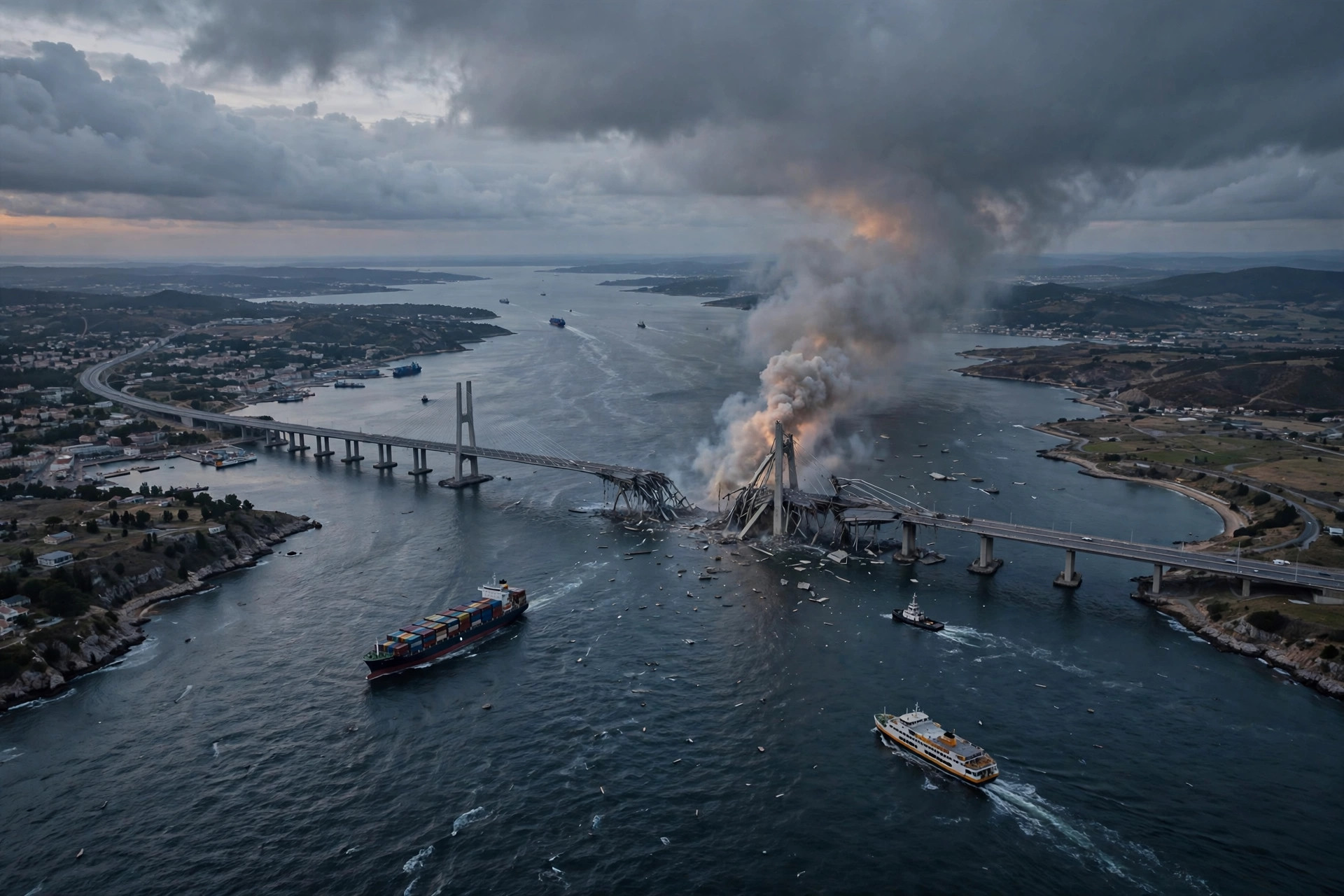
The Crimean Bridge third strike landed just after midnight on 19 November 2026, and it hit the one part of the crossing that was still working. Neptune missiles struck the railway section of the 19-kilometre bridge linking Russia with occupied Crimea, and train traffic stopped while engineers assessed the damage. It was the third strike on the bridge in four days. On 16 November the road arch had shifted by about 15 degrees. On 17 November it collapsed, taking the roughly 225-metre road section down with it. Now the railway was out too — and within hours, in Shenzhen, Vladimir Putin said the strikes had ended any prospect of agreements.
How the Crimean Bridge Third Strike Unfolded
Three separate strikes, four days. Around 2:00 a.m. Moscow time on Monday 16 November, Ukrainian drones struck the bridge, and one of the road bridge's structural arches shifted by about 15 degrees according to Russian media, forcing a partial closure of road traffic. The second blow came around midnight on 16–17 November, when the bridge was struck again by a variety of weapons: the arch structure collapsed and the main road span beneath it fell. Vantor satellite imagery put the fallen road section at roughly 225 metres long. Both train and vehicle traffic were suspended, though trains started moving again later that day.
Then came the third strike. Just after midnight on 19 November, another Ukrainian attack hit the rail bridge. Ukraine's Defence Ministry said Ukrainian forces struck with Neptune missiles, adding that hits had been confirmed near the arch and the railway tracks, and that all train traffic had been halted while the extent of the damage was assessed. Ukraine's General Staff said the railway section had been damaged and traffic across the bridge suspended. Sergei Aksyonov, the Russian-installed head of Crimea, said rail travel would resume from around 4 p.m. local time on Thursday, and Russia's transport ministry said nobody had been hurt. CNN reported that some rail traffic across the bridge did resume on Thursday afternoon, while the road section stayed shut.
What the Bridge Carries — and Why It Keeps Being Hit
The Kerch Bridge is the only direct land link between Russia and Crimea, the peninsula Moscow seized in 2014. It is 19 kilometres long, cost $3.7 billion to build, and was designed to handle 40,000 cars a day and move 14 million passengers and 13 million tons of cargo a year, according to Russian state media figures cited by CNN. Those numbers describe a civilian artery. The bridge's other job is military: it is a key route for supplies to Crimea, which Russia uses as a base to support its front-line troops in southern Ukraine.
That dual role is why the bridge has been attacked so often, and why each attack carries weight beyond the damage itself. A road closure strands holiday traffic and freight. A rail closure cuts the heavy supply line — fuel, ammunition, armoured vehicles — that moves most efficiently by train. Volodymyr Zelenskyy described the strikes as the seventh phase of an operation lasting several weeks. The operation, he said, was a response to Russian strikes on Ukrainian infrastructure, and it was carried out with weapons Ukraine makes itself.
The Crimean Bridge Third Strike and the Weapons Behind It
How the missiles found their target is itself part of the story — and the accounts do not agree. The Financial Times, as reported by New Voice of Ukraine, said Ukraine used a dedicated fleet of networked drones for guidance, without relying on Starlink or Starshield. That report is single-sourced, so it is presented here as reported, not as established fact. What is established is the weapon named by Kyiv for the railway section: Neptune, Ruta and FP-5 Flamingo missiles, in Zelenskyy's own account of the operation. Zelenskyy listed eleven Ukrainian systems used across the campaign, from Palianytsia missile-drones on the road section to Neptune, Ruta and Flamingo on the railway section.
One manufacturer's claim has been confirmed on the record. Destinus, the Dutch-headquartered defence company, said seven of its Ruta cruise missiles struck the bridge on 17 November, of nine launched, and that its Da Vinci drones helped suppress Russian air defences. Its president, Oleksandr Danyliuk, told Reuters the same figures directly. On 20 November, Russian foreign ministry spokeswoman Maria Zakharova said Dutch-made Destinus weapons had been used in the attack, citing a statement by Destinus itself. Which weapon actually brought the span down remains contested: Fire Point, maker of the FP-5 Flamingo, says its missile delivered the final blow. The strikes themselves are not in dispute; the credit for the collapse is.
The Wider Campaign: Kaleykino and the Druzhba Pipeline
The bridge was not the only target on the night of 18–19 November. Ukrainian drones also struck the Kaleykino oil pumping station near Almetyevsk in Russia's Tatarstan republic, around 1,300 kilometres from the Ukrainian border. The independent Russian outlet Astra first identified the target; Tatarstan's authorities then confirmed a drone attack on oil storage tanks near Almetyevsk, saying debris had damaged civilian structures but no one was hurt, and that an automatic fire-extinguishing system had contained the blaze. On 20 November, Ukraine's General Staff formally confirmed the strike, saying three 50,000-cubic-metre storage tanks at the Kaleykino-1 facility had been hit — one caught fire, two others were damaged.
Kaleykino matters because it is a key hub of the Druzhba pipeline system, where crude from Western Siberia and several Russian regions is blended for onward transport to refineries and into the Druzhba network. It had been hit before, in February 2026. No disruption to Druzhba transit or to oil flows through the station has been reported from this attack, and the extent of any disruption to the station's own operations remains unclear. The strike fits a pattern seen across the autumn, including the drone attack and fire at the Ust-Luga oil port on Russia's Baltic coast, which showed that energy infrastructure far from the front line is now in reach. Read more about that attack in our report on the Ust-Luga drone attack.
Putin's Answer: 'No Agreements'
The most consequential sentence of the week was spoken in Shenzhen. Putin said on 19 November: "after the strikes on the Crimean Bridge, there will be no agreements. We will respond to these strikes." He added that "our response will be far more painful". The third strike had come hours before his trilateral meeting with US President Donald Trump and Chinese leader Xi Jinping, and the bridge campaign has now become part of the backdrop to every conversation about ending the war. Putin also ordered the bridge closed to military hardware and ammunition transport — a measure that concedes, in its own way, how exposed the crossing has become.
That backdrop matters because talks about Ukraine have been moving in several directions at once. US envoys have met Putin in Moscow, and five European nations have been working to speak for Europe in the negotiations. A ceasefire covering energy infrastructure and the Black Sea was one of the few areas where a limited deal looked plausible; Putin's statement takes it off the table, at least for now. Read the latest on the diplomacy in our report on the Ukraine peace talks in Moscow and the European E5 peace talks after the Dublin deal.
What Happens Next
Three questions will decide what this week means. First, how badly is the railway damaged? The extent was still being assessed on 19 November, and a quick resumption of some trains does not prove the line is fully sound — the road arch took far longer to judge, and its collapse was visible from space. Second, can Russia repair the bridge faster than Ukraine can hit it again? All three strikes this week caused real damage, and the pattern of the campaign suggests more attempts will follow. Third, what does "far more painful" retaliation look like? Russian strikes on 13 November left parts of 12 Ukrainian regions without power, and the answer is likely to be measured in Ukraine's power grid, not in statements.
For now, the bridge stands damaged but not destroyed, the road section is shut, and the talks that might have eased the energy war are off the table. The fullest account of the previous blow is in our report on the 17 November arch collapse. What changed on 19 November is not just the railway. It is the diplomatic weather around it.
Sources: CNN, Associated Press, Reuters, Wikipedia, The Level Report, WarSight, Shipping Telegraph, Archynewsy, New Voice of Ukraine, Financial Times, Kyiv Post, Kyiv Independent, Meduza, Ukrinform, The Moscow Times, Sofx — November 2026.