
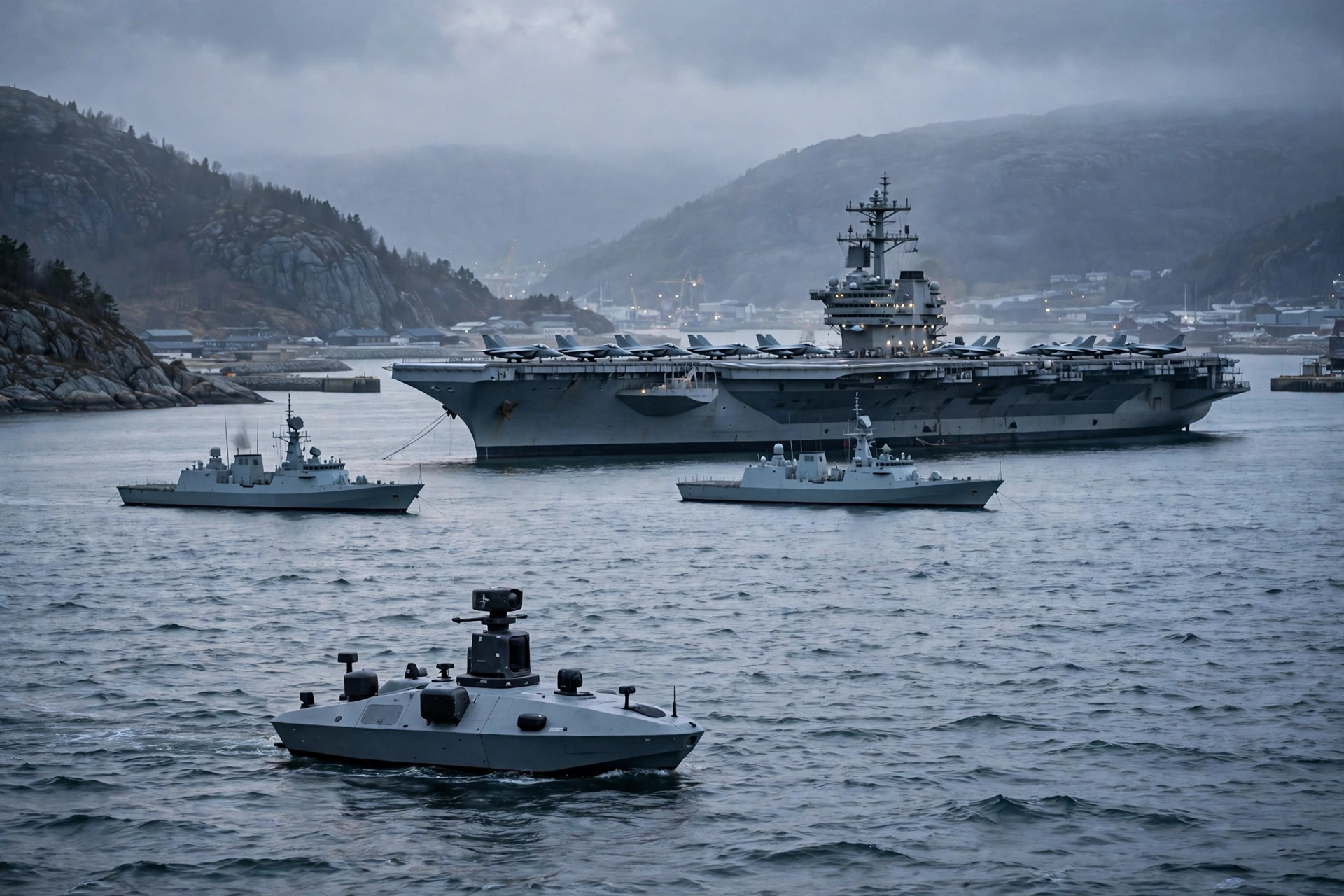
The Northern Navies Initiative is the clearest sign yet that ten northern European countries intend to watch the seas around them together rather than alone. On 10 November 2026, representatives of all ten Joint Expeditionary Force (JEF) maritime nations signed the agreement aboard the Royal Navy aircraft carrier HMS Prince of Wales during the International Sea Power Conference in Oslo, Norway. The UK Ministry of Defence said the deal would make the JEF NATO's maritime vanguard in the North Atlantic, the High North and the Baltic Sea. It is not a new alliance and it does not replace NATO. It is a practical agreement about how ten navies operate, train, plan and share equipment before a crisis arrives.
First Sea Lord General Sir Gwyn Jenkins signed for the Royal Navy. The agreement delivers on a Statement of Intent he proposed in London in April 2026. The ten countries are the United Kingdom, Denmark, Estonia, Finland, Iceland, Latvia, Lithuania, the Netherlands, Norway and Sweden. Together, according to an inventory count by GlobalMilitary.net, their navies field 25 destroyers and frigates and 19 attack submarines. The point of the Northern Navies Initiative is to turn those separate fleets into something closer to one force.
What the Northern Navies Initiative actually does
The agreement covers joint planning, joint training, compatible equipment and mutual support at sea. The UK Ministry of Defence said the JEF navies will operate in the same way, train to the same standard and plan together before a crisis. Equipment will be interoperable by design, so future autonomous platforms can plug into each other's command and control systems. The Ministry gave two concrete examples. A Royal Navy frigate could transfer operational responsibility to another JEF member without losing momentum. A warship could repair, refuel and resupply in an allied port. Small examples, but they describe the difference between ten navies that happen to sail in the same waters and ten navies that can act as one.
The Northern Navies Initiative also sets out how the group would fit into a larger war. The Ministry said the JEF should be able to act early, combine quickly and transition seamlessly into NATO command if the Alliance needs to mobilise at scale. That wording matters. The JEF is a UK-led grouping that has operated since 2014, built for fast crisis response in northern Europe. NATO remains the collective defence framework. The new initiative sits between the two: faster than NATO's full machinery, but designed to fold into it.
Why the Northern Navies Initiative was signed now
The trigger is Russian naval activity. UK defence ministers said Russian naval activity around the UK rose 41% in the first nine months of 2026, a figure reported by The Guardian and described by Minister for Defence Readiness Luke Pollard as a huge increase. Defence Secretary Wes Streeting, speaking at the Atlantic Future Forum aboard HMS Prince of Wales in Oslo, reported the same 41% rise in Russian maritime activity in the UK's area of responsibility in the High North. The concern is not only warships. Pollard said Russian spy ships such as the Yantar have been trying to build a picture of the UK's critical national infrastructure and map undersea cables. Russian frigates have escorted oil tankers and other trade vessels in UK waters, and in June 2026 one fired shots at a yacht south of the Isle of Wight, according to The Guardian's reporting.
The threat to undersea infrastructure runs through the whole agreement. Cables and pipelines carry Europe's data and energy across the North Atlantic, the Arctic and the Baltic Sea. In April 2026, Britain said it had deployed military vessels to deter Russian submarines that had spent more than a month in and around British waters. The Northern Navies Initiative is the longer-term answer to the same problem: permanent cooperation instead of one-off deployments.
The £90m Atlantic Net sensor network
Signed alongside the pact was the first phase of Atlantic Net, part of the UK's Atlantic Bastion programme. The UK Ministry of Defence said Atlantic Net is a framework worth £90 million with UK company Ocean Infinity Solutions, building a network of autonomous systems and sensors across the North Atlantic to detect Russian submarines. The UK plans to spend the £90 million on drones, sensors and artificial intelligence systems to help the Royal Navy counter Russian undersea threats and protect critical infrastructure. The Royal Navy said it will bring the first phase of Atlantic Net into operation within months.
Atlantic Bastion is the wider British strategy for transforming anti-submarine warfare by combining traditional platforms with autonomous systems. Atlantic Net is one component: ocean sensors, digital processing, unmanned vehicles and cooperation with existing ships. The distinction matters because the £90 million buys the first phase of a surveillance network, not a finished system that already watches every metre of the North Atlantic. What it does buy is the start of a shared picture of the sea, built from sensors and drones rather than from warships alone.
Ten navies, three seas and one choke point
The Northern Navies Initiative covers three stretches of water: the North Atlantic, the Arctic and the Baltic Sea. Each carries a different risk. The North Atlantic holds the Greenland-Iceland-UK gap, the narrow passage Russian submarines must cross to reach the open Atlantic, which the Royal Navy describes as a strategic choke point in the High North. The Baltic Sea is shallow, crowded and ringed by JEF members, including Estonia, Latvia, Lithuania, Finland and Sweden. The Arctic is opening as ice retreats, and with it the routes and resources that follow.
The ten members bring different strengths. The UK and Norway bring large navies and deep experience in the North Atlantic. Denmark, the Netherlands and Sweden bring frigates and submarines. Finland, Estonia, Latvia and Lithuania bring Baltic knowledge and proximity to Russia. Iceland brings location: its waters sit astride the Atlantic routes. Canada applied to join the JEF in September 2026, according to reporting at the time, but no decision on that application has been announced.
What happens next for the Northern Navies Initiative
The signing is the start of the work, not the end of it. The navies must now turn the agreement into shared procedures, shared training and equipment that genuinely plugs together. The first test will be Atlantic Net: whether the sensor network comes into operation within months, as the Royal Navy said, and whether its picture of submarine movements is shared across the ten members. The second test will be exercises at sea, where a frigate handing over to an allied ship or refuelling in an allied port stops being an example in a press release and becomes routine.
For readers in the JEF countries, the change is practical rather than dramatic. No new alliance has been created, no treaty obligation added, and no fleet has been merged. What has changed is the commitment to act together early, before a crisis, with shared drones, shared sensors and shared plans. In waters where Russian submarines are more active than they were a year ago, that is the point. The Northern Navies Initiative bets that ten navies watching together will see more, sooner, than ten navies watching alone.
Read more: Iceland rules out a more permanent NATO troop presence, Canada's latest Russia sanctions, Ukraine peace talks open in Abu Dhabi and the UN report on Russian energy strikes in Ukraine.