
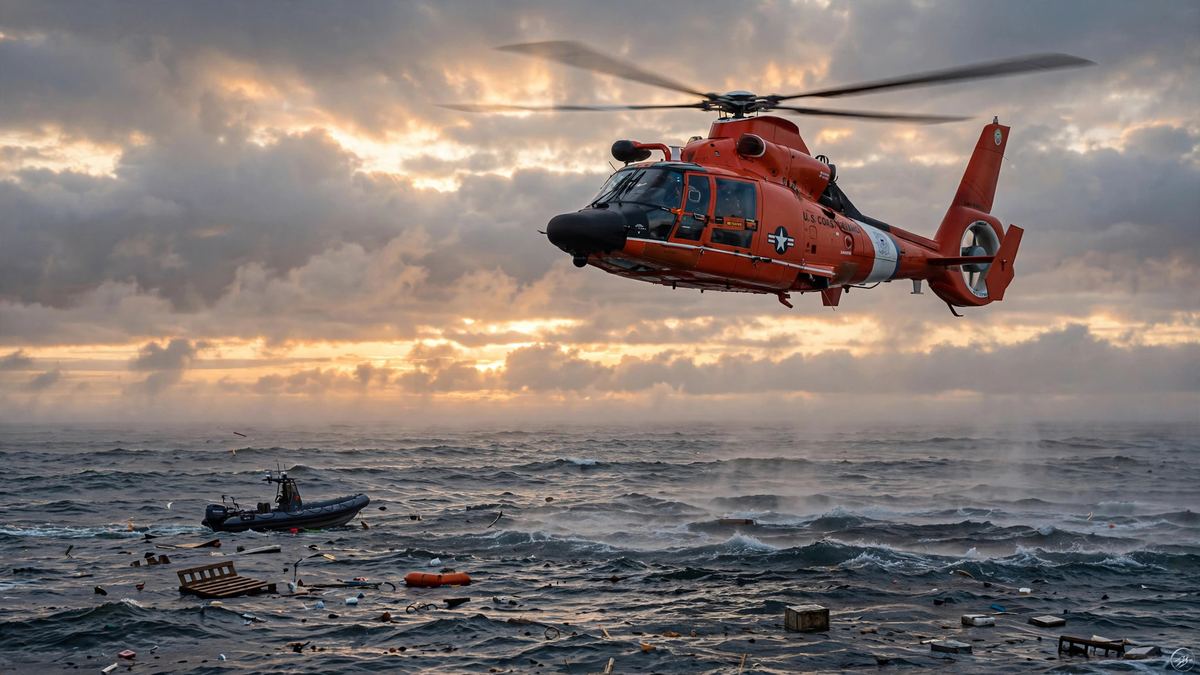
Sixteen people have been pulled from the Pacific Ocean off Mexico's Baja California coast after the boat they were on capsized in the early hours of Friday, 16 October 2026 — and eleven people are still missing. Several of the survivors were suffering from severe injuries consistent with shark bites when rescuers reached them, the United States Coast Guard said. A multinational search involving American and Mexican crews is continuing in the open ocean about 140 miles west of Ensenada. The story is trending per news coverage.
The emergency began at about 1 a.m. Pacific time on Friday, when someone aboard the vessel transmitted a Mayday call saying the boat was sinking. A Coast Guard rescue helicopter reached the reported position roughly two hours later — and found no boat at all. "There was no sight of a vessel in the water, just straight people in the water," Petty Officer Chris Sappey told reporters. What the crew found instead were people floating in the open Pacific, some clinging to debris, in the dark.
It took the helicopter crew, which included a rescue swimmer, about 90 minutes to pull sixteen people from the water. "People were holding onto each other, to debris, just treading and trying to stay above water before being rescued," Lt. Santiago Tamburini of the Coast Guard told the Associated Press and the Canadian Broadcasting Corporation. One survivor told officials that as many as 27 people had been aboard the vessel — a figure the Coast Guard has not been able to verify, but one that has framed the search for those still unaccounted for.
The shark-bite injuries
The detail that has drawn worldwide attention is what happened to some of the survivors while they waited in the water. "Several of the individuals rescued were suffering from severe injuries consistent with shark bites, and the Coast Guard provided life-saving first aid while en route [to] San Diego," the agency said in a statement on Saturday.
The rescued were flown by helicopter to San Diego and taken to local hospitals. Three were admitted to Scripps Mercy Hospital San Diego, including one person treated for a suspected shark bite and two treated for cold exposure, hospital spokesperson Janice Collins said. Two of the survivors were reported to be in critical condition. The Coast Guard has not identified the species involved or described exactly how the encounters occurred — the injuries are officially described as "consistent with" shark bites, a careful phrasing that reflects what rescuers could observe in the field.
Shark researchers note that the waters off Baja California are home to several large shark species, and that blood in the water from a sinking, plus hours of thrashing and debris, can draw predators. The incident is a stark illustration of why time matters so brutally in open-water rescues: the wait for help is measured not only in exposure and exhaustion, but in what else is in the water.
The search for the eleven missing
The search operation has been one of the larger recent Coast Guard responses in the region. The Coast Guard and the US Navy deployed two helicopters, a fixed-wing aircraft and a cutter, while the Mexican Navy contributed its own assets, including a Navy combat ship. The Coast Guard planned to add another helicopter to the operation on Saturday, and searchers have been running coordinated patterns over the area where the vessel went down.
That area — about 225 kilometres west of Ensenada — is open ocean, far from shore, with conditions the Coast Guard describes as unforgiving. "We all know it's a suspected smuggling route," Tamburini said, adding that the sea in that area "is unforgiving," and that it was unclear whether the vessel got lost, suffered engine failure, was swept out to sea, or was ever meant to go that far. The search area is so remote that the first aircraft to arrive found only scattered people and debris — no hull, no life raft, no wreckage of any kind.
Although the incident did not happen in US waters, the Coast Guard sent its assets anyway. "We were able to help, and that's why we launched our assets," Petty Officer Charlie Valor said on Saturday. The Mexican Navy and US Navy are assisting, making this a three-service, two-nation effort for eleven lives still unaccounted for.
Who was aboard — and why
All sixteen of the people rescued are Mexican nationals, the Mexican consulate in San Diego told the Associated Press. US Customs and Border Protection is interviewing the survivors, according to the Coast Guard, which suggests investigators are trying to establish whether the vessel was part of a smuggling operation — and who organised it.
The origin and destination of the vessel remain unknown. Officials have not recovered the boat or identified what type it was. But the location tells its own story: the waters off Baja California are a well-documented corridor for maritime smuggling, where small open boats known as pangas leave the coast in the dead of night carrying migrants north toward the United States. "Boats in that area can be for fishing, leisure, personal recreation. We just don't know what they were doing out there," Tamburini said — though he acknowledged the route's reputation.
Coast Guard commanders have been blunt about the pattern. "This case highlights the extreme dangers of taking to the sea," said Capt. Robert Tucker, commander of Coast Guard Sector San Diego. "The vessel had a large number of people onboard and was following a route normally used in illegal maritime smuggling operations. Offshore conditions are unforgivable and can quickly result in death." The Coast Guard could not formally confirm to reporters that this was a human-smuggling attempt, but the circumstances — the hour, the route, the number of people aboard a vessel that left no trace — fit the established pattern.
A deadly corridor
Deadly attempts to move people by sea from Mexico toward the United States are not new, and the recent record is grim. In May 2025, at least three people died when a panga flipped off the coast about 35 miles north of the US-Mexico border. In 2023, eight people were killed in one of the deadliest maritime smuggling accidents off the US coast, after two boats approached a San Diego beach in heavy fog and one capsized in the surf. The open-ocean route far off Ensenada is more remote than those cases — and therefore even less survivable when something goes wrong.
Maritime smuggling routes have also produced disasters on the other side of the world: a migrant boat capsizing off Djibouti killed 139 people earlier this month, a reminder that overcrowded, unseaworthy vessels are a global phenomenon, not a regional one. And the ocean itself has been volatile for lawful shipping too — the UAE rescued 22 crew from a burning tanker this month, and Hurricane Simon battered Mexico's Pacific coast as a Category 4 storm.
What happens next
Three separate efforts are now running in parallel. The first is the search itself: aircraft and ships from the Coast Guard, the US Navy and the Mexican Navy are still scouring the waters west of Ensenada for the eleven missing, though every hour reduces the odds of survival in cold open water. The second is the medical recovery of the sixteen survivors, two of them in critical condition, with hospitals in San Diego treating shark-bite wounds, cold exposure and the effects of hours in the ocean.
The third is the investigation. Customs and Border Protection is interviewing the survivors to determine who organised the voyage, how the passengers were recruited, and what type of vessel was used. If the case is confirmed as a smuggling operation, it will join a growing caseload of maritime smuggling investigations along the Pacific coast. Prosecuting the organisers of such voyages is difficult — the vessels are often disposable, the organisers rarely aboard — but survivor testimony is often the key evidence, which is one reason CBP's interviews began quickly.
For now, the facts are these: 27 people were reported aboard, 16 were rescued — all Mexican nationals — 11 remain missing, several survivors suffered injuries consistent with shark bites, and no vessel has been found. The search continues. Sources: Associated Press, 17-18 October 2026 (via People, Reflector, Suaragarut); US Coast Guard Sector San Diego statements — Lt. Santiago Tamburini, Petty Officer Chris Sappey, Petty Officer Charlie Valor, Capt. Robert Tucker (16-17 October 2026); People (18 October 2026); CBC News, as reported via Associated Press (17 October 2026); NBC San Diego via the New York Post (16 October 2026); Fox LA (16 October 2026); New York Post (16 October 2026); Al Jazeera, via 234Radio (17 October 2026); Dispatch Times (17 October 2026); The Sun (18 October 2026).
US involvement in Mexican operations remains politically explosive, as shown by the treason charge against the former prosecutor accused of letting CIA agents join a drug-lab raid.