
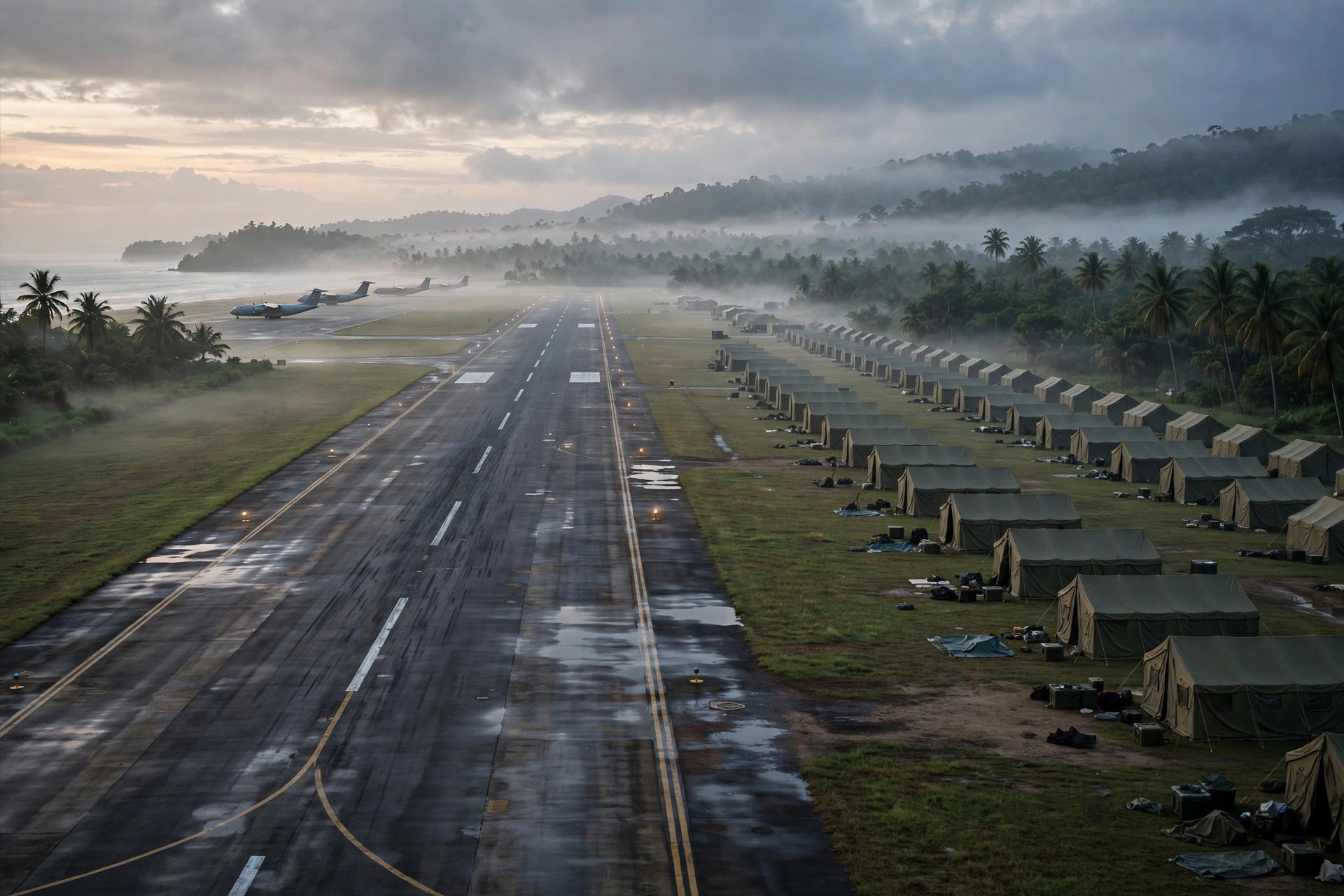
The Ecuador US military base question came to a head on Sunday, when President Daniel Noboa denied that the United States has a military base in his country — days after an investigation by the Agence France-Presse documented an unusual deployment of American aircraft, tents and construction work at an airbase near the port city of Guayaquil. Noboa's answer was categorical. Speaking to the digital news outlet Altavoz, he said American personnel at Taura Air Base were there solely for "temporary activities" as part of security cooperation between the two countries. "Sometimes there's a specific mission. Sometimes there's a specific operation," he said. "We work together. It's not an American base. It's an Ecuadoran base." The denial leaves a gap the president did not close: he did not address the American aircraft AFP documented, he gave no figure for how many US personnel are at the base, and he sidestepped a journalist's request to visit Taura. The story matters because Ecuador's voters rejected foreign military bases in a referendum a year ago, and because the constitution still bans them — so what is happening at Taura is not only a security question but a legal one.
What the Ecuador US military base claim is about
The facts at the centre of the Ecuador US military base dispute come from AFP's investigation, published in October. The news agency documented an unusual deployment of US aircraft at Taura Air Base, the installation of dozens of tents, and infrastructure work at the facility. It identified about 20 US military flights at the base from June to mid-October, and obtained documents referring to the presence of US soldiers. AFP also reported that personnel at the base had taken part in drone flights to gather intelligence. When the investigation was published, the Pentagon, US Southern Command and Ecuador's air force did not respond to AFP. The full scope of the Ecuador US military base presence has not been made public — no official figure for personnel numbers, no published agreement, and no public inventory of what was built. That silence is the reason the story has not gone away: the physical evidence of a deployment exists in AFP's reporting, while the official account of it consists of a single word, "temporary". Noboa's framing is that the personnel are engaged in time-limited missions as part of broader bilateral cooperation, and that the facility remains under Ecuadoran control. What he has not explained is how temporary activities require dozens of tents, infrastructure work and roughly 20 military flights over four months, or why the deployment was not disclosed before AFP reported it. The questions are sharpened by what happened inside Ecuador's own armed forces: the then-air force commander, General Mauricio Salazar, asked the armed forces to clarify the legality of the deployment in a letter in September — a sign that the legal basis for hosting US personnel was being questioned at the top of the service itself, before the story became public.
The referendum a year ago — and why it still shapes this story
None of this can be understood without the referendum of November 2025. Noboa had campaigned to change the constitution and reverse the ban on foreign military bases that Ecuador has carried since 2008, arguing that the country needed outside help against drug trafficking. Ecuadorans voted against the change: more than 60% voted No, on a turnout of 82.3%. The result was a direct popular verdict, and it is the reason the president's wording on Sunday was so careful. He did not say there are no American soldiers in Ecuador — AFP's documents show there are. He said there is no American base, and that the base is Ecuadoran. The distinction is the whole argument: a foreign base is banned, but cooperation with foreign personnel on an Ecuadoran base is, in his account, something else entirely. Whether that distinction holds up legally is the question the Ecuador US military base row raises — the same question General Salazar's letter raised in September, and it has not been answered publicly since. Quito and Washington have strengthened their cooperation against drug trafficking in recent years, and the security case for that cooperation is real — Ecuador's ports, including Guayaquil, sit on trafficking routes that have brought rising violence to the country. But the referendum result means any cooperation that looks like a base carries a political cost, and the government has a visible incentive to describe the Taura deployment in the narrowest possible terms. The contrast with the country's recent politics is striking: Ecuador's politics have been turbulent, with the arrest of opposition figure Luisa González in a money-laundering probe in October 2026, and even a livestreamed Mass in Ecuador made headlines in October when a crucifix fell during the service — but the Taura question is the one with constitutional consequences.
Why the Ecuador US military base question matters now
Three things will decide how this story develops. The first is access: Noboa sidestepped a journalist's request to visit the Taura base, and until independent observers are allowed in, the argument will rest on AFP's reporting against the president's word. The second is documentation: the legality question raised by General Salazar in September needs an answer from the armed forces or the government, and the documents AFP obtained referring to US soldiers have not been explained. The third is the American side. The Pentagon and US Southern Command did not respond to AFP in October, and their silence leaves the scale and purpose of the deployment to be inferred from flight counts and tents. For readers, the honest summary of the Ecuador US military base story is this: American military personnel are at Taura Air Base — Noboa does not dispute that. About 20 US military flights used the base between June and mid-October, and dozens of tents and infrastructure work were installed there — AFP documented both. The president says the presence is temporary cooperation on an Ecuadoran base; the voters said no to foreign bases a year ago; and the armed forces' own former commander asked whether the deployment was legal. None of those facts has been reconciled, and that is why the denial, rather than ending the story, has become the story. Referendums like the one Ecuador held in November 2025 are binding expressions of the public will, and the gap between that verdict and the deployment at Taura is now the central question in Ecuadoran politics.