
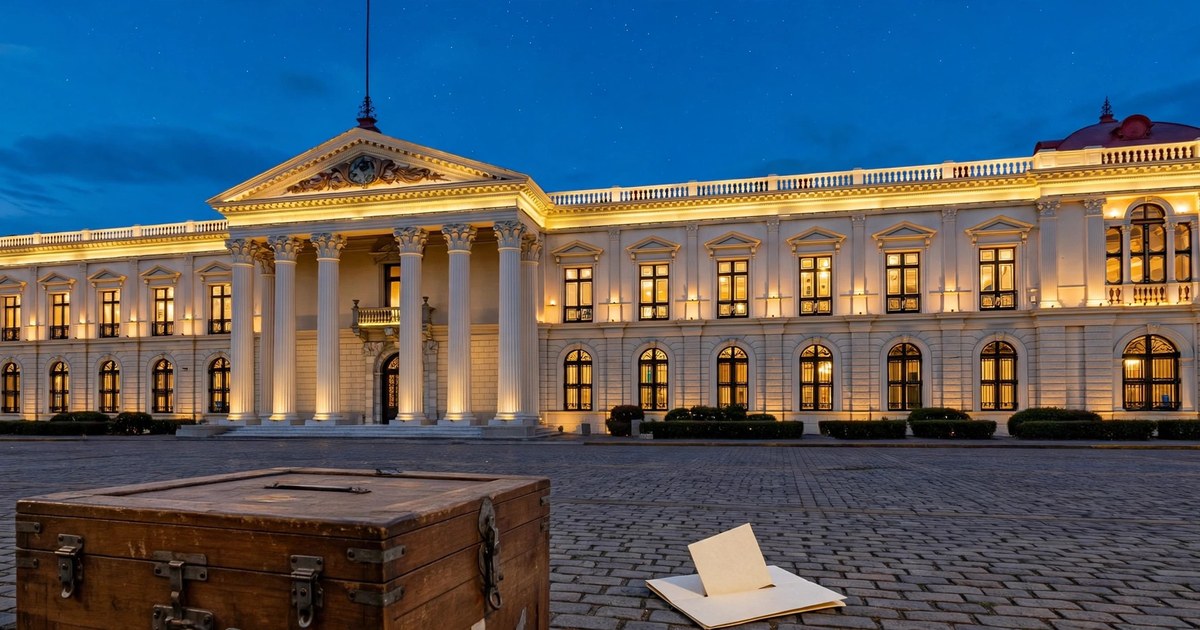
Nayib Bukele has made the Bukele third term official. El Salvador's president registered on Thursday night, 19 November 2026, to seek an unprecedented third consecutive term in the country's February 2027 election — a bid that would have been unconstitutional only a few years ago, and one his critics say could keep him in power indefinitely. He arrived at the Supreme Electoral Tribunal in San Salvador in a fleet of police cars, greeted by supporters carrying "Bukele 2027" signs and chanting "six more years", according to Reuters. At 45, and polling between 55% and 70% for re-election, he is the overwhelming favourite to win. The real question now is what a third term — and the constitutional changes that made it possible — will mean for a country whose constitution once banned consecutive re-election outright.
Bukele Third Term: What Happened on 19 November
Bukele submitted his presidential candidate paperwork to the Supreme Electoral Tribunal on Thursday night, alongside Vice President Félix Ulloa, who is also seeking another term. Crowds gathered outside the tribunal building as he arrived, cheering and chanting "six more years", Reuters reported. After signing his registration, Bukele thanked the crowd and said the country was moving toward a democratic election that would feature "freedom of expression", according to BusinessWorld.
The registration was the final formal step in a candidacy that has been taking shape for months. Bukele secured his ruling Nuevas Ideas party's nomination in July, running unopposed in the party's 12 July primary, Reuters reported. Candidates had to register by Thursday, and the deadline also covered the 60 congressional seats and 44 municipal council seats that will be contested on the same day. The general election is scheduled for 28 February 2027, according to the Supreme Electoral Tribunal.
Four opposition candidates will stand against him, including Maytee Iraheta of the right-wing Nationalist Republican Alliance (ARENA) and Rafael Aguirre of the left-wing Farabundo Martí National Liberation Front (FMLN), Reuters reported. The polls give them little hope: Bukele has support of 55% to 70%, while opposition parties poll in single digits. The Associated Press puts his approval rating at around 90%, largely because of his war on the country's gangs.
How the Bukele Third Term Became Possible
None of this would have been possible under the constitution Bukele inherited. El Salvador's constitution long prohibited consecutive re-election, in part because of the Central American nation's fragile democracy, the Associated Press noted. A president served one term and stepped aside. That rule survived for decades — until Bukele's allies began dismantling it, one step at a time.
The first step came in 2021, two years after Bukele took office. The Supreme Court ruled that sitting presidents could seek re-election, a break from the country's past that opened the way for his second term in 2024, Reuters reported. Bukele won that election in a landslide, and his party took control of Congress. Nuevas Ideas now holds 54 of the 60 seats in the legislature. It was that dominance that made the next step possible.
The decisive step came in July 2025. Congress approved a constitutional amendment allowing indefinite presidential re-election, Reuters reported. The same amendment extended presidential terms from five years to six, abolished second-round votes, and rescheduled the presidential election to February 2027 so it coincides with the legislative and municipal elections. The current term is scheduled to end early, on 1 June 2027, and the president and vice president elected in February will begin a new six-year term on that date. If Bukele wins, he would remain in office until 2033 — and under the amended rules, he could seek re-election again after that.
That is the arithmetic behind the headline. A court ruling in 2021, a landslide in 2024, a supermajority in Congress, and an amendment in 2025: each step on its own looked procedural. Together, they removed every constitutional obstacle between Bukele and a third term.
Bukele Third Term: What the February 2027 Election Decides
On 28 February 2027, Salvadorans will vote for a president and vice president, all 60 members of Congress, and 44 municipal councils. The presidential race is the one the world will watch, but the congressional result matters almost as much: a Nuevas Ideas supermajority would leave Bukele free to govern exactly as he has for the past five years, while a weaker result would force him to negotiate for the first time.
The opposition faces long odds. Beyond Iraheta and Aguirre, two other candidates are standing, but none of the opposition parties polls above single digits, according to Reuters. The campaign will test whether any challenger can turn the debate from security — where Bukele is strongest — to the concentration of power, where his critics say he is most vulnerable. El Salvador is not the only country voting in February 2027: South Sudan's elections were also postponed to February 2027.
What the vote will not decide is whether the third term itself is legal. That question was settled in Congress in 2025. The election decides only whether voters want six more years of it — and, by the size of the margin, how much of a mandate Bukele can claim for the next phase of his presidency.
Why Critics Call It Democratic Backsliding — and What Supporters Say
The criticism is blunt. The ruling Nuevas Ideas party has scrapped term limits, a move the opposition and rights groups say will allow Bukele to consolidate power indefinitely without institutional checks and balances — accusations the government rejects, Reuters reported. For his critics, the sequence is the evidence: a court ruling that cleared the way for a second term, a constitutional amendment that removed the limit entirely, and an election calendar rewritten to suit the incumbent.
Bukele's supporters answer with results. The state of emergency in place since 2022, and the crackdown on organised crime that came with it, has driven a sharp drop in homicides, Reuters reported. That is the foundation of his popularity: an approval rating of around 90%, according to the Associated Press, and re-election support of 55% to 70% in the polls. For many Salvadorans, the argument is simple — the country was one of the most violent in the world, and now it is not.
Both claims can be true at once. A leader can be genuinely popular and still be dismantling the rules that would one day remove him. That tension is the real story of the February 2027 election: a vote in which the favourite is a president whose supporters credit him with saving the country, and whose critics say he is rewriting its constitution so he never has to leave.
Bukele's Rise: From Publicist to President
Bukele, a former publicist, was expelled from the FMLN in 2017 and came to power in 2019, ending three decades of rule by ARENA and the FMLN, Reuters reported. He built his appeal on a direct, often confrontational style and on a promise to do what the old parties could not: end the gang violence that had defined daily life in El Salvador for a generation.
His government has since taken its security campaign beyond El Salvador's borders. Bukele has taken his crime offensive to Haiti, the Associated Press reported, where El Salvador's soldiers in Haiti have become part of a regional security mission. The registration also comes as Washington reworks its posture across Latin America — the United States and Venezuela signed a military cooperation deal this week after a 20-year freeze.
What Happens Next
The campaign now runs to 28 February 2027. Watch three things. First, whether any opposition candidate can break out of single digits and force a debate about power rather than security. Second, whether Nuevas Ideas keeps its grip on Congress, where 54 of 60 seats gives it the freedom to keep rewriting the rules. Third, what Bukele does with the mandate if he wins: a third term until 2033 would make him the longest-serving Salvadoran leader of the democratic era, and the amendment he passed means the question of a fourth term is no longer hypothetical.
For now, the paperwork is filed, the deadline has passed, and the February vote is set. El Salvador's voters will decide whether the man who remade the country's security and its constitution gets six more years to remake it further.
Sources: Reuters; Associated Press; BusinessWorld.