
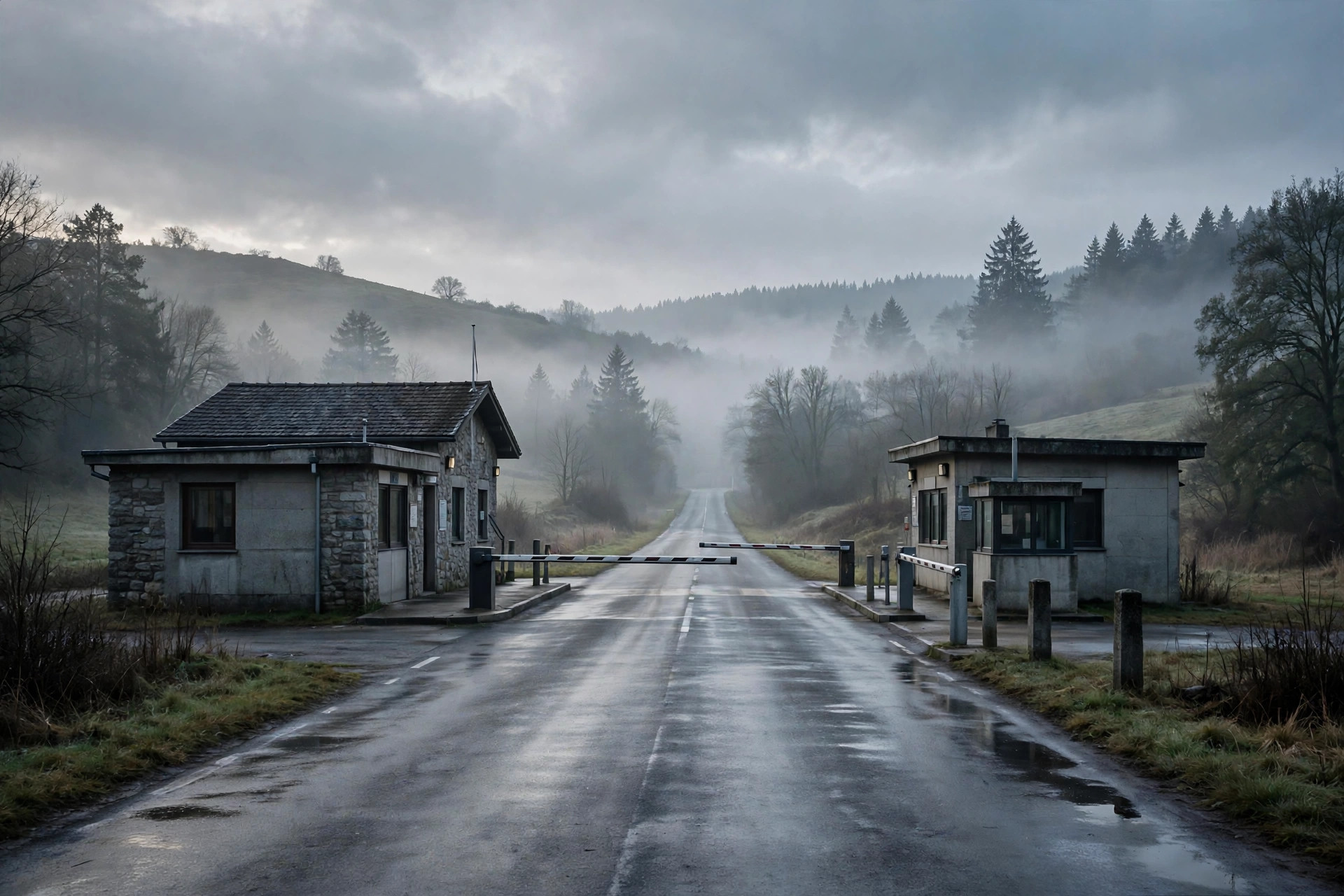
Estonia closes Russia border December 1: the country's three road crossings with Russia — Narva, Koidula and Luhamaa — will shut on that date, Foreign Minister Margus Tsahkna announced on Sunday 15 November, after Estonian security services said they had foiled an arson attack on a drone manufacturer. Eight people were detained over the alleged attempt to set fire to Threod Systems, a company in Viimsi that makes long-range reconnaissance and attack drones and supplies Ukraine. Estonia's Internal Security Service, known as KAPO, assesses that Russia's military intelligence service, the GRU, ordered the attack. That assessment has not been tested in court, and the Kremlin has denied the allegations. The border closure has no end date.
The alleged attack itself was stopped before it could do serious damage. According to the London Daily News, the attempt took place at about 03:00 on Saturday 14 November, when the suspects tried to set fire to the Threod Systems facility. The company's own security staff intervened, and the fire caused only minor damage. Nobody was injured. Eight suspects were detained, and five of them were placed under arrest, Prosecutor General Astrid Asi said. The suspects are Latvian citizens, and the investigation is continuing. Latvia's State Security Service, the VDD, tipped off its Estonian counterparts and seized explosives at nine sites in Latvia, a detail that shows the plot was being watched before it reached the factory gate.
Estonia Closes Russia Border December 1: The Foiled Attack on Threod
Threod Systems is not a household name, but in the world of military drones it is a significant company. Based in Viimsi, near the Estonian capital Tallinn, it builds long-range reconnaissance drones — aircraft that fly far ahead of friendly forces to observe enemy positions — and attack drones, which carry explosives to a target. Its products are supplied to Ukraine, where drones have become one of the main weapons of the war with Russia. A fire at its factory would have disrupted production and sent a message to other defence suppliers in the Baltic states.
KAPO chief Margo Palloson said investigators had established GRU involvement in the plot, the Helsinki Times reported. The GRU is Russia's military intelligence directorate, and it has been linked by Western governments to sabotage operations across Europe in recent years. The word to note here is "assesses": KAPO's position is an intelligence assessment, not a finding by a court. The eight suspects have been detained, not convicted, and the case has yet to be tried. The distinction matters, because the border closure that followed is a government response to an assessed threat, not a punishment handed down by a judge.
The Kremlin's response came on 16 November. Spokesman Dmitry Peskov called the allegations "entirely baseless", according to The Library Estate. That denial is part of the record and belongs in any fair account of the story. Russia has denied involvement in similar incidents before, and Western governments have continued to attribute them to Russian intelligence. Readers should know both positions: Estonia's security service says its investigators established GRU involvement, and the Kremlin says the claim is entirely baseless.
Background: The August Arson at Milrem Robotics
The Threod incident was not the first attack on an Estonian defence company this year. In August, an arson attack hit Milrem Robotics, another Estonian firm that supplies Ukraine, and that attack was also linked to Russian intelligence, the Helsinki Times reported. Milrem makes robotic ground vehicles used by the Ukrainian military. The pattern — two defence suppliers, both working for Ukraine, both hit by fire within three months — is what turned a single foiled attack into a national security decision. One incident can be treated as a crime; two, with the same alleged sponsor, look like a campaign.
Estonia has been one of Ukraine's most committed supporters since Russia's full-scale invasion in 2022, relative to the size of its economy, and the region's security tensions are visible in incidents such as a Russian warship hit in the Gulf of Finland. It has sent weapons, hosted refugees and pushed for tougher sanctions. It also shares a long border with Russia and a history of occupation that makes security threats feel immediate rather than abstract. The Baltic states — Estonia, Latvia and Lithuania — have spent the last few years hardening their defences, building fences, buying weapons and preparing for hybrid attacks that fall short of open war: sabotage, cyber attacks, disinformation and border pressure.
Latvia's role in the Threod case is a reminder that this is a regional problem, not a bilateral one. The suspects are Latvian citizens, the explosives were seized in Latvia, and the tip-off came from Latvia's VDD. The Baltic security services work closely together, and an attack planned in one country and carried out in another is exactly the kind of case that needs that cooperation. It also raises a question that investigators will have to answer: how a group of Latvian citizens came to be involved in an alleged GRU-ordered attack on an Estonian factory.
Why Estonia Closes Russia Border December 1
The border closure is the government's answer to the assessed threat. Foreign Minister Margus Tsahkna announced on Sunday 15 November that the Narva, Koidula and Luhamaa crossings would close on 1 December, with no end date given. Prime Minister Kristen Michal instructed preparations for the closure, and Interior Minister Igor Taro is to submit a formal proposal to the government. The sequence — announcement, preparation, formal proposal — shows a decision taken quickly but through the normal machinery of government, not by decree.
Narva is the largest of the three crossings and the one most people will notice. It sits on the river that forms the border, opposite the Russian town of Ivangorod, and it carries cars, buses and lorries between the two countries. Koidula and Luhamaa are smaller crossings in the south-east. Closing all three means there will be no road crossing from Estonia into Russia at all. Rail and air links were already heavily restricted, so the closure effectively seals the land border for ordinary travellers and for trade by road.
The effects will fall unevenly. People who live near the border and cross it for family, work or shopping will be cut off. Businesses that still trade across the frontier will have to reroute. Russian citizens living in Estonia, and Estonians with relatives in Russia, will lose their most direct route. The government has evidently decided that those costs are worth bearing, given the security assessment. Whether the closure is temporary or becomes permanent will depend on whether the threat is judged to have passed — a question tied to the wider debate over Ukraine's push for NATO membership and NATO's posture in the north — and no end date has been set, which suggests the government is not expecting a quick resolution.
Key Facts About Estonia Closes Russia Border December 1
The facts reported by the sources named in this article are as follows. At about 03:00 on Saturday 14 November, an attempt was made to set fire to Threod Systems in Viimsi. Company security foiled the attack; damage was minor and nobody was injured. Eight people were detained, all Latvian citizens, and five were placed under arrest. KAPO assesses that Russia's GRU ordered the attack, and KAPO chief Margo Palloson said investigators established GRU involvement. Latvia's VDD tipped off Estonia and seized explosives at nine sites in Latvia. On Sunday 15 November, Foreign Minister Margus Tsahkna announced that the Narva, Koidula and Luhamaa border crossings would close on 1 December, with no end date. Prime Minister Kristen Michal instructed preparations, and Interior Minister Igor Taro is to submit a formal proposal. On 16 November, Kremlin spokesman Dmitry Peskov called the allegations "entirely baseless". An arson attack at Milrem Robotics in August was also linked to Russian intelligence.
One point of care: the title of this article says Estonia "closes" the crossings on December 1. The closure was announced on 15 November and takes effect on 1 December; it has not happened yet at the time of writing. The body of this article makes that timing clear, and the title uses the present tense in the way headlines do for a decision that has been taken and dated. The GRU attribution is the Estonian government's assessment, not a court finding, and the Kremlin's denial is recorded above.
What Happens Next After Estonia Closes Russia Border December 1
The first step is the formal proposal from Interior Minister Igor Taro, which will set out the legal basis and the practical arrangements for the closure. Border guards will need to be redeployed, signage changed, and arrangements made for the people and vehicles caught by the change. The government will also have to decide what happens to residents of the border region who depend on crossing, and whether any exceptions will be allowed for humanitarian or family reasons.
The investigation into the Threod attack will continue in parallel. The eight detained suspects will face prosecutors, and the evidence for the GRU assessment will be tested — first in the investigation, and eventually, if charges are brought, in court. The explosives seized in Latvia will be examined, and the links between the suspects and whoever ordered the attack will be traced. That process will take months, and its outcome will shape how the incident is remembered: as an intelligence assessment, or as a proven fact.
The wider question is whether other Baltic states follow Estonia's lead. Latvia and Lithuania face the same kind of threat, and they will be watching how the closure works in practice. If the security situation worsens, more crossings could close; if it eases, Estonia may set an end date. For now, the message from Tallinn is plain: a foiled arson attack on a drone maker has closed a border, and the border will stay closed until the government is satisfied the threat has passed.