
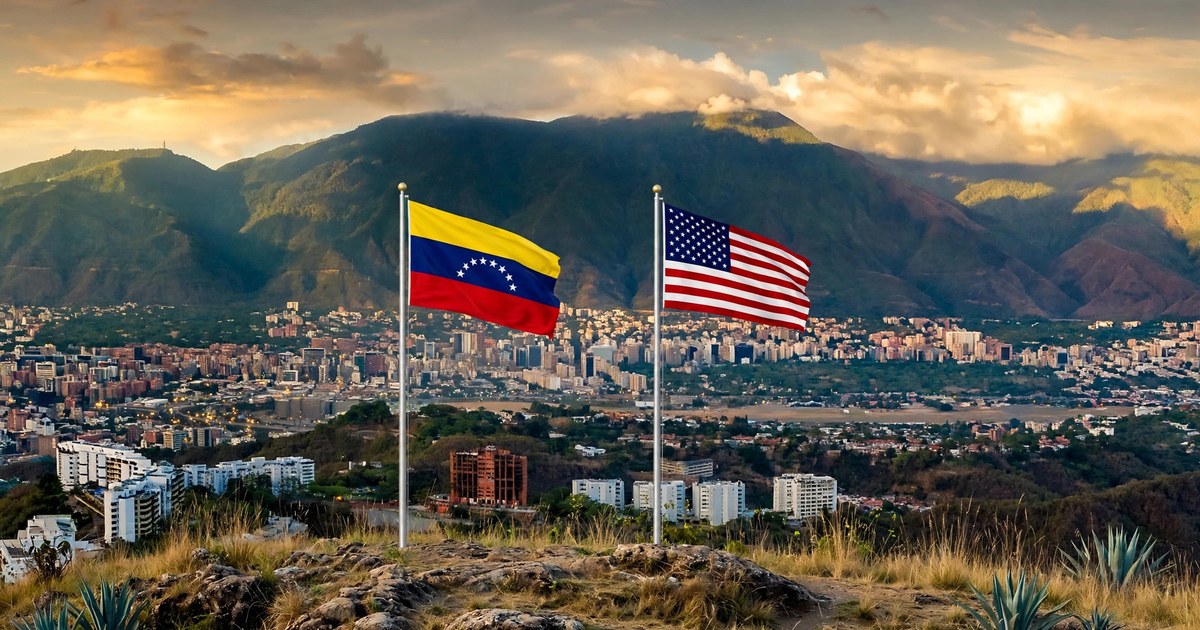
The United States and Venezuela signed a military cooperation agreement in Caracas on Wednesday, 18 November 2026, restoring defense ties that had been frozen for two decades — less than a year after American special forces flew into the Venezuelan capital and captured its then president, Nicolás Maduro. The US Venezuela military deal was announced by Defense Secretary Pete Hegseth during a surprise first visit to the country, and it covers joint training, intelligence sharing and defense equipment, according to the Associated Press and CNN.
Hegseth called the US Venezuela military deal "historic" and said Venezuela had gone "from our most aggressive regional threat to a compliant security partner". He made the announcement outside the newly re-inaugurated US Embassy in Caracas, after meeting interim President Delcy Rodríguez at the Miraflores Palace. The deal, he said, "reestablishes a renewed military partnership" that will let American and Venezuelan forces train together, share intelligence and work with more defense equipment and capabilities together.
He also warned that the partnership would not be "cosmetic". CNN reported that Hegseth said it would require defense and security reforms in Venezuela to modernize its military and eliminate what he called "persistent threats" to both nations.
What the US Venezuela military deal covers
The agreement was signed by Hegseth and his Venezuelan counterpart, Defense Minister Gustavo González López, according to footage broadcast on Venezuelan state television and reported by CNN. The Wall Street Journal reported that the pact allies the two countries' militaries "to ensure that the Venezuelan people are not threatened by foreign actors or narco-terrorists or criminals".
Rodríguez welcomed the arrangement in her own terms. "The renewed opportunity to strengthen the training of our Bolivarian national armed force, enhance its operational equipment and facilitate access to new technologies is highly beneficial for our military personnel," she said on Wednesday, according to The Times.
Defense News reported that Hegseth framed the deal as part of what he called the "Donroe Doctrine" — a play on President Donald Trump's name — and said Venezuela was "on its way to rebuilding its military alongside the United States". The Pentagon's own statement, issued later, acknowledged Hegseth's trip to Caracas and his meetings with Venezuelan officials, the Journal reported.
Hegseth also tied the partnership to the drug war. The Daily Caller reported that he said the military partnership would mean an increase in strikes against drug cartels in the region, and the Journal reported that the agreement allows the US to help Venezuela bolster territorial control and get rid of narco-terrorists who have long sought haven there.
Why the deal ends a 20-year freeze
The striking thing about the signing is how long the two militaries have been apart. The Times reported that US-Venezuela military cooperation, once one of the strongest alliances in the region, was largely frozen two decades ago after a 2006 arms embargo imposed during the George W. Bush administration on the government of the socialist president Hugo Chávez. The break dates to the Chávez era in the mid-2000s, and for twenty years the two countries' armed forces barely spoke.
What changed is the government in Caracas. After Maduro's capture in January, Rodríguez's interim government has moved steadily closer to Washington — first on oil, now on defense. The US Venezuela military deal is the second big agreement of the year between the two sides, and it turns a relationship defined by confrontation into something closer to a partnership.
The January raid that changed everything
On 3 January 2026, several Chinook helicopters flew dozens of Delta Force commandos directly into Caracas to capture Maduro and his wife, Cilia Flores, The Times reported. About 80 people were killed in the raid, mostly Cuban and Venezuelan soldiers. There were no US casualties. Maduro and Flores are now in New York facing drug trafficking charges, and Maduro's trial in New York is set for June 2027.
Since the raid, the two sides have cooperated more than the public record shows. Last month, a military strike carried out by Venezuela with US intelligence and drone support hit an alleged base and cocaine distribution site run by the Colombian guerrilla group the ELN in Venezuela's Apure state, The Times reported. The Wall Street Journal reported separately that US drones struck a camp of Colombian drug-trafficking guerrillas just inside Venezuelan territory, killing more than two dozen fighters in an operation coordinated with the government in Caracas. And since September 2025, the US has carried out airstrikes against dozens of suspected drug-trafficking speedboats, some of which set sail from Venezuela, the Journal reported.
Hegseth's own path to Caracas ran through Florida. The Journal reported that on Tuesday, the day before the signing, he visited the Doral offices of US Southern Command, the headquarters of the US military in Latin America, whose commander is Gen. Francis Donovan, according to the Associated Press. The House voted 211-204 earlier this month to send impeachment articles against Hegseth to committee, effectively blocking them, as covered in our report on the Hegseth impeachment vote.
The oil deal behind the military deal
The US Venezuela military deal follows an oil agreement signed in late August, which Trump called "the largest oil deal in history". The Times reported that the Rodríguez government granted North American Blue Energy Partners, an American-backed oil company, long-term rights over 17 oil fields containing roughly 65 billion barrels of reserves — about 20 per cent of all of Venezuela's oil.
Defense News reported that the United States secured a 35% stake in the parent company of North American Blue Energy Partners, along with a guaranteed share of output and first refusal rights on the remainder. The company plans to produce over 250,000 barrels per day by year-end as it prepares to have 10 well clusters in service. Alejandro Betancourt, the UK-based Venezuelan billionaire who runs the company, was at the palace on Wednesday for the signing of the military agreement, The Times reported.
The oil deal is part of the point. The Times reported that it is intended to raise production, generate revenue for the US and Venezuela, and reduce Chinese and Russian influence in the country. Hegseth made the same argument about energy in his speech at the embassy, saying the arrangement rendered "the Strait of Hormuz a non-factor for the western hemisphere" in terms of its oil supplies. His Hormuz remark also underlines how much of Washington's attention is still fixed on the Gulf, where US and Iranian forces have exchanged fire around Qeshm, Kuwait and Bahrain.
What is still unclear about the US Venezuela military deal
For all the ceremony around the US Venezuela military deal, the details are thin. CNN reported that the timeline and scope of the deal remain unclear, and the Defense Department has not responded to questions about the agreement or Hegseth's trip, nor did it provide a daily schedule for the secretary on the day of his visit. The Associated Press reported that the Pentagon did not immediately offer further details on the new partnership.
The Pentagon has not published the text of the agreement, and it has not said whether American troops will be stationed in Venezuela, how much the partnership will cost US taxpayers, or when the first joint training will take place. How much the agreement will cost American taxpayers was not discussed at the announcement, according to The Center Square.
One clue about what may come next: The Center Square reported that Secretary of State Marco Rubio said last week that the US and Venezuela were in talks to secure a military presence in the South American country. Whether the new agreement is that presence, or a step toward it, is one of the questions the Pentagon has yet to answer.
Why it matters and what happens next
The US Venezuela military deal completes a turnaround that would have looked impossible a year ago. In January, the United States was flying commandos into Caracas to seize a president. In November, its defense secretary is signing a partnership in the presidential palace and talking about rebuilding Venezuela's military alongside America's. For the interim government, the pact is a stamp of legitimacy from Washington. For the Trump administration, it is the next step in a strategy that pairs oil deals with security cooperation across Latin America — CNN reported that Wednesday's deal is the latest effort to bolster security cooperation with Latin American countries against what the administration calls "designated terrorist organizations" in the region.
What to watch now is whether the words turn into anything concrete. The first test is whether the Pentagon publishes details: the scope, the timeline, the cost. The second is whether joint training and equipment deliveries actually start, and whether the promised increase in strikes on cartels materializes. The third is political: whether the interim government holds together, and whether the oil money — 250,000 barrels a day by year-end, if North American Blue Energy Partners hits its target — starts flowing fast enough to steady a country that has spent two decades in confrontation with Washington.
Sources: Associated Press; CNN; The Times; The Wall Street Journal; Defense News; The Daily Caller; The Center Square.