
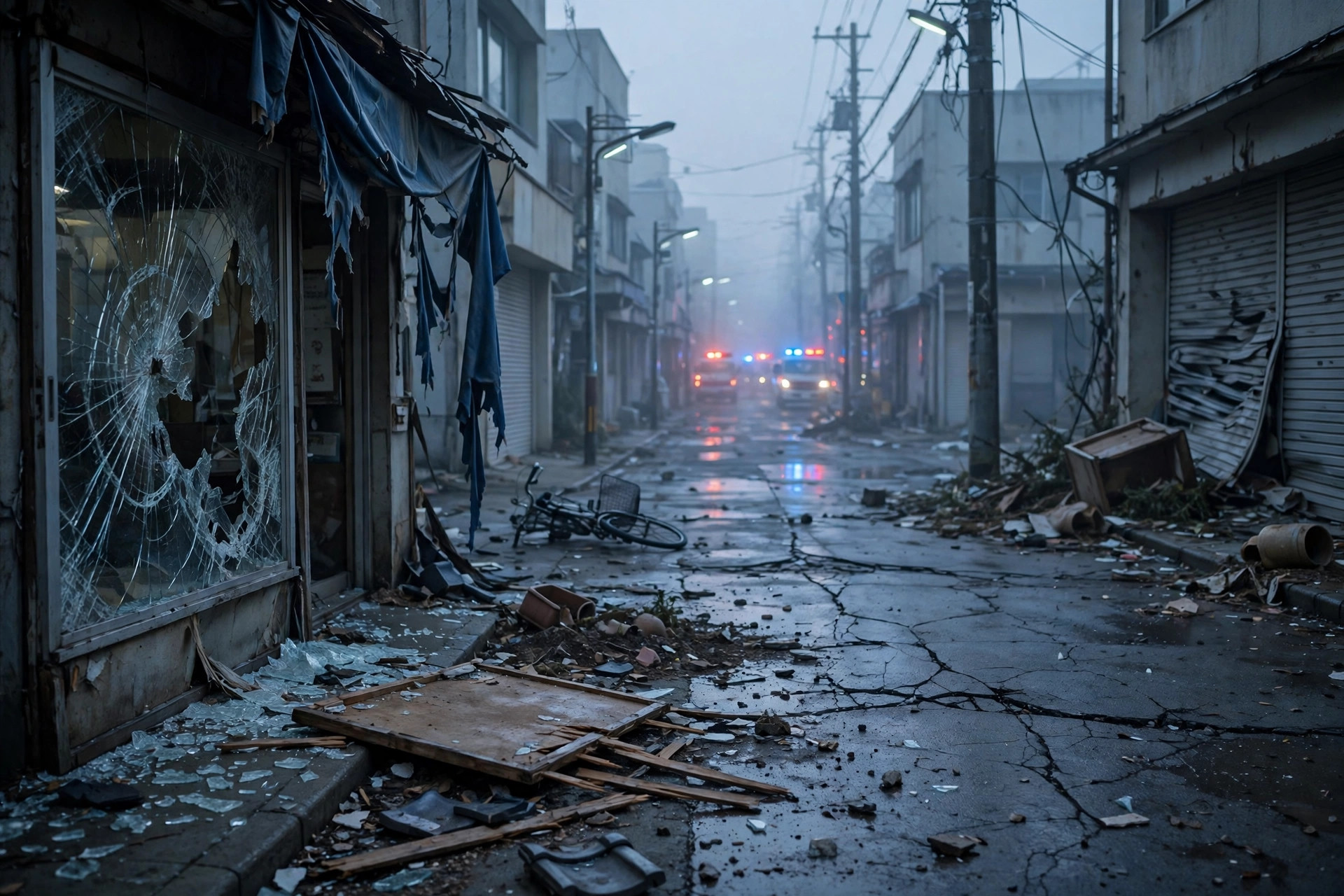
The Japan earthquake November 2026 struck in the middle of the night, when most people in central Japan were asleep. At 01:04 JST on Sunday 8 November 2026, a magnitude 5.7 earthquake shook western Shizuoka Prefecture, with its epicentre about 18 km north of Hamamatsu. At least 22 people were injured, according to local media reported by AP, and the shaking was felt across a wide area of central Japan. No tsunami warning was issued. The Japan Meteorological Agency, known as JMA, held an emergency press conference at about 03:00 JST and warned that strong aftershocks were possible over the coming week, especially in the next two to three days. For residents of Shizuoka and the neighbouring prefectures, the quake was a sharp reminder that Japan sits on one of the most active earthquake zones on earth, and that even a moderate quake can cause injuries, damage and disruption far from its epicentre.
Japan Earthquake November 2026: What Happened at 01:04 JST
The Japan Meteorological Agency put the magnitude at 5.7. The US Geological Survey, known as USGS, put it at 5.5. The two figures differ because the agencies use different measurement methods and different sets of seismic stations, and such differences are common in the first reports after an earthquake. The epicentre was in western Shizuoka Prefecture, about 18 km north of Hamamatsu. The depth was about 38 to 41 km. A quake at that depth is deep enough that its energy spreads over a wide area, and that is what happened here: the shaking was felt across central Japan, including Kyoto, Nara, Yamanashi in the Mount Fuji area, Gifu and Nagano. The USGS-based estimate put the number of people who felt the shaking at about 13 million. That figure describes how many people were in the area where shaking was felt, not how many were hurt. The number of people injured was far smaller, but the injuries were real. At least 22 people were injured, according to local media reported by AP. Store windows shattered, and people fled buildings in the shaking. In the dark, in the early hours of a Sunday morning, the sudden movement woke households across the region and sent some people out into the streets.
The strongest shaking measured upper 5 on Japan's seven-level seismic intensity scale, recorded in Chita in Aichi Prefecture. Lower 5 was recorded in Seto in Aichi Prefecture, Urugi in Nagano Prefecture, Ena in Gifu Prefecture and Hamamatsu itself. Japan's intensity scale measures how strongly the ground shakes at a given place, rather than the total energy released by the quake, so the same earthquake can produce different intensity readings in different towns. The readings of upper 5 and lower 5 describe shaking strong enough to make standing difficult, to move heavy furniture and to break windows. That matches the reports from the night: store windows shattered and people fled buildings. The quake was felt in Kyoto and Nara to the west, in Yamanashi near Mount Fuji, and in Gifu and Nagano to the north. The breadth of the felt area, together with the estimate of about 13 million people feeling the shaking, shows how widely the energy travelled from an epicentre in western Shizuoka.
Background: Shizuoka, the Nankai Trough and Japan's Shaking Scale
Shizuoka Prefecture sits on the Pacific coast of central Honshu, between Tokyo and Nagoya, and Hamamatsu is one of its largest cities. The quake area is in the Nankai Trough region, a long offshore zone where one tectonic plate slides beneath another. The Nankai Trough is well known in Japan because it has produced large earthquakes in the past and because scientists watch it closely for signs of a future major quake. After the Japan earthquake November 2026, JMA said that its observations showed no unusual change suggesting a major quake is imminent. That statement matters because it answers the question many people in the region ask after any sizeable quake in this area: does this mean a bigger one is coming? JMA's answer, based on its observations at the time, was that there was no unusual change pointing to an imminent major quake. The agency still warned about aftershocks, which are a separate and normal feature of earthquakes. Aftershocks are smaller quakes that follow a larger one as the ground settles, and they can be strong enough to cause further damage, especially to buildings already weakened.
Japan uses its own seven-level seismic intensity scale, and the readings from this quake help explain the pattern of injuries and damage. Upper 5 in Chita and lower 5 in Seto, Urugi, Ena and Hamamatsu describe shaking that is felt strongly by everyone in the area. At those levels, unsecured objects fall, windows can break, and people can lose their balance. The reports of shattered store windows fit that picture. The scale is different from magnitude. Magnitude, given here as 5.7 by JMA and 5.5 by USGS, describes the size of the earthquake at its source. Intensity describes what people actually experience at a particular place. A magnitude 5.7 quake is moderate in global terms, but in a densely populated part of Japan, with millions of people living within the felt area, even moderate shaking can injure people who are caught by falling objects or broken glass, or who fall while moving in the dark. Readers who want wider context on how Japan prepares for such events can read Japan's disaster agency and stockpile plans.
Japan Earthquake November 2026: Where the Shaking Was Felt
The shaking from the Japan earthquake November 2026 reached well beyond Shizuoka. It was felt in Kyoto and Nara, in Yamanashi in the Mount Fuji area, and in Gifu and Nagano. The USGS-based estimate of about 13 million people feeling the shaking gives a sense of the scale of the felt area. That number is an estimate based on population and shaking data, and it should not be confused with a count of injuries or damage. The injury count, at least 22 people according to local media reported by AP, is the figure that describes the human cost. The contrast between the two numbers is itself informative. A quake felt by about 13 million people injured at least 22, which shows that most people in the felt area experienced shaking without being hurt, while a small number were unlucky enough to be hit by falling objects, cut by glass, or hurt while fleeing buildings. Store windows shattered in places, and people fled buildings, which is the natural response when a building shakes hard in the night and nobody yet knows whether a stronger shock will follow.
The timing added to the difficulty. At 01:04 JST, most people were at home and asleep. An earthquake in the middle of the night gives no daylight to judge damage, and it wakes people suddenly, which can lead to falls and confusion. The emergency press conference held by JMA at about 03:00 JST, roughly two hours after the quake, gave the public its first official account of what had happened and what might come next. The agency warned of possible strong aftershocks over the coming week, especially in the next two to three days. That warning is the practical message for residents: the first quake may not be the last shock, and the days immediately after are the period when aftershocks are most likely to be strong. People in the affected area were left to check their homes in daylight, to look for cracks, broken glass and fallen objects, and to stay alert for further shaking.
Why It Matters: Injuries, Buildings and the Hamaoka Plant
The injury figure is the most direct measure of what the Japan earthquake November 2026 did. At least 22 people were injured, according to local media reported by AP. The wording matters: at least 22 means the count could rise as more reports come in, and it should not be read as a final total. The injuries were reported alongside shattered store windows and people fleeing buildings, which points to the typical pattern of a moderate urban quake: cuts from glass, bruises from falling objects, and injuries sustained while moving quickly in the dark. The quake also tested infrastructure. The Hamaoka nuclear power station reported no malfunctions detected after the quake. That check is routine after any sizeable earthquake near a nuclear plant in Japan, and the result, no malfunctions detected, is the outcome residents and regulators want to hear. The plant's location in the region makes the check a central part of the story, and the absence of reported malfunctions is a concrete fact, not an assumption.
The quake also matters because of where it happened. The epicentre was in western Shizuoka Prefecture, about 18 km north of Hamamatsu, in the Nankai Trough region. JMA said its observations showed no unusual change suggesting a major quake is imminent. That is a careful, limited statement. It does not say a major quake will never happen in the Nankai Trough region. It says that, on the observations available after this quake, there was no unusual change pointing to one being imminent. For a region that lives with that long-term risk, the distinction between a short-term warning and a long-term risk is important. The short-term warning from JMA was about aftershocks over the coming week, especially the next two to three days. The long-term picture remains one of preparedness rather than prediction. The quake also came two days after a separate magnitude 6.1 quake struck near Tokyo on Friday 6 November, according to JMA via Xinhua. That earlier quake is a separate event, mentioned here only as context, and it adds to the sense of a restless week for seismic activity in central Japan. For wider context on Japan's changing rules for visitors, readers can also see Japan's new tax-free shopping rules.
Key Facts at a Glance
The core facts of the Japan earthquake November 2026 can be set out plainly. JMA magnitude was 5.7, and USGS magnitude was 5.5. The quake struck at 01:04 JST on Sunday 8 November 2026. The epicentre was in western Shizuoka Prefecture, about 18 km north of Hamamatsu. The depth was about 38 to 41 km. The strongest shaking was upper 5 on Japan's seven-level scale in Chita, Aichi Prefecture. Lower 5 was recorded in Seto in Aichi Prefecture, Urugi in Nagano Prefecture, Ena in Gifu Prefecture and Hamamatsu. At least 22 people were injured, according to local media reported by AP. Store windows shattered, and people fled buildings. The shaking was felt across central Japan, including Kyoto, Nara, Yamanashi in the Mount Fuji area, Gifu and Nagano, by an estimated 13 million people on a USGS-based estimate. No tsunami warning or threat was issued. JMA held an emergency press conference at about 03:00 JST and warned of possible strong aftershocks over the coming week, especially the next two to three days. The Hamaoka nuclear power station reported no malfunctions detected. The quake area is in the Nankai Trough region, but JMA said observations showed no unusual change suggesting a major quake is imminent. A separate magnitude 6.1 quake struck near Tokyo on Friday 6 November, according to JMA via Xinhua.
Two points in that list deserve care. First, the injury figure is at least 22, not a final count, and it comes from local media reported by AP. Second, the magnitude has two figures, 5.7 from JMA and 5.5 from USGS, because the two agencies measure the quake differently. Neither figure is wrong; they are different readings of the same event. The depth is also given as a range, about 38 to 41 km, for the same reason. The felt-area estimate of about 13 million people is a USGS-based estimate, and it describes people who felt the shaking, not people who were injured. Keeping those distinctions clear is what makes the story accurate. A separate record-setting weather story from the same period is covered in October 2026, the warmest October on record.
What Happens Next: Aftershock Warning and the Week Ahead
The clearest guidance after the Japan earthquake November 2026 came from JMA at its emergency press conference at about 03:00 JST. The agency warned of possible strong aftershocks over the coming week, especially in the next two to three days. That is the period to watch. Aftershocks can damage buildings that were weakened by the first quake, and they can injure people who are cleaning up broken glass or moving heavy objects. Residents in the affected prefectures, including Shizuoka, Aichi, Nagano, Gifu and the wider felt area, have reason to keep furniture secured, to check for cracks and gas or water problems in daylight, and to stay ready to move to safety if shaking returns. The warning does not say a strong aftershock will happen. It says one is possible, and that the risk is highest in the first two to three days.
The other questions to watch are the injury count and the damage reports. At least 22 people were injured, according to local media reported by AP, and that figure may change as hospitals and local authorities report further cases. Damage reports, including the shattered store windows already reported, will become clearer in daylight and over the following days. The Hamaoka nuclear power station will remain under observation, although no malfunctions were detected after the quake. JMA will also keep watching the Nankai Trough region, and its statement that observations showed no unusual change suggesting a major quake is imminent will be tested against further data as aftershocks are recorded. The separate magnitude 6.1 quake near Tokyo on Friday 6 November, reported by JMA via Xinhua, is a reminder that the week brought more than one sizeable shock to central Japan. For now, the practical story is a moderate quake, at least 22 people injured, a wide felt area, no tsunami threat, no reported malfunction at Hamaoka, and a week of aftershock vigilance ahead.
Sources
AP via The Hindu BusinessLine; Japan Meteorological Agency; US Geological Survey; IBTimes Singapore. November 2026.