
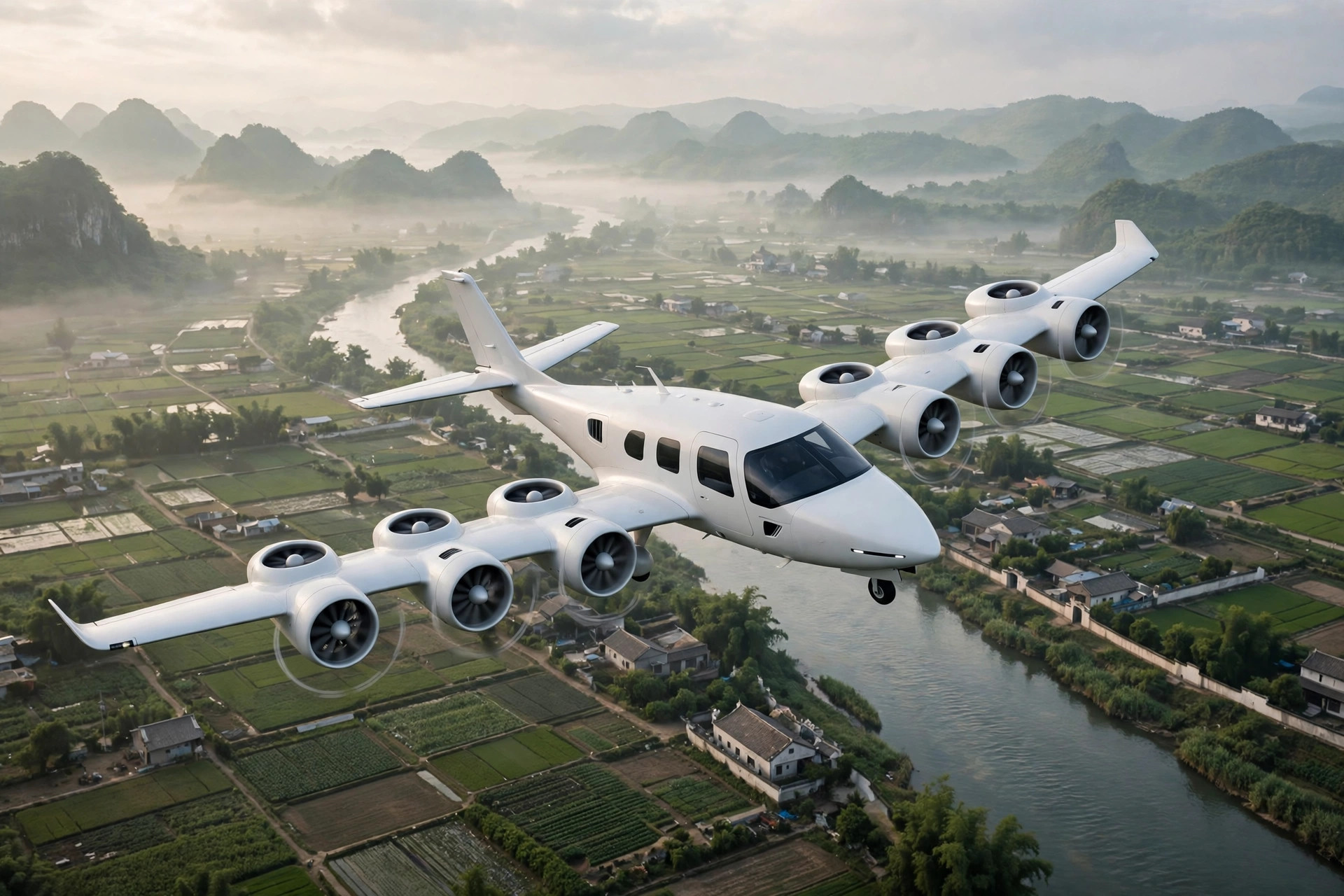
COMAC CE-25A first piloted flight took place on Saturday 14 November in Binzhou, Shandong province, and it is the most significant step yet in China's push into electric aviation. For the first time, the 19-seat, battery-powered, 10-tonne aircraft flew with a crew on board — two pilots and a flight-test engineer — after nineteen uncrewed validation flights. According to Xinhua, the aircraft operated normally and its performance met expectations. The flight lasted 16 minutes and 38 seconds in the air and covered 60.4 kilometres, state broadcaster CCTV reported. That distance is modest, and the aircraft is a long way from carrying paying passengers, but the flight still matters: it is the first time a piloted electric aircraft of this size has flown in China, and it moves the programme from autonomous testing into the crewed phase that certification requires.
COMAC CE-25A First Piloted Flight: What Happened on 14 November
The test flight took place in Binzhou, a city in Shandong province, and the aircraft carried three people: two pilots and a flight-test engineer. CCTV reported that the aircraft was airborne for 16 minutes and 38 seconds and covered 60.4 kilometres, with the total test lasting 57 minutes and 46 seconds from start to finish. The aircraft, registered B-0EFH, is powered by ten electric ducted fans, five mounted on each wing, and it is designed to carry nineteen passengers. COMAC — the Commercial Aircraft Corporation of China, the state-owned manufacturer behind the C919 airliner — said the aircraft operated normally and that its performance met expectations. The model is not new to the public eye: it was first shown as a model at the 2023 China International Import Expo, and the programme has been working through uncrewed validation flights since its first autonomous flight on 2 February 2026. Nineteen of those uncrewed flights were completed before the crewed flight, which is the normal order of things in flight testing: prove the aircraft can fly itself first, then put people in it. The flight was short and cautious, as first crewed flights are supposed to be. The point was not to set a record but to show that the aircraft behaves as expected with a crew at the controls.
What the Flight Proved — and What It Did Not
The most important number in this story is the one that is easy to misread: 400 kilometres. That is the CE-25A's design target for range, along with a cruise speed of 300 kilometres per hour and a ceiling of 2,400 metres, according to Simple Flying. None of those figures was demonstrated on 14 November. The aircraft flew 60.4 kilometres in under seventeen minutes, which is roughly a seventh of its target range, and it did so with three crew and no passengers. That is normal for this stage of testing, but it means the 400-kilometre figure should always be described as a target, not as something the aircraft has done. The flight proved that the aircraft can take off, fly and land with a crew on board, and that its systems work as designed in the air. It did not prove that the aircraft can fly 400 kilometres, carry nineteen passengers, operate in bad weather, or fly the same route day after day. Certification has only just begun: China's aviation regulator, the CAAC, has accepted COMAC's type-certificate application, which is the formal start of the process that ends, years from now, in an approval to carry passengers. There is no launch customer, no price and no date for entry into service. Anyone describing the CE-25A as a working airliner is getting ahead of the facts by several years.
How the CE-25A Fits China's Electric Aviation Plans
The CE-25A was developed by COMAC together with CATL, the battery giant, and Shanghai Jiao Tong University, which tells you where the programme's hardest problems sit: batteries and the engineering of electric propulsion. Batteries are heavy and hold far less energy per kilogram than jet fuel, which is why electric aircraft are starting small — nineteen seats, short ranges — while electric cars, which do not have to lift their own weight into the sky, have moved much faster. The "25" in the aircraft's name refers to CCAR-25, the Chinese airworthiness standard for transport-category aircraft, a signal that COMAC intends this to be certified as a real airliner rather than an experimental curiosity. The programme fits a wider Chinese strategy of building aviation capability at home: COMAC's C919, a conventional jet, is already in service with Chinese airlines, and the CE-25A is an attempt to get ahead in the next generation of propulsion rather than catching up in the current one. Electric vehicles have shown how quickly battery costs can fall once production scales, and aviation is hoping for a similar curve, though the physics are less forgiving in the air. China's clean-technology industries are now world leaders in batteries and solar panels, and the CE-25A is an attempt to extend that lead into the sky.
Why a 19-Seat Electric Plane Matters
Nineteen seats sounds small, but it is a sensible size for the routes electric aircraft are meant to serve first: short hops between smaller cities, island connections, and regional services where a large jet would be half empty. Electric aircraft are quieter than conventional planes, produce no exhaust emissions in flight, and are cheaper to maintain because electric motors have fewer moving parts than jet engines. For remote communities and short regional routes, those advantages could matter a great deal, even if the aircraft never flies long distances. There is also an environmental case: aviation is one of the hardest sectors to decarbonise, and short-haul electric flight is one of the few places where battery technology is already close to workable. The CE-25A is not competing with the C919 or with long-haul jets; it is aimed at a gap in the market that conventional aircraft serve expensively and noisily. That is also why other countries are working on similar aircraft — the race is not only about who flies first, but about who builds the supply chains, the batteries and the certification experience that will matter when the market grows. China and the United States compete across advanced technologies, and aviation is one of the most visible arenas of that competition.
What Happens Next After the COMAC CE-25A First Piloted Flight
The programme now enters the long, unglamorous phase of flight testing: more crewed flights, longer distances, heavier loads, worse weather, and the slow accumulation of evidence that the CAAC will need before it grants a type certificate. The nineteen uncrewed flights that came before were the warm-up; the crewed test campaign is the real work, and it will take years. Watch for three things. First, whether COMAC publishes longer flights approaching the 400-kilometre target, which would show the battery and propulsion system performing as designed. Second, whether the CAAC process moves forward steadily, which would signal that the regulator is satisfied with the aircraft's safety case. Third, whether any airline signs up as a launch customer, which would show that someone other than the manufacturer believes the economics work. Until those things happen, the CE-25A is best understood as a promising prototype that has passed an important test — a piloted electric aircraft of nineteen seats, flown with a crew, on a short and careful flight — and not as the beginning of electric passenger services. The flight on 14 November was a milestone, and milestones deserve to be reported accurately: what was proved, what was not, and how far there still is to go.