
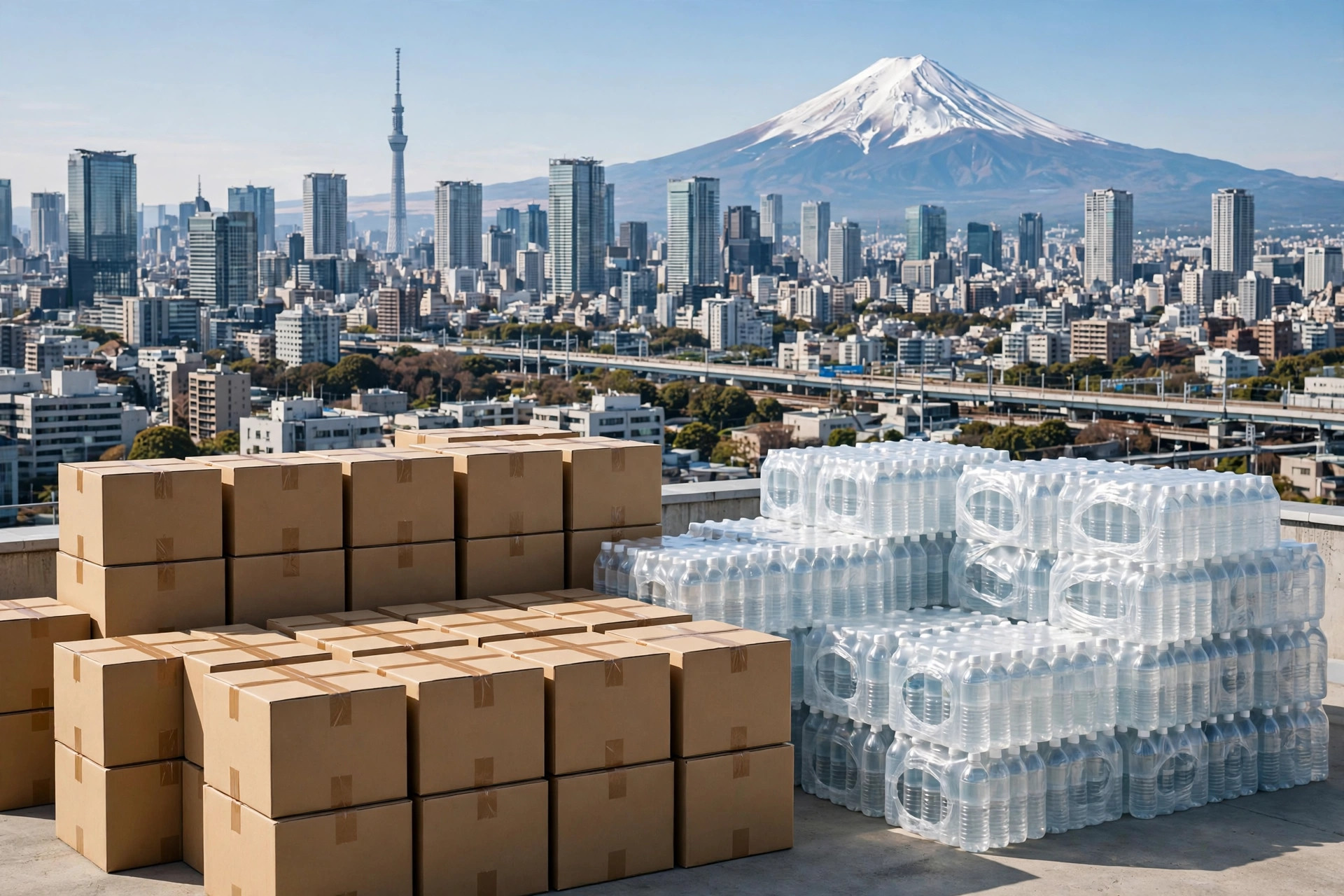
Japan has launched its National Disaster Management Agency on 2 November 2026, creating a new body at the heart of government to prepare the country for the major earthquakes and volcanic eruption it has long feared. The Japan National Disaster Management Agency starts work with 352 staff, sits directly under the Cabinet, and is headed by the prime minister herself — a structure designed to cut through the slow, fragmented decision-making that has hampered past disaster responses. Its first minister, Goshi Hosono, used the launch day to issue a nationwide appeal: households should keep at least three days' worth of water, food and emergency toilets, and ideally a week. The message, officials stressed, is about everyday readiness, not a warning that a disaster is about to strike.
For a country that sits on the Pacific Ring of Fire, the launch is one of the most significant changes to Japan's disaster machinery in decades. Japan has world-class earthquake engineering and a public drilled in evacuation routines, yet major disasters — from the 2011 Tohoku earthquake and tsunami to the 2024 Noto Peninsula earthquake — exposed the same weakness again and again: no single body with the authority to coordinate ministries, local governments and the Self-Defense Forces from the first hours of a crisis. The new agency is meant to close that gap before the next big one arrives, rather than after it.
What the Japan National Disaster Management Agency Will Do
The Japan National Disaster Management Agency replaces and upgrades the Cabinet Office's disaster management department, which had a staff of about 220. The increase to 352 staff — roughly 60 percent more people — gives the new body the depth to plan, train and coordinate full-time rather than borrowing officials from other ministries when a crisis breaks. Because it sits directly under the Cabinet and is headed by Prime Minister Sanae Takaichi, it can issue instructions across ministries without waiting for the usual inter-agency negotiations. Hosono, who serves as the first disaster management minister and also holds the reconstruction portfolio, will run the agency day to day.
The agency was created by the National Disaster Management Agency Establishment Act, Act No. 61 of 2026, which was promulgated on 17 July 2026, and its launch date was set on 25 September 2026. Its core job is coordination: drawing up national disaster plans, running joint exercises with prefectures and municipalities, stockpiling and pre-positioning supplies, and taking charge of the government-wide response when a major disaster strikes. It will also push disaster prevention into everyday policy — from building standards and evacuation routes to the supply chains that keep food, water and fuel moving after an earthquake.
The agency's reach will grow beyond Tokyo. According to reports on the launch, the locations of its regional offices are to be decided by the summer of 2027, with local bureaus following by the summer of 2028. That timetable matters because the areas most at risk — the Pacific coast facing the Nankai Trough, and the densely populated Tokyo region — need permanent local staff who know the terrain, not officials flown in after the ground has already shaken. The government has also put money behind the ambition: according to Nikkei, via EuropeSays, the agency's budget demand for fiscal year 2027 is 65.2 billion yen, and the government aims to raise overseas sales by Japan's disaster-prevention industry from about 1 trillion yen in 2024 to roughly 2 trillion yen by 2030.
Why Japan Created a National Disaster Management Agency Now
Japan's decision to build a new agency now reflects a hard lesson from its own recent history. When the 2011 earthquake and tsunami struck, and again when the Noto Peninsula earthquake hit on New Year's Day 2024, the response involved a maze of ministries, prefectural offices and agencies, each with its own chain of command. Decisions about evacuations, supply deliveries and rescue deployments had to be negotiated across organisational boundaries while roads were cut and communications were down. A single body with clear authority at the centre is intended to remove that friction in the first hours, when delays cost lives.
The timing also reflects what scientists have been warning about for years. The Nankai Trough, the undersea fault running along Japan's Pacific coast, is expected to produce a megaquake at some point, and government estimates have long put the potential damage in the hundreds of thousands of lives and trillions of yen if it strikes at full strength. A major earthquake directly beneath the Tokyo metropolitan area, home to around 37 million people, is another long-standing scenario. Neither threat is new, and neither has a date attached to it — which is precisely why the government argues the preparation cannot wait for a warning sign. The agency's creation is part of a broader shift in Japanese policy toward treating disaster readiness as a permanent national project, alongside economic and security policy. It comes in the same season as other major policy moves in Tokyo, including the Bank of Japan's decision to hold its key rate, covered in our report on the Bank of Japan holding its rate at 1.25 percent in October 2026, and inflation reaching a three-year high — a reminder that the new government is juggling economic pressure and disaster readiness at the same time.
The Three Scenarios the Agency Is Built Around
The new agency is designed around three specific scenarios that officials have named as its top priorities. The first is a Nankai Trough megaquake, the giant earthquake expected along the subduction zone off Japan's Pacific coast, which could trigger a massive tsunami and devastate a wide arc of coastline from central to western Japan. The second is a major earthquake striking directly beneath the Tokyo metropolitan area, where the concentration of people, buildings and infrastructure would make even a moderate quake enormously destructive. The third is an eruption of Mount Fuji, which has not erupted since 1707 but remains an active volcano whose ash fall could paralyse the capital region.
Planning for all three scenarios means preparing for very different kinds of disaster. A Nankai Trough quake would demand mass evacuation from coastal areas and a huge seaborne and airborne relief effort. A Tokyo quake would trap millions of people in a city where roads and railways could be unusable, making the pre-positioning of supplies inside the capital essential. A Mount Fuji eruption would bring ash fall over a vast area, disrupting transport, power and water for days or weeks. The agency's job is to hold detailed plans for each scenario, keep them updated, and rehearse them with the local governments that would have to carry them out. That is also why the regional offices matter: a plan written in Tokyo is only useful if the officials in Shizuoka, Kochi or Wakayama know it by heart.
The Japan National Disaster Management Agency and the Stockpile Call
The most talked-about part of the launch was not the organisation chart but the household advice that came with it. On 2 November, Hosono issued a nationwide "emergency request" urging citizens to prepare at least three days' worth — and, if possible, a week's worth — of water, food and emergency toilets. The wording matters: three days is the minimum, and a week is the preferred target, not a new rule or a legal requirement. There is no mandatory obligation and no penalty for households that do not stockpile. The request is an appeal, not an order, and it applies to ordinary preparedness, the same kind of advice disaster authorities in Japan have given for years, now delivered with the full weight of a new agency behind it.
Hosono was careful to explain what the request is not. At a press conference on 30 October, he clarified that it is not a warning about war or about any specific disaster, and that it is not based on any new forecast. That point was reinforced by the Japan Meteorological Agency, whose Nankai Trough information on 7 October said there had been no change indicating a heightened likelihood of a megaquake. In other words, the stockpile call is not a signal that officials know something the public does not; it is the new agency using its first day in the spotlight to raise the baseline of household readiness across the country. The confusion it caused in some overseas coverage — where the request was framed as an "emergency" warning — shows how easily preparedness advice can be mistaken for a prediction, and the agency will need to keep drawing that line clearly.
For households, the practical advice is straightforward. Water comes first: enough drinking water for every member of the family for at least three days, ideally a week. Then food that needs no cooking or refrigeration, such as canned goods, dried food and energy bars. Then emergency toilets, which become critical when water supplies and sewage systems stop working — a detail that is often overlooked until it is too late. Torches, batteries, a radio and any regular medicines complete the basic kit. The agency's message is that a household that can look after itself for three days gives rescue services the breathing room to reach the people who cannot.
What Happens Next
The agency's first months will be a test of whether a new organisation can change habits faster than the disasters it is meant to face. Its immediate tasks include finalising its staffing, setting up its internal divisions, and beginning the work of deciding where its regional offices will go — a decision expected by the summer of 2027. It will also need to build working relationships with the prefectures and municipalities that actually run evacuations and shelters, and with the Self-Defense Forces, the police and the fire services that do the rescuing. Those relationships cannot be created by law alone; they have to be built through joint training and shared plans.
The public will judge the Japan National Disaster Management Agency less by its structure than by its visibility. If its advice becomes a normal part of Japanese life — if households quietly keep a few days of water and food, if local governments run regular drills, if the plans for the Nankai Trough, Tokyo and Mount Fuji are rehearsed rather than filed away — then the launch of 2 November 2026 will be remembered as the day Japan stopped treating disaster readiness as an emergency measure and started treating it as a permanent part of how the country is run. The next test, as always in Japan, will come without warning. The agency's purpose is to make sure the country is ready anyway. Visitors planning a trip will also find Japan continuing to update its rules for travellers, including new tax-free shopping rules that took effect in November 2026.