
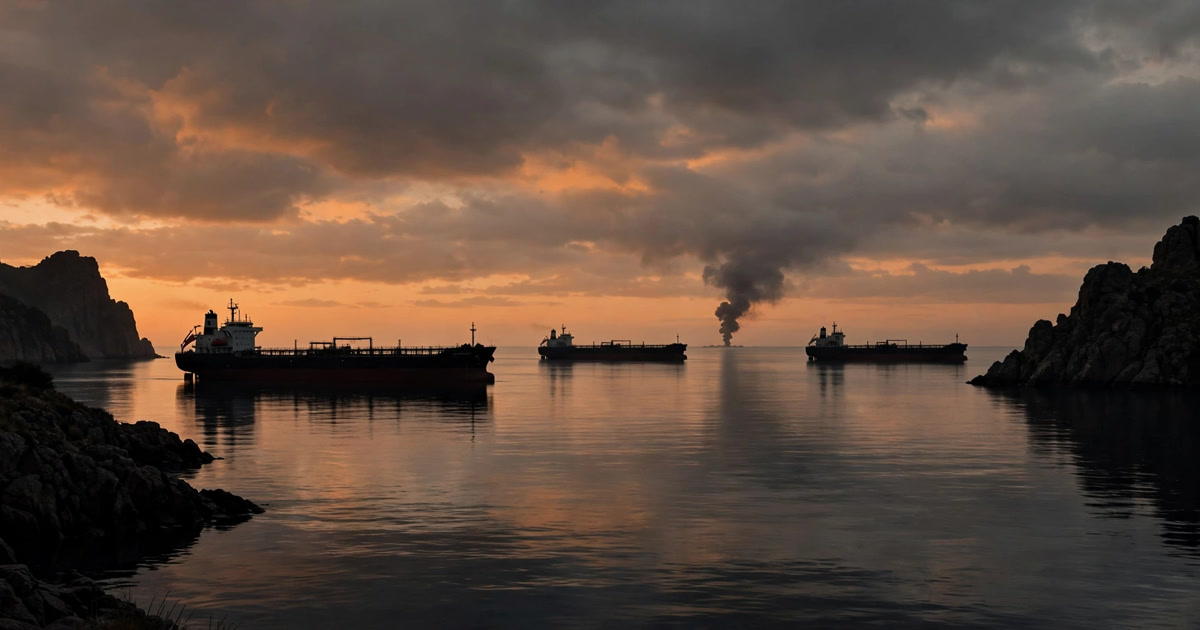
Iran's state television has reported that seven oil tankers were damaged or caught fire overnight in and around the Strait of Hormuz — in what would be the largest number of vessels hit in the strategic waterway in a single day since the Iran war began in February. The story is trending per news coverage across major international outlets: the Associated Press led its Middle East roundup with the report, and Reuters, Oilprice.com, FXStreet and others are carrying the claims.
According to the report, which cited a statement from the naval forces of Iran's Islamic Revolutionary Guard Corps (IRGC), four tankers caught fire after being tracked and targeted while transferring oil — transfers Tehran described as "illegal" — in the northern Persian Gulf. Three other vessels were damaged and left immobilised after striking naval mines west of the Strait of Hormuz. The incidents were said to have taken place overnight between Wednesday and Thursday, October 22.
What the IRGC Navy is claiming
The IRGC Navy statement, carried by Iranian state TV, alleged that its forces had been tracking the four tankers as they conducted ship-to-ship oil transfers — a practice commonly used to move oil outside formal channels — before hitting them and setting them ablaze. The three mine-struck vessels, it said, were attempting to cross through what Tehran called unauthorized routes in the waterway, with the statement alleging that at least one vessel had deliberately switched off its positioning and radar systems.
The report provided no information about possible casualties, and — crucially — it did not identify the tankers by name, disclose the flags they were sailing under, give the number of crew aboard, or specify the precise locations of the reported incidents.
What has not been independently confirmed
The Iranian claims have not been independently verified. The United Kingdom Maritime Trade Operations (UKMTO), the British maritime security monitor whose advisories shipping companies rely on, had not reported the alleged attacks at the time of writing — though maritime monitors have noted in recent days that some shipping companies are reluctant to disclose incidents publicly, for fear of insurance and commercial consequences.
That silence does not disprove the claims, but it does mean the full scale of the overnight incidents remains unclear. Independent confirmation would require statements from maritime authorities, shipping companies, or the flag states of the vessels involved — none of which had emerged by Thursday morning.
Tehran's warning to Washington
Alongside the tanker claims, the IRGC Navy issued a direct warning to the United States: any American attempt to facilitate oil tanker movements through what it described as "illegal passages" in the strait could prompt a broader response — including attacks on US military bases across the region. Since the war began, the IRGC has repeatedly targeted US military installations in Gulf countries.
The warning follows Trump's recent decision to postpone strikes on Iran after claiming "productive" talks, and comes amid open speculation about whether US-Israeli attacks on Iran could resume. The United States, for its part, has been sending more military assets to the region, including a third aircraft carrier and thousands of troops — joining what is already the largest force of American warships and aircraft in the Middle East in decades.
Oil markets react: Brent tops $111
Oil prices surged on Thursday as markets reacted to the escalation. Brent crude, the international benchmark, rose roughly 3% to top $111 a barrel — its highest level in five months — while West Texas Intermediate climbed more than 1.5% to around $99 a barrel. Later Asian trading saw Brent at about $106 and WTI near $95 as the initial spike moderated.
The spike fits a now-familiar pattern. Oil surged past $100 a barrel in the weeks after US-Israeli strikes on Iran in late February, peaked at $126 in April, fell back below $100 in late May, and dropped to $71 in early July amid hopes for a ceasefire. Prices began climbing again after a memorandum of understanding between the US and Iran collapsed and fresh hostilities broke out in the Gulf.
The International Monetary Fund now forecasts a 4.8% economic contraction across the Gulf in 2026 due to the Iran war's impact on energy exports. And despite the attacks, Middle East oil exports appear to have surpassed prewar levels recently: Kpler data cited by the Wall Street Journal showed regional shipments averaging more than 24 million barrels per day in the week — underscoring how much of the world's oil still flows through these contested waters.
A wider escalation: Houthis hit Saudi targets
The Hormuz claims arrived alongside a parallel escalation by Yemen's Houthi fighters, who are aligned with Iran. On Wednesday, Houthi strikes hit several targets in Saudi Arabia: two people were killed and eight wounded in an attack on the civilian airport in Dammam, and a drone strike on the Shaybah oilfield — one of Saudi Arabia's biggest — killed two more, according to reports. Operations at Shaybah remain unaffected, but the attacks rattled markets amid concerns about potential disruption to Saudi supply, just as the Kingdom had largely restored its exports via the Strait of Hormuz and the Red Sea.
In response, the United States has ordered some diplomats and family members to leave their missions in Saudi Arabia and plans to withdraw family members from other Middle East posts, Reuters reported. Saudi Aramco has also instructed staff to vacate its Dhahran headquarters and work remotely — a sign of how seriously regional actors are treating the threat picture. The Houthis say they are responding to the Saudi-led coalition's offensive in Yemen, which is seeking to reclaim territory in the southwest on the Red Sea and the critical Bab el-Mandeb strait.
These shipping attacks are the latest chapter in a long-running maritime campaign. Earlier this year, a supertanker carrying two million barrels of oil exploded after hitting a mine in the Strait of Hormuz, and the US has struck back at sea — including the destruction of an Iranian surveillance vessel in the Gulf of Oman as Hormuz attacks surged.
The political backdrop: elections in Israel and the US
The timing is politically charged. Israel holds its election on October 27, days away, with Prime Minister Benjamin Netanyahu facing the possibility of losing power — and Israeli media have reported, citing unnamed sources, that Netanyahu urged US President Donald Trump last week to restart strikes on Iran before November's US midterm elections. The reports said Trump told the Israeli prime minister to "go ahead and prepare," without making a firm commitment to resume hostilities. Netanyahu has denied the reports.
Voters heading into those midterms are expressing anger over rising prices linked to the war — a dynamic that makes every Hormuz escalation a domestic political event in Washington too. Tehran, meanwhile, insists it has learned important military lessons from the war and has indicated it could expand its targets to include infrastructure such as undersea cables and data centres.
Iran's top diplomat, Abbas Araghchi, said on Wednesday that Tehran remains open to diplomacy but is ready to defend itself. That dual posture — open to talks, ready for war — was also visible in Tehran's seven-day plan to reopen the Strait of Hormuz, floated earlier this month, which would require the US to accept Iranian terms for the waterway's management.
What happens next
Several things will determine whether this becomes a turning point or another entry in the war's grinding maritime campaign. First, independent confirmation: vessel identities, casualty reports, and statements from shipping companies or flag states would establish the true scale of the overnight incidents. Second, the American response — whether Washington treats the IRGC's base-threat warning as bluster or adjusts its posture around the arriving third carrier. Third, Hormuz traffic itself: daily shipping volume through the strait has already dropped to roughly ten commodity ships a day over the last ten days, the lowest since May, according to maritime monitors.
Mediators, meanwhile, are still trying to bring Washington and Tehran back to formal talks — an effort that looks harder with every burning tanker on the water.
Frequently Asked Questions
What did Iran claim happened in the Strait of Hormuz overnight?
Iran's state TV, citing the IRGC Navy, reported that seven oil tankers were damaged overnight on October 22: four caught fire after being targeted while transferring oil in the northern Persian Gulf, and three others were immobilised after striking naval mines west of the Strait of Hormuz. If confirmed, it would be the most vessels damaged in the waterway in a single day since the Iran war began on February 28.
Has the tanker attack been independently verified?
No. The UK Maritime Trade Operations monitor had not reported the alleged attacks, Iran disclosed no vessel names, flags, casualty figures or precise locations, and no shipping company or flag state had confirmed the incidents by Thursday morning. The claims come solely from Iranian state media citing the IRGC Navy.
Why is the Strait of Hormuz so important?
The strait connects the Persian Gulf with the Gulf of Oman and the Arabian Sea, making it the key global energy shipping route. Disruptions there directly affect international oil supplies and prices: Brent crude topped $111 a barrel within hours of the latest reports. Regional shipments recently averaged more than 24 million barrels per day, per Kpler data.
How did oil prices and the US react?
Brent crude surged about 3% to a five-month high above $111 a barrel, and WTI climbed to around $99. Separately, the US ordered some diplomats and family members to leave missions in Saudi Arabia and plans to withdraw families from other Middle East posts, while Saudi Aramco told Dhahran staff to work remotely.
Could this escalate into a wider war?
The risk is real and explicitly on the table: the IRGC warned that US attempts to escort tankers through the strait could trigger attacks on US military bases across the region, Iran has threatened to expand targets to undersea cables and data centres, and the US is deploying a third aircraft carrier to the region. The timing — days before Israel's election and weeks before US midterms — adds to fears that US-Israeli strikes on Iran could resume.
Tehran's threats now extend beneath the sea: Iran has warned it could cut seven undersea internet cables as the confrontation with Washington deepens.
Sources: Associated Press, Reuters, Oilprice.com, FXStreet, TBS News, Zotpaper, Energyworth Online, Phillip Nova, ING, Kpler via Wall Street Journal, UK Maritime Trade Operations, IRGC Navy (via Iranian state TV).
Tehran's oil lifeline has since collapsed entirely, with Iran's shadow tanker fleet running dry under the US blockade.