
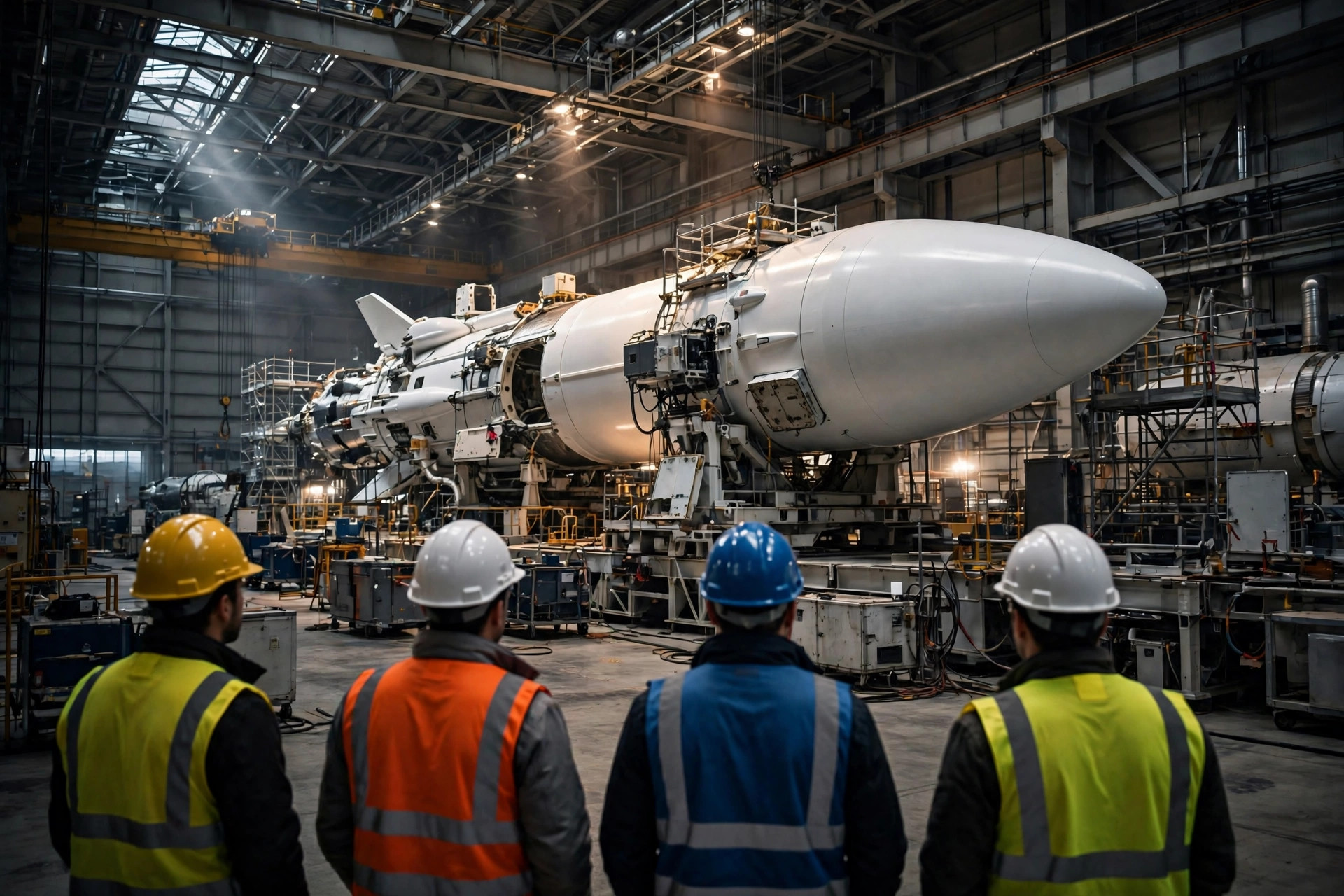
The Hanwha rocket plant Suncheon facility is now open, and with it South Korea has taken its biggest step yet toward a private-sector space industry. Hanwha Aerospace held a completion ceremony on Wednesday 4 November 2026 for its space launch vehicle manufacturing centre at the Yulchon Industrial Complex in Suncheon, South Jeolla Province. The plant is the country's largest private rocket factory, covering about 59,504 square metres, and it will assemble and test the sixth Nuri rocket, scheduled for launch in 2027. For a country whose space programme was built inside government laboratories, the opening marks a handover: the rockets will now be built by a company, not a research institute.
Hanwha rocket plant Suncheon: inside the new facility
The numbers give a sense of the scale. The Suncheon plant covers 59,504 square metres, or about 18,000 pyeong, roughly 640,500 square feet and about 14.7 acres. Construction began in February 2024, and the completion ceremony drew around 200 representatives from the government, the National Assembly, local government and the aerospace industry. Kim Sun, Hanwha's executive vice president and head of the space business division, called the plant core infrastructure for South Korea's leap into a private-sector-led New Space era, a remark reported by TechTimes.
The facility integrates and assembles key launch-vehicle components under one roof. It will manufacture core parts such as methane engines and propellant tanks, and it hosts a Mutual Growth Partnership annex housing 40 partner companies from Korea's aerospace supply chain, according to TechTimes. The Korea Aerospace Research Institute, KARI, has transferred 129 types of assembly equipment to the Suncheon site, lending the tooling free of charge so that stage assembly can move out of its own facilities. That transfer is the practical core of the privatisation: the jigs, fixtures and know-how that once sat in a government research centre now sit in a factory.
What the Hanwha rocket plant will build first
The plant's first assignment is the sixth Nuri rocket, scheduled for launch in 2027. Nuri is South Korea's first domestically developed launcher, built over 14 years with the help of more than 300 local companies. At Suncheon, Hanwha will assemble and test the 75-ton-class engine and all three stages of the sixth Nuri rocket. The stages will then be transported by sea to the Naro Space Center in Goheung, where the final vehicle assembly takes place and the rocket is joined into a single vehicle before launch.
The sixth flight matters because it will be the first Suncheon-assembled Nuri. Earlier Nuri rockets were assembled at KARI's facilities. Hanwha has already been moving into the work: the company embedded 42 of its staff in the fifth Nuri launch operations, taking direct responsibility for a commercial mission for the first time, according to TechTimes. The Suncheon plant also has capacity for the next generation of vehicles, including methane engines, reusable technology demonstrators and launch vehicles Hanwha is developing independently.
Why the Hanwha rocket plant Suncheon matters for Korea's space plans
The plant is the physical result of a policy decision taken in December 2022, when the South Korean government designated Hanwha as the system integrator for the Nuri rocket. Under that arrangement, Hanwha took on production responsibility while KARI kept technical supervision. In July 2025, KARI and the Korea AeroSpace Administration, KASA, signed a technology-transfer agreement worth 24 billion won, giving Hanwha exclusive Nuri manufacturing and launch rights through 2032. It was the first time South Korea had transferred the full lifecycle of a launch vehicle to a private company.
The logic is commercial as much as technical. A government laboratory can build a rocket, but it cannot sell launches the way a company can. By handing production to Hanwha, South Korea is betting that a private operator can cut costs, win foreign customers and build a launch business rather than a research project. The commercial launch market Hanwha wants to enter is dominated by SpaceX, whose scale was underlined this year by a $40 billion computing deal tied to its AI ambitions. Hanwha's challenge is to carve out a share of that market with a smaller, newer vehicle.
The investment behind the bet is large. Hanwha Aerospace plans to invest about 23 trillion won, around US$16.5 billion, in space transportation. That sits inside a wider pledge by Hanwha Group to invest 55 trillion won in aerospace and artificial intelligence by 2040, announced on 3 July 2026. The Suncheon plant is the first major piece of that spending to become a working factory rather than a plan on paper.
Key facts: Hanwha's space plans to 2033
The timetable runs well beyond the Nuri's sixth flight. Hanwha plans to enter the space transport market in 2029 with its own launch vehicle, and to begin commercial launch services in 2033 with the next-generation vehicle. That next-generation vehicle, known as KSLV-III, has its first launch targeted for no earlier than 2031, and its stages will also be assembled at Suncheon. The plant is therefore being built for two generations of rockets at once: the Nuri work that starts now, and the KSLV-III work that follows.
The figures behind the programme are worth setting out. The plant covers 59,504 square metres. Construction ran from February 2024 to November 2026. The technology-transfer agreement of July 2025 was worth 24 billion won and runs through 2032. The planned space transportation investment is about 23 trillion won, or US$16.5 billion. The wider group pledge is 55 trillion won in aerospace and AI by 2040. Nuri itself took 14 years to develop with more than 300 local companies involved. India's space programme has had its own recent success, with ISRO's NVS-03 navigation satellite launch restoring the NavIC system, a reminder that Asia's launch market is becoming crowded.
What happens next at Suncheon
The next milestone is the sixth Nuri flight in 2027. The stages assembled at Suncheon will travel by sea to the Naro Space Center in Goheung for final assembly, and the launch will test whether the private production line works as well as the government one it replaces. A successful flight would confirm the model and set up the 2029 market entry. A failure would raise hard questions about the speed of the handover, since Nuri is still South Korea's only domestic launcher.
Beyond Nuri, the plant's longer test is commercial. Hanwha must turn a factory built for one national rocket into a business that sells launches to satellite operators, and it must do so against established competitors. Elon Musk's companies have also been reshaping the space business, with a proposed Tesla-SpaceX merger under discussion. The Suncheon opening is a confident statement of intent, but the judgement that matters will come in 2027, when the first Suncheon-built rocket leaves the ground.
Sources: TechTimes, Seoul Economic Daily, The Elec, AJU Press, November 2026