
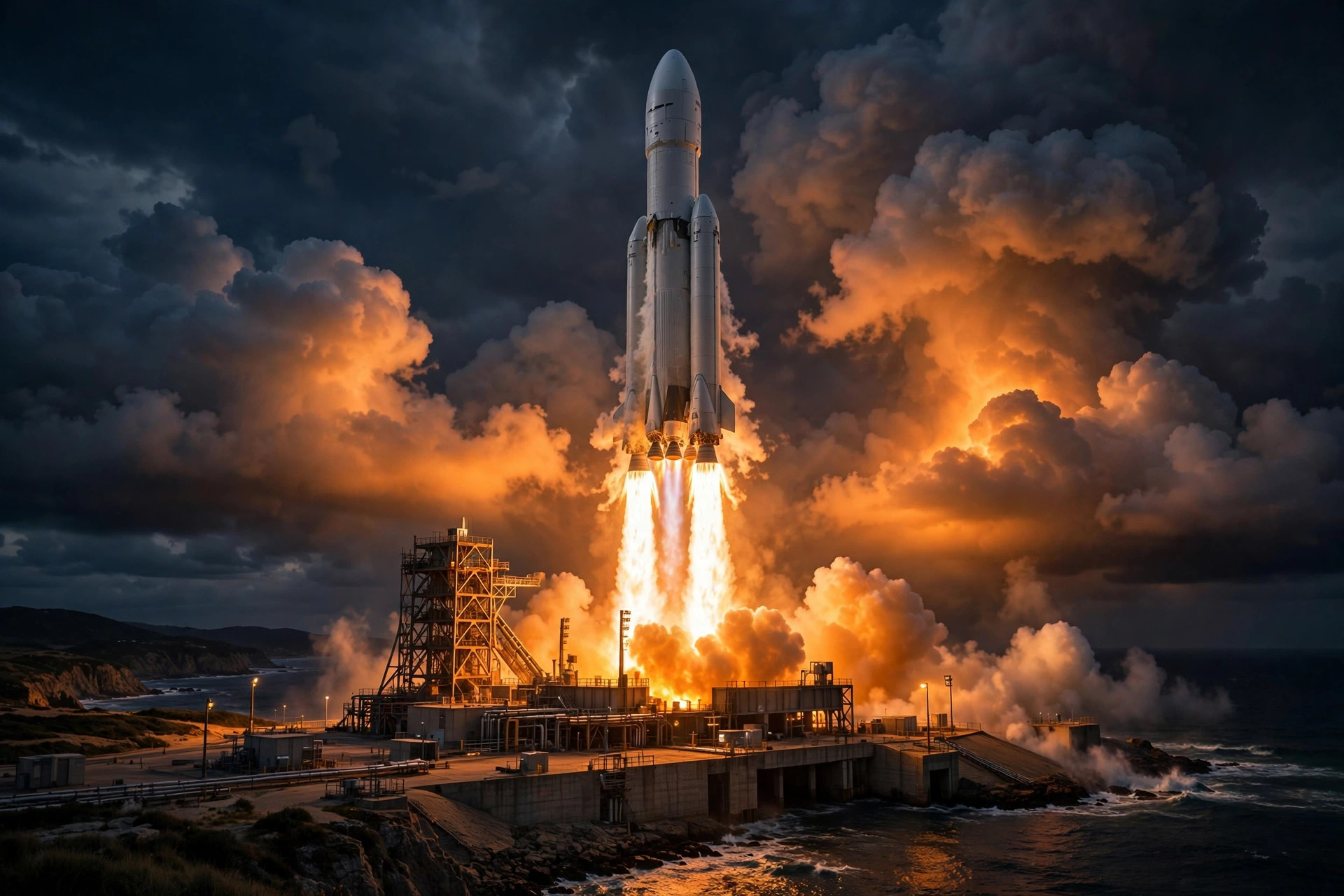
The NVS-03 launch on 30 October 2026 was a significant night for India's space programme and for users of its regional navigation system. The Indian Space Research Organisation, known as ISRO, launched the satellite on its GSLV-F18 rocket from Sriharikota, and in the early hours of 31 October 2026 it declared the mission a success. The announcement mattered for a practical reason as well as a symbolic one: according to ISRO Chairman V Narayanan, the launch restored the NavIC constellation to its minimum operational configuration of four satellites. That statement was about the constellation count, and it is important to understand exactly what it does and does not mean. The launch phase succeeded, and the satellite was placed in its intended transfer orbit, but the satellite must still perform orbit-raising manoeuvres with its own engine to reach its final geosynchronous orbit before it can provide navigation services. This article explains what happened during the NVS-03 launch, why the mission was needed, what the satellite carries, and what still has to happen before it enters service.
What the NVS-03 launch achieved on 30 October 2026
Liftoff took place at 11:51 PM IST on Friday, 30 October 2026, from the Second Launch Pad at the Satish Dhawan Space Centre, known as SDSC SHAR, in Sriharikota. The rocket was GSLV-F18, the 20th flight of the Geosynchronous Satellite Launch Vehicle, usually shortened to GSLV. The vehicle is about 50 metres tall and weighed about 420 tonnes at liftoff. It is a three-stage rocket, with a solid first stage, a liquid second stage and a cryogenic upper stage. A cryogenic stage uses propellants stored at very low temperatures, and in this design it is the stage that gives the satellite the final push towards its transfer orbit. At 12:23 AM IST on 31 October 2026, ISRO declared: "Mission Success! GSLV-F18 has successfully placed NVS-03 in the intended orbit." That declaration confirmed the launch phase. It did not mean the satellite was already in its final working orbit, because the target for the launch was a Geosynchronous Transfer Orbit, usually called GTO, rather than the final geosynchronous orbit itself. The transfer orbit is elliptical, with a perigee of 170 km and an apogee of 37,023 km, and an inclination of 20.75 degrees. Perigee is the lowest point of the orbit and apogee is the highest point, so the satellite was left in a stretched orbit that it must now circularise and raise using its own engine. Its final slot is 32.5 degrees East, and reaching that slot is the next stage of the mission.
The satellite itself weighs approximately 2,250 kg, according to the ISRO brochure and a quote from the Chairman reported by ANI. IANS reported a figure of 2,232 kg, so the figure used here is approximately 2,250 kg, which is the figure given in the ISRO brochure and in the Chairman's remarks. NVS-03 is the third satellite in the second-generation NVS series for NavIC, which stands for Navigation with Indian Constellation. NavIC is India's regional navigation system, and its service area covers India and about 1,500 km beyond its borders. The satellite carries an indigenous atomic clock, using Rubidium, and an L1 band signal. An atomic clock provides the precise timing that a navigation system depends on, because navigation works by measuring tiny differences in the time taken for signals to travel from satellites to a receiver. The L1 band signal is part of how the satellite broadcasts the signals that receivers on the ground use to work out their position. Together, the clock and the signal payload are central to what NVS-03 is designed to do once it reaches its final orbit and enters service.
Why the NVS-03 launch matters for NavIC
The reason the NVS-03 launch was closely watched is that the NavIC constellation had fallen below the number of satellites needed for basic positioning. Space Minister Jitendra Singh said in a reply in Parliament on 29 July that only 3 satellites were providing navigation services. Four satellites are required for basic positioning, because a receiver normally needs signals from at least four satellites to calculate latitude, longitude, altitude and time. With only three satellites providing navigation services, the system could not provide that basic positioning in the normal way. That is the context for Chairman V Narayanan's statement after the launch that the launch "restored the NavIC constellation to its minimum operational configuration of four satellites". That wording describes the constellation count once NVS-03 is counted among the satellites available for the system. It should not be read as a claim that NVS-03 was already in operational service at the moment of the launch announcement, because the satellite still has to complete its orbit-raising manoeuvres and reach its final slot at 32.5 degrees East before it can provide navigation services. The distinction matters: a successful launch restores the count, and the orbit-raising phase that follows is what turns that restored count into a working service.
The need for NVS-03 also comes from what happened to its predecessor. NVS-02 was launched on GSLV-F15 on 29 January 2025. It reached its transfer orbit, but it failed to reach its working orbit after a pyro-valve and oxidiser-line drive-signal fault. A pyro-valve is a valve operated by a pyrotechnic device, and the oxidiser line carries the oxidiser used by the satellite's propulsion system, so a fault in that area prevented the satellite from carrying out the manoeuvres needed to raise its orbit. NVS-03 flew with corrective measures, with the valves activated and open, according to the verified account of the mission. That detail is part of why this launch was not treated as a routine flight: it was a return to the same task after a failure in the orbit-raising phase, with changes made to address the fault that had stopped NVS-02. The launch campaign for NVS-03 lasted 47 days, and there were 56 days between successive GSLV missions, the shortest interval so far, according to Chairman Narayanan via ANI. A shorter interval between missions of the same rocket family is a sign of how quickly the launch team turned the vehicle around, and it also reflects the pace at which ISRO was working to restore the constellation.
What happened during the GSLV-F18 flight
The flight itself followed the familiar pattern for a GSLV mission to a transfer orbit. The three stages worked in sequence: the solid stage provided the initial thrust at liftoff, the liquid stage continued the climb, and the cryogenic upper stage delivered the satellite towards its transfer orbit. The rocket lifted off from the Second Launch Pad at SDSC SHAR in Sriharikota at 11:51 PM IST on Friday, 30 October 2026, and ISRO's declaration of success came at 12:23 AM IST on 31 October 2026, about 32 minutes after liftoff. That timing is consistent with a launch in which the satellite is separated in its intended transfer orbit and the mission is declared a success once that separation and the orbit achieved have been confirmed. The target orbit was the elliptical Geosynchronous Transfer Orbit described above, with a perigee of 170 km, an apogee of 37,023 km and an inclination of 20.75 degrees. The satellite's final slot is 32.5 degrees East, and the orbit-raising manoeuvres that follow will use the satellite's own engine to move it from the transfer orbit to that final geosynchronous position. Until those manoeuvres are complete, the satellite is on its way to its working orbit rather than already working there.
It is also worth placing the mission in the wider sequence of the NVS series. NVS-03 is the third satellite in the second-generation NVS series, and NVS-04 and NVS-05 are planned. That plan shows that NVS-03 is not a one-off replacement but part of a continuing series of satellites intended to sustain and develop NavIC. The second-generation series is the current phase of the system, and each satellite in the series adds to the constellation that provides the service over India and about 1,500 km beyond. The launch of NVS-03 therefore fits into a longer programme, even though the immediate reason for attention was the restoration of the minimum configuration of four satellites. October 2026 was a busy month for major stories around the world, including US GDP growth in Q3 2026, the decision by the ECB to hold interest rates in October 2026, and the Federal Reserve holding interest rates in October 2026, but for India's space programme the NVS-03 launch was the story that mattered most that night.
What happens next for NVS-03
The next phase for NVS-03 is orbit-raising. The satellite must use its own engine to raise its orbit from the transfer orbit, with a perigee of 170 km and an apogee of 37,023 km, to its final geosynchronous orbit at 32.5 degrees East. That process takes place over a series of manoeuvres rather than in a single step, and it is the phase in which the satellite moves from being a successfully launched spacecraft to being a satellite in its working position. Only after it reaches its final slot and completes the checks that follow can it begin providing navigation services as part of NavIC. That sequence is also why the account of NVS-02 matters: NVS-02 reached its transfer orbit on 29 January 2025 but did not reach its working orbit, so the orbit-raising phase is not a formality. It is a real part of the mission, and it is the part that NVS-03 must now complete with the corrective measures that were put in place for this flight. The planned NVS-04 and NVS-05 satellites are part of the same longer programme, and they will follow as the series continues. For now, the verified position is clear and limited: GSLV-F18, the 20th GSLV flight, lifted off at 11:51 PM IST on 30 October 2026 from Sriharikota, ISRO declared at 12:23 AM IST on 31 October 2026 that it had successfully placed NVS-03 in the intended orbit, and the Chairman said the launch restored the NavIC constellation to its minimum operational configuration of four satellites. The orbit-raising that follows will decide when that restored constellation becomes a working navigation service.
Sources: ISRO, ANI, IANS, India Today, October 2026.