
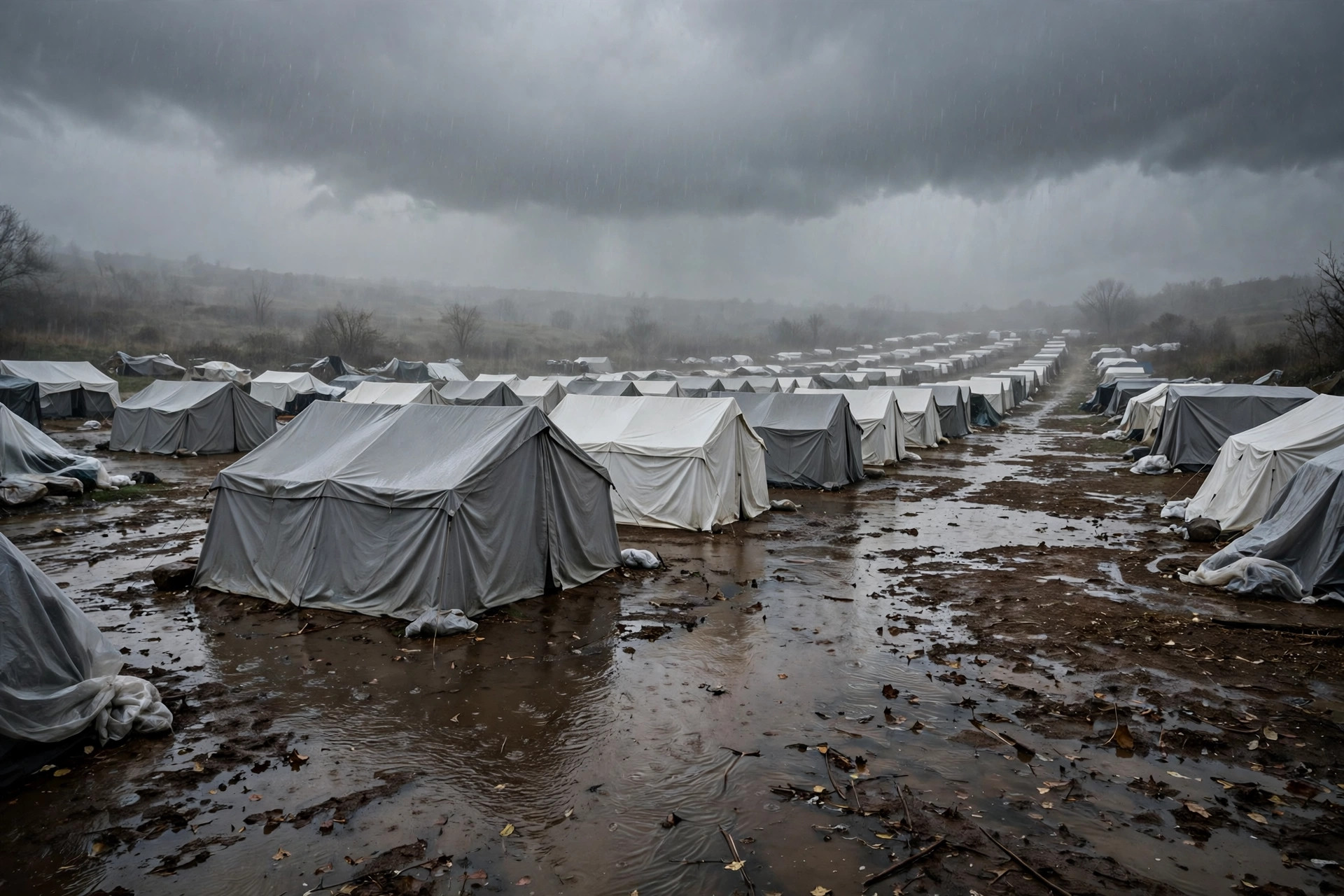
Gaza storm flooding has struck the territory hard in the first winter storm of the season. Heavy rain swept across Israel and Gaza on Friday night and Saturday 7 November 2026, flooding tens of thousands of tents sheltering displaced Palestinians in the Gaza Strip and bringing more than 100 millimetres of rain to parts of Israel's coastal plain. Gaza's government media office said at least 70,000 tents had been flooded within 12 hours, while Gaza's civil defence agency received about 1,500 distress calls in just 10 hours. In Israel, the Meteorological Service issued an orange flood warning running until 10pm on Saturday. No fatalities from the flooding had been reported by Saturday, according to Reuters, but the storm exposed a shelter crisis that aid agencies had been warning about for weeks.
Gaza storm flooding: what happened on 7 November
Rain began falling on Friday evening and intensified early on Saturday. In al-Mawasi, the coastal area in southern Gaza where more than 900,000 displaced people are sheltering, rain had been falling since 10pm on Friday, Al Jazeera's Rami Abu Taima reported from Khan Younis. By Saturday morning, families were waking to find hundreds, even thousands, of tents flooded across the Gaza Strip. Footage from camps in Gaza City, Khan Younis and Deir el-Balah showed families wading through ankle-deep water, mattresses and blankets soaked, and children standing barefoot in pools of mud and sewage.
Gaza's civil defence agency said its crews received about 1,500 distress calls in just 10 hours after the rain began early on Saturday, with water levels in several shelter sites rising by 30 to 40 centimetres. The agency later said it had received 2,166 distress calls since the storm began on Friday evening, and that crews had been able to respond to only 218 of them, according to Newscord. Civil Defence spokesperson Mahmoud Basal told Al Jazeera that a few shelter centres were completely flooded, and everyone inside them had been forced out into the open. Basal said premature babies, the elderly and the sick were most at risk.
The storm also brought down buildings damaged during the war in Gaza. Civil Defence said rescuers evacuated residents of a building in the central Nuseirat area that partially collapsed in the strong winds and rain. In northern Gaza, the wall of a separate building collapsed due to the heavy rainfall, injuring two people, according to the Wafa news agency. Reuters reported that the flooding caused injuries, although no fatalities had been reported by Saturday.
Israel storm: 100mm of rain and an orange flood warning
On the Israeli side, the same system peaked on Saturday morning. Israel's Meteorological Service issued an orange warning for flooding that ran until 10pm on Saturday, covering the Carmel region, the northern, central and southern coastal areas, and the Judean Foothills. A separate yellow warning for flash floods covered the northern Judean Desert and the Dead Sea area, also through 10pm on Saturday. The Jerusalem Post reported the alerts at 10.51pm on Friday.
The service expected the storm to peak on Saturday morning, when several places along the coast could take tens of millimetres of rain within a few hours. Accumulated totals were forecast to exceed 100 millimetres along the coastal plain and in other areas, with a genuine risk of significant urban flooding from the Tel Aviv metropolitan area south towards Ashkelon. The flash-flood risk in the Judean Desert and around the Dead Sea ran through the weekend. Route 20, a major Tel Aviv highway, was closed completely in two windows: from 11.30pm on Thursday 5 November until 4pm on Friday 6 November, and again from 11pm on Saturday 7 November until 5am on Sunday 8 November, according to Global1.News.
Gaza storm flooding: why so many tents were overwhelmed
The flooding was not a surprise to aid agencies. The United Nations Office for the Coordination of Humanitarian Affairs, OCHA, reported on 15 October that approximately 950,000 displaced Palestinians were living in locations exposed to moderate or high flood risk, including more than 400,000 in places classified as highly vulnerable. By September, UNICEF estimated that more than 1.76 million people, about 84 per cent of Gaza's population, were living in overcrowded displacement sites or damaged and inadequate accommodation. The International Organization for Migration found that 54 per cent of tents and makeshift shelters were in poor or very poor condition.
The shelter gap was measured in hard numbers before the storm. An assessment issued immediately before the storm recorded outstanding needs, as of 1 November, for approximately 121,000 tents, 561,000 tarpaulins, 57,000 emergency shelter kits and 1.7 million mattresses, according to UNifeed. Shelter partners' stocks inside Gaza stood at approximately 2,800 tents, 76,000 tarpaulins and 4,993 mattresses, with no emergency shelter kits available. Gaza's emergency committee said more than one million displaced people face the dangers of winter, and that the territory urgently needs about 200,000 tents along with heating supplies.
Civil Defence crews could do little once they reached flooded families. Raed al-Dahshan, director of civil defence in Gaza governorate, told Al Jazeera that Civil Defence does not have a single tarpaulin or a single tent, and that crews deal only with saving lives. Mohammed Salha, director of the Palestinian NGO Network, told Al Jazeera that only 180 to 200 trucks were entering Gaza daily, far short of the 600 agreed under the humanitarian protocol of the ceasefire, and that only about 40 of those carried humanitarian aid. Salha said 50,000 tents had been waiting on the Egyptian side of the border.
What the winter ahead looks like
The Gaza storm flooding of 7 November was the first of the season, and aid agencies expect more. The estimated winter response for Gaza required 267.9 million US dollars, with 186.5 million still unfunded, leaving a gap of almost 70 per cent, according to figures cited by Great Reporter. For its own winter programme across Gaza and the West Bank, UNICEF appealed for 97.5 million US dollars to protect 540,000 children and their families, covering October 2026 to March 2027, including clothing, thermal blankets, shelter reinforcement and measures to reduce flooding.
More than 125,000 families living along the coast were at particular risk of having their tents swept away by the sea, Al Jazeera's Rami Abu Taima reported. In al-Mawasi alone, more than 900,000 people are sheltering on the coast. Jonathan Veitch, UNICEF's representative for Palestine, described aid workers being stopped in the street by people pleading for assistance. The rain has exposed the distance between the warnings issued in October and the protection available to people who have already endured repeated displacement.
What happens next depends on two things: whether shelter supplies reach Gaza before the next storm, and how the rest of the winter unfolds. Gaza's emergency committee has warned that more than one million displaced people face a harsh winter. The first storm showed what that means in practice: tents underwater within hours, emergency lines overwhelmed, and families with nowhere dry to go. For context on other recent flood disasters, see our coverage of record rain and floods in Istanbul and our guide to following news from Israel.
Sources: Al Jazeera, Reuters (via SRN News), UN OCHA via UNifeed, The Jerusalem Post, Global1.News, November 2026.