
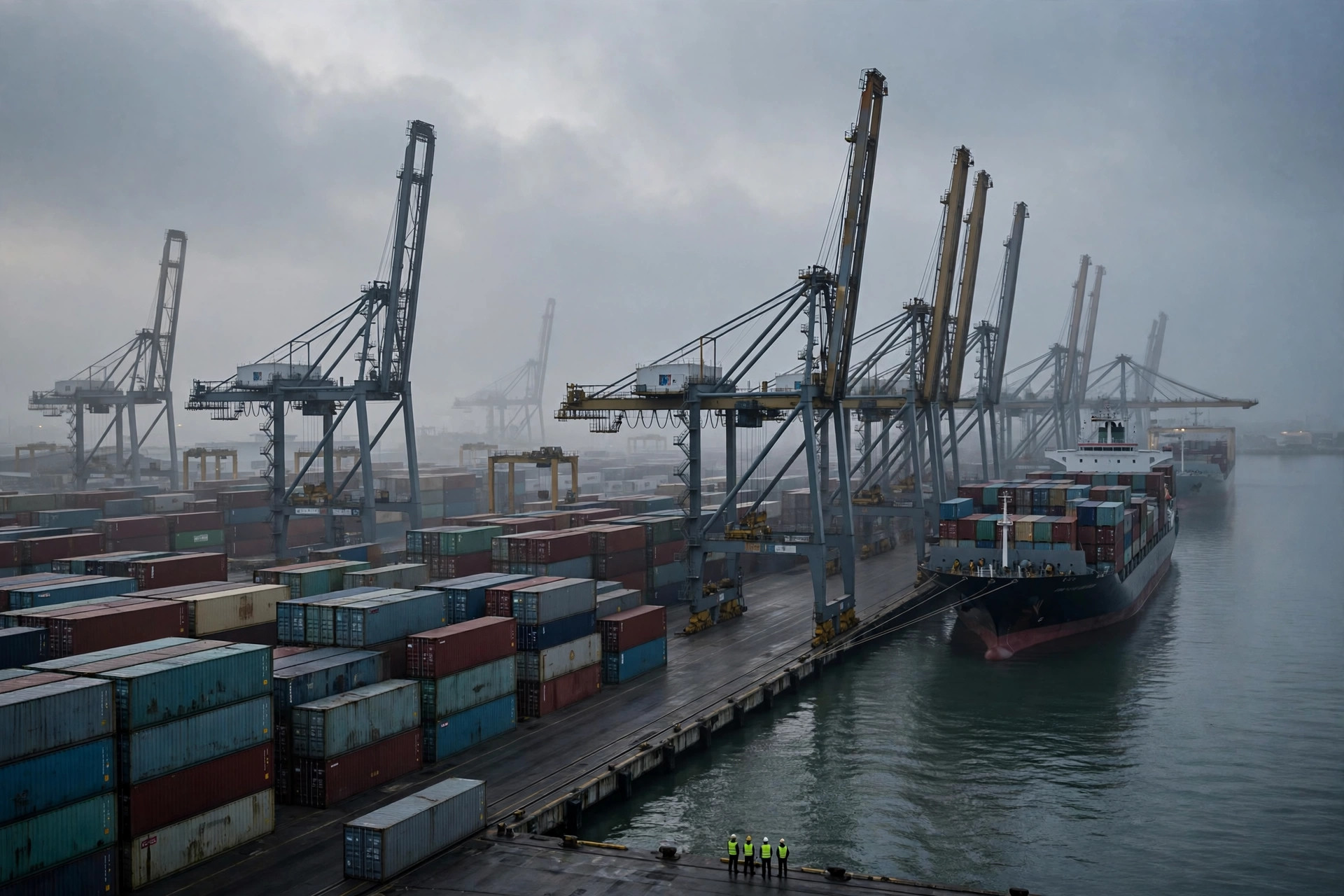
The dockworkers strike on October 30 2026 was planned as one of the largest coordinated port actions in recent years. According to Reuters, dockworkers in 22 countries were due to strike on Friday 30 October, protesting against war and against the use of ports for arms exports. Organisers said more than 25 unions backed the action at 113 ports, and that it could disrupt over 40% of Mediterranean cargo and snarl freight worth more than $2 billion. Those disruption figures were the organisers' estimates, not confirmed losses, and Reuters reported that it was unclear how many dockworkers would take part or how severe any disruption would be. This article explains what was planned, which ports were named, why the unions acted, and what readers should watch for as the day unfolds.
What the dockworkers strike on October 30 2026 involves
The action was described by organisers with the slogan "We will not work for war." It was originally called by dockworkers' unions in Italy, France, Greece, Spain's Basque Country, Turkey and Morocco, and then grew to include backing from more than 25 unions across 113 ports, according to Reuters. The planned actions varied widely. Some unions announced 24-hour stoppages, others planned shorter walkouts of a few hours, and others planned demonstrations or symbolic protests at port gates. That variation matters, because a single headline figure for "113 ports" does not mean every one of those ports closed for a full day. Readers checking whether a particular shipment or ferry would move needed to check the position port by port, and the statements of the local union and the port authority, rather than assume a uniform shutdown.
In Italy, the grassroots union Unione Sindacale di Base (USB) called a 24-hour general strike for the same day, with protests scheduled in more than 40 cities, Reuters reported. That made the Italian action broader than a ports-only stoppage, because a general strike can also affect transport, schools and public services in the cities where unions take part. In Greece, dockworkers, engineers and seafarers' unions joined the action, and ferries were to remain docked at Greek ports on Friday, with particular warnings about disruption to ferry services for the Greek islands. Dockworkers at Piraeus, Greece's largest port, said in a statement that they would stop work from 0800 to 1100 GMT and described the action as a message of peace and solidarity with peoples suffering from war. Other unions in Greece planned to stop work for 24 hours. The contrast between a three-hour stoppage at Piraeus and a full-day stoppage elsewhere shows why national summaries can mislead: the same campaign contained very different local plans.
Which ports are affected in the dockworkers strike
Reuters named major shipping hubs expected to be targeted, including Hamburg in Germany, Valencia and Algeciras in Spain, Le Havre in France, Piraeus in Greece and Genoa in Italy, as well as Morocco's Tangier Med and India's Nhava Sheva. Beyond Europe, organisers said about a dozen ports in India could be disrupted, with the Water Transport Workers Federation of India supporting the action. Labour groups joining the protest included ver.di in Germany, Ireland's largest trade union SIPTU, 3F in Denmark and CGT Ports et Docks in France, according to Reuters. The breadth of the list is the story: this was not a dispute at one port over one contract, but a coordinated campaign across shipping routes that connect Europe, North Africa and Asia.
Even so, early signals pointed to uneven impact. A spokesman for Italy's Genoa port told Reuters that it expected only a limited impact, while Piraeus warned of disruption to ferry services for the Greek islands. That gap between expectation and warning is normal in the first hours of a multi-port action. Ports with strong union organisation and a history of political stoppages tend to see visible disruption, while ports where only a minority of workers take part may keep cargo moving with delays rather than a full halt. Ferry passengers in Greece faced the clearest immediate effect, because a docked ferry is a cancelled sailing in a way that a slowed container terminal is not. Travellers were advised in general terms by the reporting to check with ferry operators and port authorities before travelling, since local decisions could change during the day.
Why dockworkers are striking over arms shipments
The unions' stated reason was opposition to war and to the movement of weapons and other military supplies through civilian ports. The campaign's focus was the use of commercial shipping terminals to transport arms to conflict zones. The Global Sumud Flotilla, a pro-Palestinian campaign group that has repeatedly tried to break Israel's blockade of Gaza to deliver humanitarian aid, said it would carry out coordinated, strategic actions on the water to support the strike, Reuters reported. The framing of the action therefore linked workplace action at ports with a wider political campaign about Gaza and about wars more broadly. That linkage is contested, as political strikes usually are: supporters describe refusing to handle arms cargo as a matter of conscience and solidarity, while critics argue that ports and their workers should not decide foreign policy or interrupt trade that other countries and companies have lawfully arranged.
Neutral reporting of the dispute needs to separate three things that are often run together. First, what the unions say they are doing and why, in their own statements. Second, what actually happens at each port, which can only be established from port operations, shipping data and verified local reporting. Third, what the action is claimed to achieve, which is a matter of political judgement rather than a measurable fact on the day. This article keeps those three things apart. The unions' claims about arms shipments are reported as claims. The disruption figures of 40% of Mediterranean cargo and more than $2 billion of freight are reported as organisers' estimates. And the question of whether the strike changes any government's policy cannot be answered from a single day of stoppages.
Dockworkers strike and the $2 billion freight question
The $2 billion figure travelled widely because it is large and concrete, but readers should understand what it does and does not mean. Organisers said the action could snarl over $2 billion worth of freight and disrupt over 40% of Mediterranean cargo. That is an estimate of freight potentially affected if stoppages were widespread and sustained, not a count of cargo that was actually stopped, damaged or lost. Reuters was explicit that the scale of actual disruption was uncertain. A container that waits an extra day at a terminal is delayed freight, not lost freight, and a ferry that sails a few hours late is a different kind of disruption from a port closed for 24 hours. The economic effect therefore depends on duration, on which terminals stopped, on whether shipping lines rerouted vessels, and on how quickly backlogs cleared afterwards. None of that could be known with confidence before the strike day had run its course.
The Mediterranean focus of the estimate also matters. The Mediterranean is one of the world's busiest shipping corridors, carrying container traffic, energy supplies and ferry passengers between Europe, North Africa and the Middle East, and connecting through the Suez Canal to Asia. A stoppage at several Mediterranean hubs at once can therefore have effects beyond the ports directly involved, as vessels wait, schedules slip and cargo misses onward connections. At the same time, global shipping networks are built with some slack and with alternative routes, so a one-day action, even a coordinated one, does not automatically become a supply-chain crisis. The useful question for businesses and travellers was not "will trade stop" but "which sailings, terminals and routes are affected, for how long, and what is the recovery plan." Port-by-port reporting through Friday and into the weekend would answer that question better than any advance estimate.
What happens next after the October 30 dockworkers strike
Three things were worth watching after Friday's action. The first was the verified operational picture: statements from port authorities and shipping lines about delays, cancellations and recovery times, set against the unions' own reports of participation. The second was whether the campaign continued beyond a single day, either through further stoppages or through follow-up protests, or whether it ended as a one-day demonstration of coordination. The third was the political response, including any reaction from governments, port employers and the shipping industry about the handling of military cargo through civilian ports. Each of those answers would arrive on a different timetable. Operational effects could be measured within days. Political effects, if any, would take longer and would be harder to attribute to one day of action alone.
For readers, the practical lesson of the dockworkers strike on October 30 2026 is to treat large coordinated-action headlines as a starting point, not a conclusion. The verified core was clear: unions in 22 countries backed action at 113 ports, with named hubs from Hamburg to Nhava Sheva, and with a stated protest against arms shipments. The scale of disruption, the number of workers who took part, and the longer-term consequences were not yet established when the action was announced. The strike illustrated how organised labour can act across borders on a political issue, and how quickly an estimate of potential disruption can become the headline figure. What it actually changed, at ports and in policy, would only become clear from the evidence of the day itself. Readers can follow related coverage of Gulf tensions and shipping disruption through our earlier reporting on US warnings to Gulf states over Iran strikes, the Ras Tanura refinery attack and oil prices, and the Houthi attacks on Riyadh airport and a Saudi oil pipeline.